
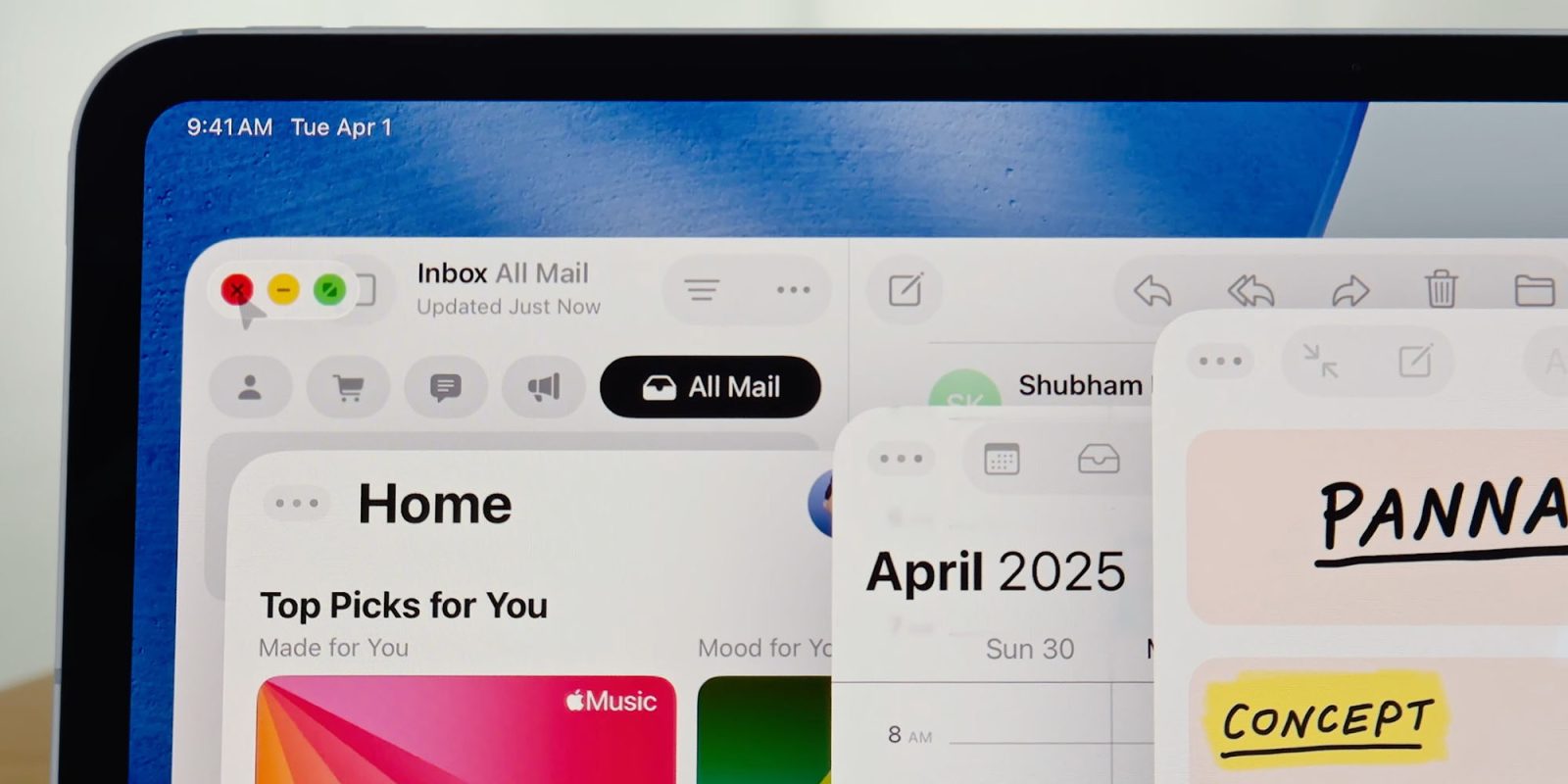
iPadOS 26 arguably brings the biggest update to the iPad ever seen, turning it into something much more Mac-like in both UI and capabilities.
But since iPads have been using the same chips as Macs since 2021, why did it take so long? That’s the question Apple’s software head Craig Federighi sets out to answer in a new interview …
iPadOS 26 is so ground-breaking that I argued Apple has finally turned the device into something worthy of the term ‘computer.’
The biggest change by far is proper windowing. The iPad started as a single-tasking device: one full-screen app at a time. Later, Slide Over and Split View made it possible to work with more than one app at a time, but it was pretty clunky and unintuitive. Stage Manager further improved usability, but for me it was still a poor substitute for the window flexibility you get on a Mac. But now the iPad works pretty much exactly like a Mac in this respect. You can open multiple apps, then position, size, and overlay each window as you like [and] finally, the iPad gets a menubar!
But given that the iPad got an M1 chip way back in 2021, meaning the hardware was absolutely capable of this and more, why has it taken so long to let the software take advantage of it? Arstechnica asked Federighi to explain.
He suggests that one element was that iPads actually have to react faster than Macs.
“You have to start with the grounding that the iPad is a direct manipulation touch-first device,” Federighi told Ars. “It is a foundational requirement that if you touch the screen and start to move something that it responds. Otherwise, the entire interaction model is broken—it’s a psychic break with your contract with the device.”
Mac users, Federighi said, were more tolerant of small latency on their devices because they were already manipulating apps on the screen indirectly.
Top comment by Cuban Missiles
The Mac Pro still runs on M2. Apple is not investing much since most folk have moved to the Mac mini studio or just the mini, which is running M4. We have moved to the MacBook Air at work for most staff, with just a few who use the MacBook Pro. All this is to say that as technology continues to improve and shrink, the bigger and heavier hardware will fade to the background for niche use cases. This update to the iPad will clearly start to take over the laptop market. And at some point in the future, the folding phone will take over everything.
Plus, he implies, using the iPad via keyboard and trackpad has been a niche thing until more recently.
“Over time the iPad’s gotten more powerful, the screens have gotten larger, the user base has shifted into a mode where there is a little bit more trackpad and keyboard use in how many people use the device,” Federighi told Ars. “And so the stars kind of aligned to where many of the things that you traditionally do with a Mac were possible to do on an iPad for the first time and still meet iPad’s basic contract.”
Why do older iPads get full windowing when they didn’t get Stage Manager? That one is simpler, he says: iPadOS 26 has been built from the ground up.
We re-architected our windowing system and we re-architected the way that we manage background tasks, background processing, that enabled us to squeeze more out of other devices than we were able to do at the time we introduced Stage Manager.
The full piece is worth reading.
Highlighted accessories
- A16 iPad
- Logitech keyboard and trackpad for iPad
- EIP Pencil 2
- Apple MagSafe Charger with 25w power for iPhone 16 models
- Apple 30W charger for above
- Anker 240W braided USB-C to USB-C cable
Image: Apple


FTC: We use income earning auto affiliate links. More.



Comments