
While Apple first started supporting eSIMs back in 2018, it’s only this year that it has taken full advantage of the technology.
For the first time, Apple is using the space previously occupied by an insertable SIM card slot for additional battery capacity …
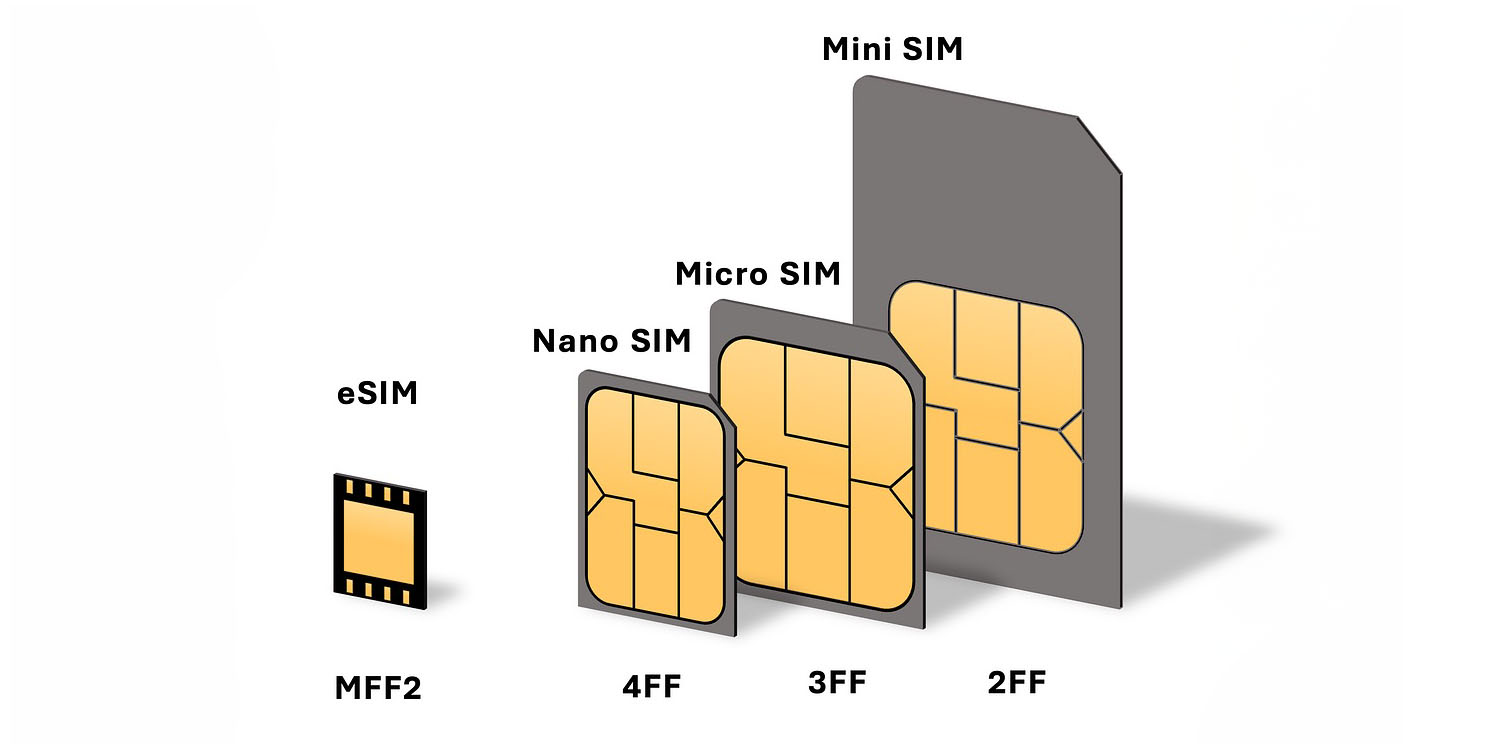
A quick history of SIMs
SIM is short for Subscriber Identity Module and refers to an integrated circuit or smart card used to store your phone’s identity number and other data. In the early days of mobile phones, it was usual to store your contacts on the SIM rather than in the phone itself.
There have been four generations of insertable SIM cards:
- Original (credit card sized!)
- Mini
- Micro
- Nano
eSIMs
Insertable SIM cards are now gradually being replaced by eSIMs. This is a software-based SIM stored on a circuit board which is part of the smartphone itself.
These sims have a number of advantages, the most notable of which are appreciated when travelling. Instead of having to wait until you arrive and then seeking out a retailer to sell you a physical local SIM, you can enable an eSIM in your destination country before you even travel. You also don’t have to deal with the risk of losing your original SIM, nor of damaging the contacts when removing and inserting a SIM.
Apple first adopted eSIMs with the iPhone XS and XR in 2018. However, it was only with the iPhone 14 lineup that the company dropped support for insertable SIM cards in US models. As a side note, Steve Jobs had wanted to do this from the start, even before eSIMs existed!
An additional benefit this year
With the iPhone 14, 15, and 16, there was no real benefit to the US model over those made for other markets – other than a slightly slicker look without the SIM tray cutout. Apple simply had a piece of plastic in the space occupied by the SIM tray in other models.
This year, however, Apple has taken advantage of the internal redesign to free up that space for additional battery. That’s the reason that eSIM-only iPhone Air and iPhone 17 models (now available in a few other countries) have a little more battery capacity than those with a physical SIM tray.
While the difference may be modest, I’d argue that this is enough justification to switch to eSIM-only models worldwide as of the iPhone Fold and iPhone 18 line-up – with the possible exception of China.
Top comment by Augusto Galindo
I prefer eSIM-only iPhones—especially now that they offer better battery life. I actually import them from the US rather than buying them locally.
That said, eSIM is still a headache in many countries. A lot of carriers require a monthly plan to use eSIM, which isn’t ideal for travelers. Alternatives like Airalo or MobiMatter are significantly more expensive. On top of that, most carriers force you to visit their offices just to activate an eSIM. That might be fine if it were a one-time thing, but it gets worse: many carriers block the ability to transfer an eSIM from one iPhone to another. So every time I upgrade, I have to go back to the office, wait an hour, pay a fee, and then wait up to four more hours for the service to work.
Of course, none of this is the fault of eSIM technology itself—it’s carriers making it unnecessarily difficult for customers to switch freely between providers.
Yes, eSIMs are not yet supported by every carrier in every country, but in most countries, that’s simply because carriers are being lazy in adopting the technology. There would be no more effective way to persuade them to do so than by iPhones going eSIM-only.
I say China may need to be an exception because eSIMs are effectively banned there for Chinese citizens. That’s because the government wants to retain control of communications by requiring in-person ID verification for mobile accounts, and the remote activation model of eSIMs would provide a workaround for this. But Apple having to make China-specific models is nothing new.
What’s your view? Is it time to relegate these pieces of plasticized cardboard to history? Please share your thoughts in the comments.
Highlighted accessories
- Official Apple Store on Amazon
- Apple 40W Dynamic Power Adapter for iPhone 17
- Official Apple iPhone Air cases and bumpers
- iPhone Air MagSafe Battery
- Official iPhone 17 cases
- Official iPhone 17 Pro cases and Pro Max cases
Image: Wikimedia Commons/CC0


FTC: We use income earning auto affiliate links. More.





Comments