Author

Avatar for Mark Gurman

Mark Gurman

@markgurman

Mark is an award-winning journalist who worked at 9to5Mac for over six years. He covers Apple and other topics related to the consumer technology industry.

Mark is regarded as one of the go-to reporters for all Apple-related matters, one of Wired‘s top 16 people to follow in technology, and one of TIME Magazine‘s top 25 bloggers of 2013Mark has also been profiled by CNN Fortune multiple times, NPR, the Los Angeles Times, LA Weekly, the Huffington PostBusiness Insider, Columbia Journalism Review, MarketplaceHaaretz, and USA TodayMark was also recently named to the 2015 Forbes 30 under 30 List.

In 2012, Mark published the first photos of the iPhone 5, broke the news about Apple’s switch to an in-house Maps application, revealed the first 15-inch Retina MacBook Pro, forecasted that Apple would update the iPad’s software with Siri support, and accurately revealed the iPad mini’s higher-than expected price point.

In 2013, Mark published the first photos of the original iPad Air, provided the first details about Jony Ive’s end-to-end iPhone and iPad software update called iOS 7, provided information about OS X Mavericks, and detailed Apple’s early work on the Apple Watch.

In 2014, Mark revealed Apple’s work on a new Health application for iOS 8 and the Apple Watch, Ive’s redesign of OS X called Yosemite, and details about the iPhone 6 and iPhone 6 Plus.

Mark started out 2015 with a significant scoop detailing Apple’s yet-to-be-released 12-inch MacBook with a Retina display, thinner design, and more advanced trackpad and keyboard. He has continued the year by reporting on several details about iOS 9, including the new Proactive Assistant, redesigned Siri, upgraded Maps with transit functionality, new system font, split-screen iPad apps, Swift 2.0, as well as predicting a performance focus for both that software upgrade and OS X El Capitan. Mark finished the year by reporting the majority of the details about the new Apple TV, iPhone 6s and 6s Plus, Apple Watch updates, the iPad Pro, the iPad mini 4, and iMacs.

Mark started out 2016 with exclusive reports on Apple’s work on a pair of completely wireless Beats headphones for the iPhone 7, details on the iPhone SE, iPad Pro 9.7-inch, Apple Watch updates, Apple’s March product event, new Apple retail initiatives, and Tim Cook’s Town Hall meeting with Apple employees.

Mark has also written long-form features on “Apple Anonymous,” a group of retail employees who discuss work over Twitter and the fascination of watches by Apple executives. Most significantly, in fall 2014, Mark published an extensive profile of Apple’s PR and Communications department that was compiled over two months into nine chapters. Mark also provides analysis on relevant technology industry topics, such as Apple’s recent executive shakeup. Mark kicked off his writing career at the end of 2009, and he had his first significant break in 2011 with a story detailing Siri and the iPhone 4S.

You can follow him on Twitter.

Connect with Mark Gurman

Digitimes says iPad Air 2 will be ‘thinner’ and have ‘improved fingerprint recognition’

Site default logo image


Screenshot 2014-09-03 09.43.44

Says Digitimes:

Touch panel makers TPK and GIS are among some of the makers receiving orders from Apple for full-lamination units. Sources said the new model will remain unchanged in terms of size and resolution, but that it will be thinner, equipped with an enhanced processor, and contain improved fingerprint recognition features.

Two problems there (at least).

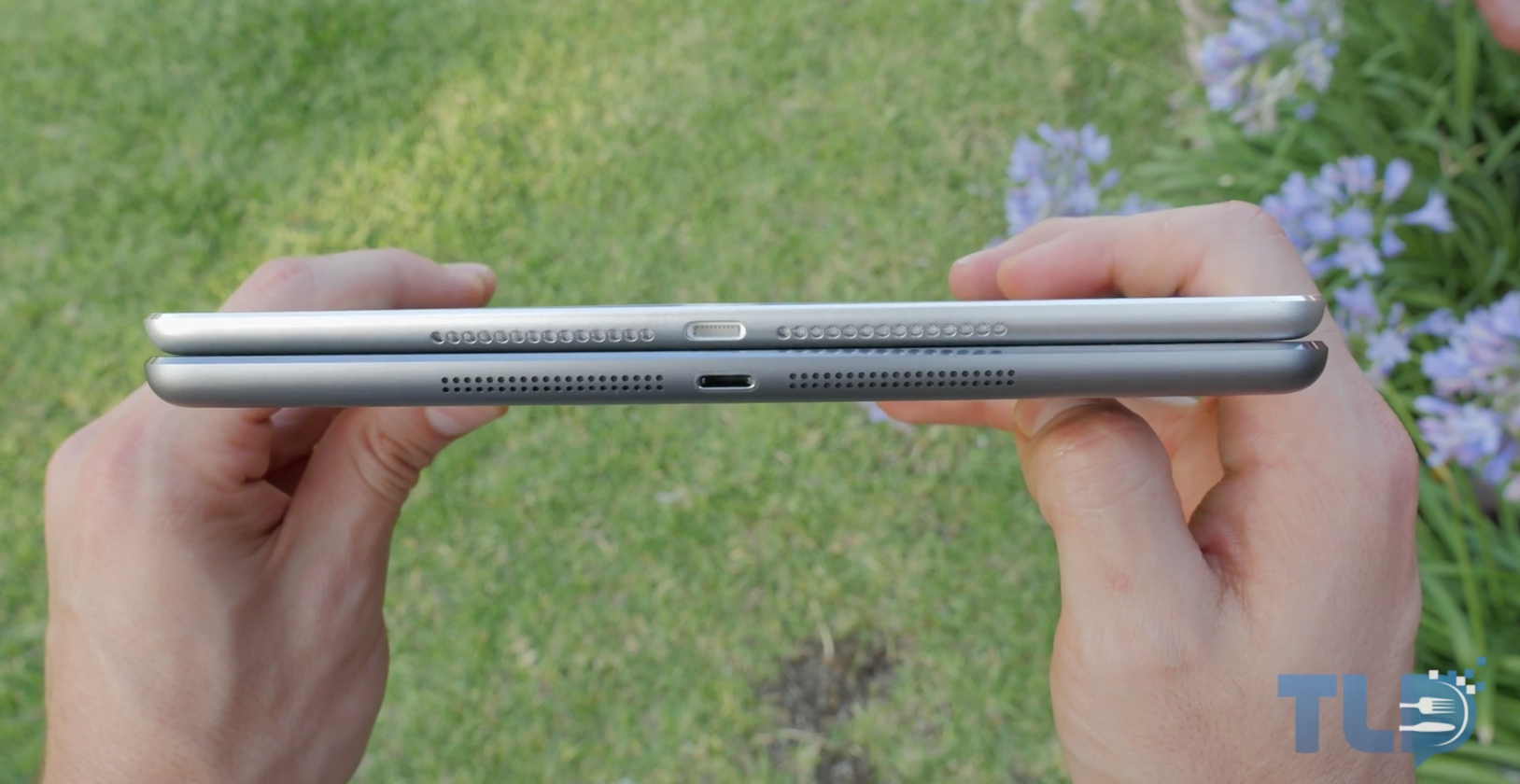
1) The current batch of physical mockups/leaks indicate that the new iPad Air will look mostly the same as the current version, and that it will be roughly the same thinness. You can tell in the image above that the new model (on the top) is only very slightly skinner.

2) How can the fingerprint sensor be “improved” if it never existed in the first place? Nonetheless, we’re hearing the new model does include a Touch ID sensor, like the iPhone.


Expand
Expanding
Close

Site default logo image

Helpful shift scheduler for Apple Store employees turning into App Store app for all

A couple of years ago, Australia-based former Apple Retail Store employee Josh Hunt realized that he (and his colleagues) had a major problem: even with Apple’s cloud technologies, viewing his Apple Store work schedule was a pain. Apple’s internal network allows Apple Store employees to view their hours each day, but this information is not easily accessible from the Calendar application on the iPhone, iPad, or Mac. Hunt created a tool called Roster Genius that is a web extension to convert Apple’s internal calendaring system into a file that is compatible with the iOS and Mac calendar applications.

Roster Genius was a hit inside the Apple Retail world, and Hunt tells us that the service amassed 8,000 users in 14 countries. But Hunt shut down Roster Genius in favor of building something, alongside co-founder Sam Elliott, with larger implications: an App Store app with similar shift management functionality that could be used by all sorts of users, not just Apple Retail Store employees. The new app, launching in the coming months, is called Shifts, and as the developers tell us, “it is a calendar app, but made specifically for casual/part-time employees – that is, people who work different shifts every day.”

The application can connect to the schedules of others so that “you’ll be able to see when your days off align with your friends, and share your roster with a group of friends and coordinate for things to do on days off, organize the carpool or plan after-work drinks,” according to the developers. The interface for the app is very slick, and it boldly does not use the date picker as it instead relies on the numbered keypad for quickly entering in work times. As for the Apple Retail Store-optimized version, that’s coming back too.


Expand
Expanding
Close

Apple sets developer rules for HealthKit, HomeKit, TestFlight, and Extensions ahead of iOS 8 launch

Site default logo image

Screenshot 2014-09-02 22.39.30

Today, Apple has updated its official App Store developers Review Guidelines to outline the requirements for iOS 8 applications that will make use of the new HealthKit, HomeKit, TestFlight, and Extensions services. Today’s update indicates that Apple is nearing the release of iOS 8, the next-generation mobile operating system for the iPhone, iPad, and iPod touch ahead of the September 9th Apple media event. Apple will provide developers with a golden master seed of iOS 8 on the day of the event, according to sources with knowledge of the plans. The review guidelines are a “living document” that list reasons that App Store apps could be rejected. Below are the full lists for HealthKit, HomeKit, TestFlight, and Extensions, but here are some of the more significant points:

  • “Apps using the HealthKit framework that store users’ health information in iCloud will be rejected.” This point should reduce fears of intruders being able to access a user’s health data, especially after the scandal surrounding the leak of celebrity photos potentially stored in iCloud.
  • “Apps that share user data acquired via the HealthKit API with third parties without user consent will be rejected.”
  • “Apps that provide diagnoses, treatment advice, or control hardware designed to diagnose or treat medical conditions that do not provide written regulatory approval upon request will be rejected.” This point is crucial in that these fine print allows Apple to work around the FDA’s regulatory guidelines for mobile health applications.
  • “Apps using the HealthKit framework must provide a privacy policy or they will be rejected.”
  • “Apps must not use data gathered from the HomeKit APIs for advertising or other use-based data mining.” Same deal with HealthKit, as we noted earlier this week.
  • There are also a number of third party keyboard guidelines that will be critical for developers to follow.

In addition to those four new sections, Apple has also updated the guidelines to say that “if your app is plain creepy, it may not be accepted.” You can read all of the new bullet points below:


Expand
Expanding
Close

Apple denies iCloud/Find my iPhone breach, says ‘very targeted attack’ hit certain celebrities

Site default logo image

icloud

Apple has responded to this week’s hackings of celebrity iCloud accounts, which resulted in postings of private photographs. Here’s Apple’s statement in full:

CUPERTINO, Calif.–(BUSINESS WIRE)–We wanted to provide an update to our investigation into the theft of photos of certain celebrities. When we learned of the theft, we were outraged and immediately mobilized Apple’s engineers to discover the source. Our customers’ privacy and security are of utmost importance to us. After more than 40 hours of investigation, we have discovered that certain celebrity accounts were compromised by a very targeted attack on user names, passwords and security questions, a practice that has become all too common on the Internet. None of the cases we have investigated has resulted from any breach in any of Apple’s systems including iCloud® or Find my iPhone. We are continuing to work with law enforcement to help identify the criminals involved.

To protect against this type of attack, we advise all users to always use a strong password and enable two-step verification. Both of these are addressed on our website at http://support.apple.com/kb/ht4232.

Apple says that it conducted an investigation for more than 40 hours, and denies that iCloud or Find my iPhone was actually breached. Apple is presenting this as a very targeted username, password, and security questions hack on “certain celebrity accounts.” Apple recommends that users utilize the 2-step verification service for Apple IDs/iCloud. The company also says it is continuing to work with law enforcement on finding the hackers involved.


Expand
Expanding
Close

Apple HR chief Denise Young-Smith emails employees about diversity & inclusion

Site default logo image

Apple_Diversity

Apple’s Vice President of Global Human Resources Denise Young-Smith emailed all Apple employees last week regarding diversity and inclusion. The email continues Apple’s recent string of events to promote diversity within the company. In mid-August, Apple released diversity data and held events on campus to promote inclusion. Young-Smith was promoted to head of all Apple HR earlier this year, and she received additional attention last month when she was added to Apple’s official executive biographies web page. The full email, via a source, is below:


Expand
Expanding
Close

In-depth, high-quality hands-on video of iPhone 6 assembled from leaked parts

Site default logo image

iphone_6_1.Still003

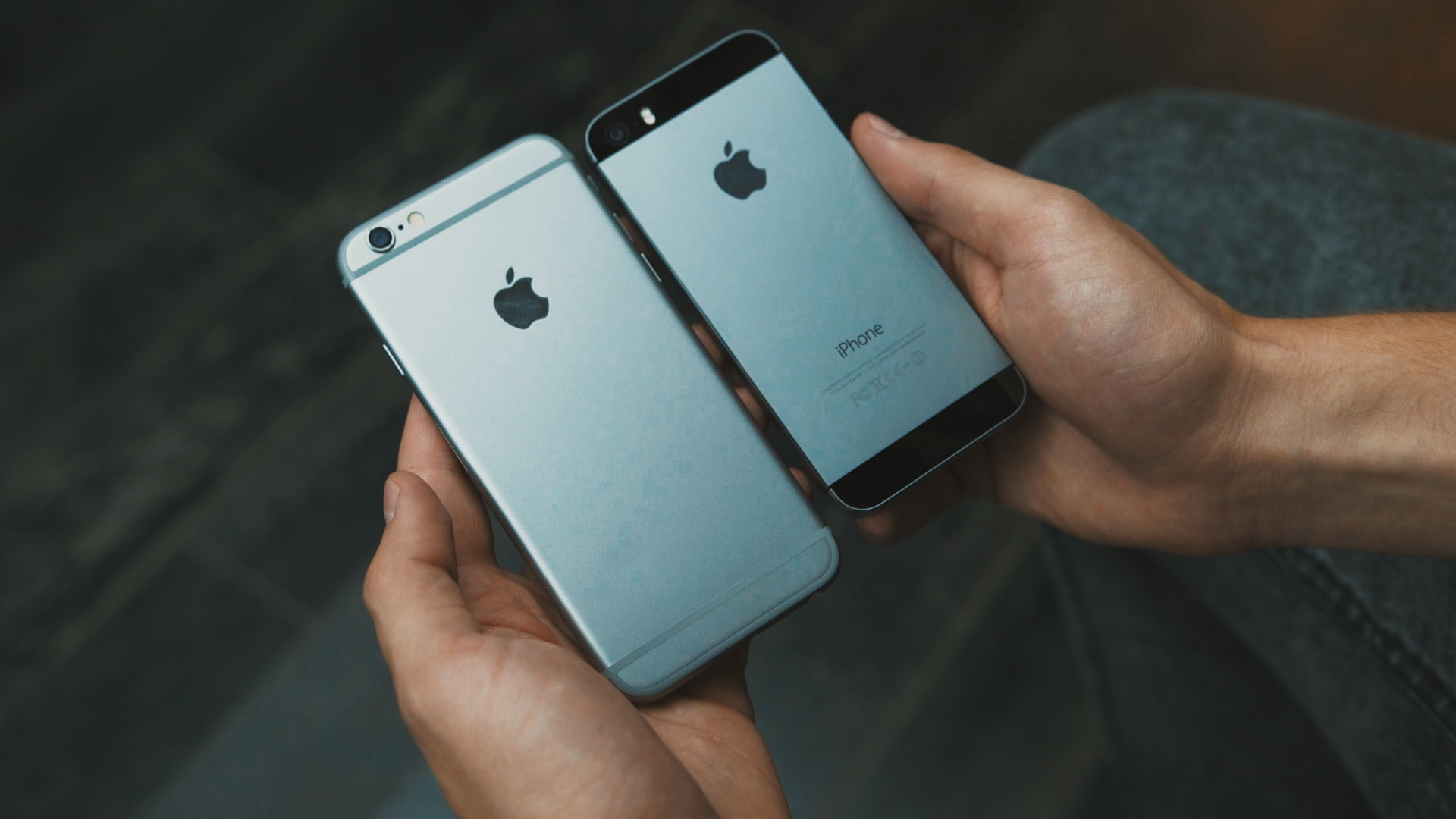
We now have our best look yet at the iPhone 6 until Apple officially launches the device on September 9th. Russia-based YouTuber Rozetked has put together what appears to be a 4.7-inch iPhone 6 (hands on footage of the 5.5-inch model went online this morning) with several of the leaked components that we’ve seen all over the web the last several months. The comparison shows both black and white front plates, along with a space gray rear shell. The video compares the design to the existing iPhone 5s and gives a very close look at the overall design aesthetic. You can find the video along with some more still photos below:


Expand
Expanding
Close

Site default logo image

UK carrier O2 teases new iPhone with funny newspaper ad

BwdqlmRCMAENoN1.jpg-large

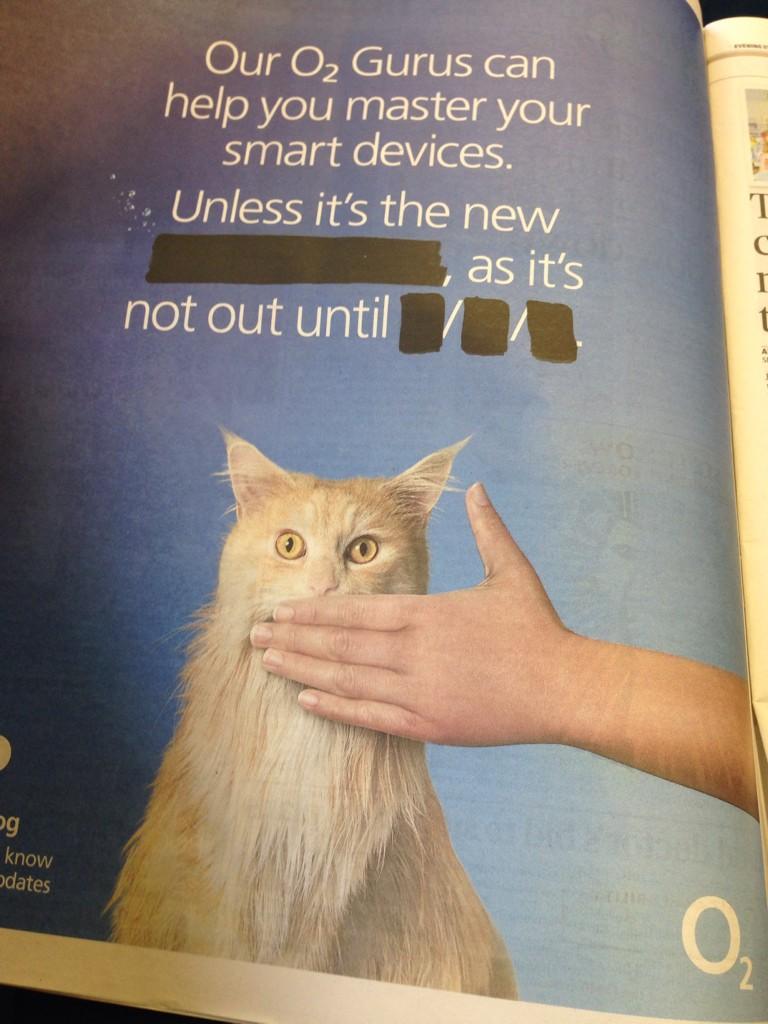
Major United Kingdom-based carrier O2 is teasing the upcoming iPhone 6 launch(es) with a humorous newspaper ad today. The ad is fairly self-explanatory. But to fill in the blanks, the new iPhone will debut at the September 9th Apple event and at least some models will likely become available on September 19th. The bigger, 5.5-inch phone is seeing some delays, and that model possibly won’t hit the streets until later in the month or even October. As for the name, the general consensus is either “iPhone 6” or “iPhone Air.” Thanks to The Verge‘s Tom Warren for bringing the ad to our attention.


Expand
Expanding
Close

Seeing Through the Illusion: Understanding Apple’s Mastery of the Media

Site default logo image
Cotton:Cook

Apple CEO Tim Cook with former VP of Worldwide Communications Katie Cotton

“Beautifully, unapologetically plastic.”

“Feature for feature, it’s identical to iPad Air in every way.”

“Just avoid holding it in that way.”

Apple’s public relations (PR) department is probably the best in the world — certainly more impressive at shaping and controlling the discussion of its products than any other technology company. Before customers get their first chance to see or touch a new Apple product, the company has carefully orchestrated almost every one of its public appearances: controlled leaks and advance briefings for favored writers, an invite-only media debut, and a special early review process for a group of pre-screened, known-positive writers. Nothing is left to chance, and in the rare case where Apple doesn’t control the initial message, it remedies that by using proxies to deliver carefully crafted, off-the-record responses.

Except for a few big exceptions, such as the memorably off-pitch quotes above, Apple’s “tell them what to believe” PR strategy has worked incredibly well for years. But it has also created tensions between the company and the people who cover it, as well as within Apple itself. The company’s long-time head of PR, Katie Cotton, left the company earlier this year as CEO Tim Cook openly sought to make a major change in the way Apple interacted with the press and its customers. As the hunt for Cotton’s replacement is still in progress, and the depth of Apple’s commitment to change remains unclear, we look today at the techniques Apple has used to quietly manipulate its coverage over the years.

You can navigate between the chapters, below:

– Part 1) Apple Events and Shredded White Booklets

– Part 2) Introducing the Teams: How PR Is Organized at 3 Infinite Loop

– Part 3) Strategies: The “Art of Deep Background” and Controlling the Press

– Part 4) The Departure of a “Tyrant”

– Part 5) Two Heads In Place Of One

– Part 6) Controversies: From Maps to Beats to Haunted Empires

– Part 7) Product Reviews, Briefings, & Reviewer’s Guides

– Part 8) Steve Jobs and the Process Behind Press Releases

– Part 9) A Friendlier, More Transparent Future?

Two months in the making, this article is the product of over a dozen interviews with journalists, bloggers, and PR professionals, including many who have worked at Apple.


Expand
Expanding
Close

Site default logo image

Part 1) Apple Events and Shredded White Booklets

From Seeing Through the Illusion: Understanding Apple’s Mastery of the Media, a profile examining Apple’s PR strategy:
Apple Unveils New Versions Of Popular iPad

“The keynote is like a production. You have to have a special appreciation for it.”

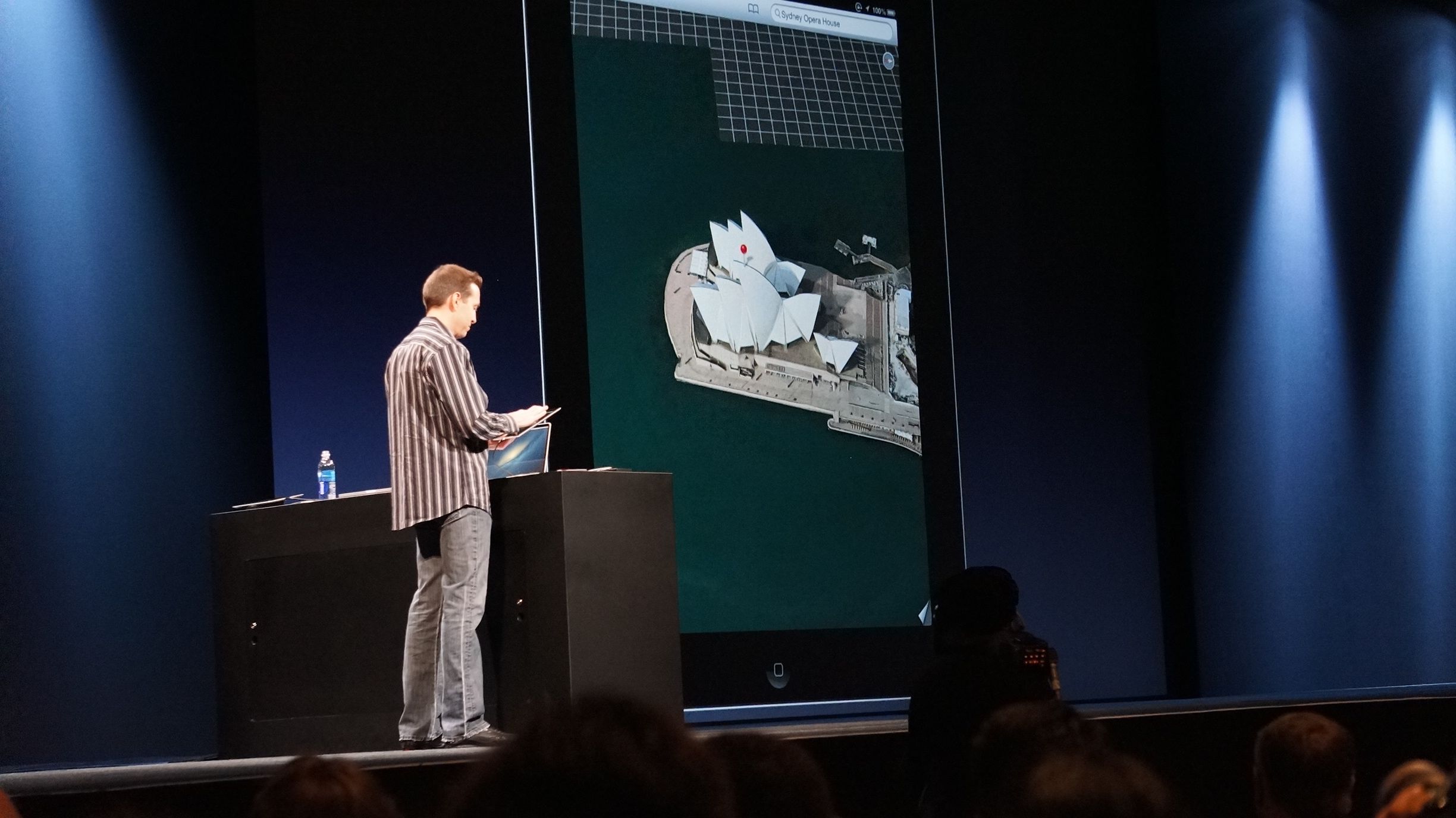
You probably never knew that an audience member fainted during one of Steve Jobs’s keynotes. Quickly and without a pause, Apple PR representatives quickly guided paramedics to escort the ill man out of the venue, without causing even a blip in the presentation. As a member of Apple’s PR team recalled, preventing what would otherwise have been a show-stopping disruption was seamless, as potential hiccups in the event had been pre-considered “down to a science.” This anecdote demonstrates both Apple’s detailed approach to event planning and wider communications strategy: it has mastered the ability to control situations invisibly, without having its efforts noticed.


Expand
Expanding
Close

Site default logo image

Part 2) Introducing the Teams: How PR Is Organized at 3 Infinite Loop

From Seeing Through the Illusion: Understanding Apple’s Mastery of the Media, a profile examining Apple’s PR strategy:

Infinite Loop 3

Unlike Microsoft, Samsung, Adobe, cellular carriers, or Wal-Mart-sized corporations, Apple handles its PR and Communications strategies wholly in-house, mirroring its control over its hardware and software strategies. While Apple still works with external agency Media Arts Lab of TBWA on print, digital, and TV marketing efforts, it is actively reducing its reliance on that firm by boosting its in-house marketing resources. According to sources, Apple is “aggressively” poaching select members of Media Arts Lab for its in-house team, but not undertaking a full-on corporate raid.

Though Apple is a gigantic and ever-growing company, its PR and Communications group is surprisingly tiny. There are only around over 30 PR employees in Apple’s Cupertino offices, with another few dozen-some individuals scattered around the world to organize events, translate press releases, and either answer or dodge questions from journalists in every time zone. The Cupertino-based office is a wing on the third floor of Apple’s Product Marketing building, 3 Infinite Loop. Framed posters of vintage Apple advertisements decorate the area, which otherwise consists of plain white hallways with offices on either side, and two small common areas.


Expand
Expanding
Close

Site default logo image

Part 3) Strategies: The “Art of Deep Background” and Controlling the Press

From Seeing Through the Illusion: Understanding Apple’s Mastery of the Media, a profile examining Apple’s PR strategy:

MEdia

Apple’s PR department presents a cool, measured public-facing image: it only responds to press inquiries when it wants to, doesn’t offer quotes unless they’ll be reprinted without criticism, and responds directly only when it determines that something needs to be said by “Apple” rather than “sources familiar with the matter.” You could picture Apple’s PR strategy as the work of a wise, wealthy, and not particularly friendly queen – one always too busy to be bothered, until for some reason, she’s not.

So it’s a surprise that Apple actually isn’t that detached from the media: it’s more like a teenage girl obsessively keeping her fingers on the pulse of coverage. Members of Apple PR seek tabloid photos of celebrities holding iPhones, while others read Apple-focused blogs actively, and keep tabs on prominent Apple beat writers using anonymized social media accounts. A former Apple PR employee notes that the team enjoys being an “overall watchdog,” monitoring what the media is saying about the company every day. This oversight is so important to Apple that a few times a week, top executives are sent a document detailing the company’s latest press coverage. When Apple is not pleased with coverage, it sometimes works to shift the narrative, even attempting to undermine giant news organizations.


Expand
Expanding
Close

Site default logo image

Part 4) The Departure of a “Tyrant”

From Seeing Through the Illusion: Understanding Apple’s Mastery of the Media, a profile examining Apple’s PR strategy:

CottonJobs

While Apple PR portrayed former VP of Worldwide Corporate Communications Katie Cotton’s departure as a way for the executive to spend more time with her children, the true reason for her departure more likely was Tim Cook’s different vision for Apple’s future public-facing appearances.

As a former member of Apple’s PR team recounted, Cotton was the company’s “ace in the hole” for journalists. Known to control all media access for Apple, Cotton’s power and attitude made some journalists fear that their access to Apple events and early product briefings would be cut off. These are two privileges that, if taken away, could negatively alter a writer’s career. Internally, Cotton was described by some Apple employees as a “tyrant.” One Apple employee called Cotton’s reign a “battle for the front facing image of the company” and said that the executive ran the group like a “fiefdom.”


Expand
Expanding
Close

Site default logo image

Part 5) Two Heads In Place Of One

From Seeing Through the Illusion: Understanding Apple’s Mastery of the Media, a profile examining Apple’s PR strategy:

Steve Dowling, Natalie Kerris, & Trudy Miller

Two Heads In Place Of One

Months after announcing her departure, Katie Cotton has moved on from Apple, according to a person close to the former executive. She is no longer involved in the media strategy that she led for 18 years, and is not participating in recruiting a replacement. A source told us that “Cotton does not believe in searching for her own successor.” While Tim Cook is pondering the future of the department, Cotton left Apple PR in the hands of two longtime deputies: Steve Dowling and Natalie Kerris. The interim leaders (pictured left and top right, respectively) took over in May, and now both report directly to Cook.

Cotton’s “emotional” departure announcement in May indicated that Cook would oversee an internal and external search for a replacement, according to people briefed on the process. It’s somewhat surprising that an 18-year veteran of Apple would abruptly depart the firm with no successor in place, and have no obvious say in who her replacement may be. Considering that Cotton left Apple the work day before WWDC, Apple’s largest event of the year, and also that she technically remains an Apple employee (following Scott Forstall, who served as an “advisor” for a few months short of a year following his departure), evidence suggests that she did not leave entirely of her own accord.


Expand
Expanding
Close

Site default logo image

Part 6) Controversies: From Maps to Beats to Haunted Empires

From Seeing Through the Illusion: Understanding Apple’s Mastery of the Media, a profile examining Apple’s PR strategy:

The number of major controversies in Apple’s recent history could be counted on a single hand, but because of the company’s size and history of PR dominance, each one has attracted global attention. Most Apple-watchers agree that the company’s largest debacle was the iPhone 4’s faulty antenna. Steve Jobs took an extended period of time before holding a press conference, simultaneously spinning the reports as overblown, and debuting a free case program. Before that Friday press conference in the summer of 2010, the iPhone 4’s negative press had spun out of control, resulting in viral YouTube videos and class action lawsuits. Although Apple downplayed the controversy publicly, it fired and quietly blamed a senior engineering executive for the issue, redesigning and then doing away with the antenna design in subsequent iPhones. Tim Cook hasn’t been perfect, but he has tended to respond quickly to controversies, suggesting that he is willing to handle controversies before they turn into crises.

Maps:

Asked to describe the iOS Maps debacle, a member of Apple PR told us that “it was certainly tough,” as “a lot of people were upset that Scott [Forstall] was not taking responsibility for his product.” The employee went on to say that that it felt internally like Forstall “was skirting the responsibility” and that it was becoming a “waiting game,” an “icky” situation. Cook did not wait too long to circumvent Forstall, however. Just a few days into iOS 6’s public launch, Cook “displayed real leadership” and “started to take Apple and make it the best company it could be both internally and externally.”

Cook wrote a Maps apology letter and decided to terminate Forstall, promoting executives such as Jony Ive, Eddy Cue, and Craig Federighi to take on Forstall’s responsibilities. “Tim played a huge personal role in writing the letter alongside the PR and Product Marketing teams,” according to the Apple employee.

After witnessing the iPhone 4 Antennagate situation, Cook knew that he had to do better than his predecessor at handling a real problem. Instead of simply watching as executives passed blame around a board room table, Cook took control of the situation and promised a solution. Whatever you may think of the decision, it was a giant moment in Apple leadership, given Forstall’s prior importance to the company; the detail-obsessed executive had been called Apple’s CEO in waiting. While Apple’s Maps team is still clouded by internal politics and incomplete features, Apple is clearly pushing forward and attempting to resolve the many problems with its Maps app. Since the apology was issued, Maps has expanded to OS X and been redesigned on iOS, but it has also gained distractions like Flyover Tours.

Beats:

Apple’s acquisition of Beats Electronics and Beats Music was not so much an issue of negative PR, but it demonstrates one of the current problems with Apple’s internal culture. When news broke of Apple being in late talks to acquire Beats on a Thursday afternoon, Apple PR had a difficult time responding to the situation because the team had no inside knowledge as to whether the claims were accurate, Apple employees told us. The company’s need-to-know culture restricts information to individuals who must know about an upcoming product, service, or announcement. In the case of the Beats leak, Apple PR could not act on the situation because they had no information beyond what had been published in media reports.

Normally, when a product leak occurs, Apple PR’s top brass typically meets with Product Managers from the respective groups to gauge how accurate the leak is. The PR team then meets to decide how to comment on the record, off the record, or when to say nothing at all. Leaks also offer Apple the opportunity to watch how consumers and other media outlets respond to particular upcoming products, and if there is time for the engineering and marketing teams to make changes, the groups now know which direction to move the products. Sometimes the leaks come from Apple itself; other times, they do not. But when an inadvertent leak is corporate- rather than product-related, the PR team’s only option is to climb high up the totem pole for assistance.
Haunted Empire:

Another low-point for Apple in recent years was the debut of former Wall Street Journal reporter Yukari Iwatani Kane’s book titled Haunted Empire: Apple After Steve Jobs. The book took a grim approach to detailing Apple under the leadership of Tim Cook, saying that the company’s best days are behind it, as Steve Jobs is no longer at the helm.

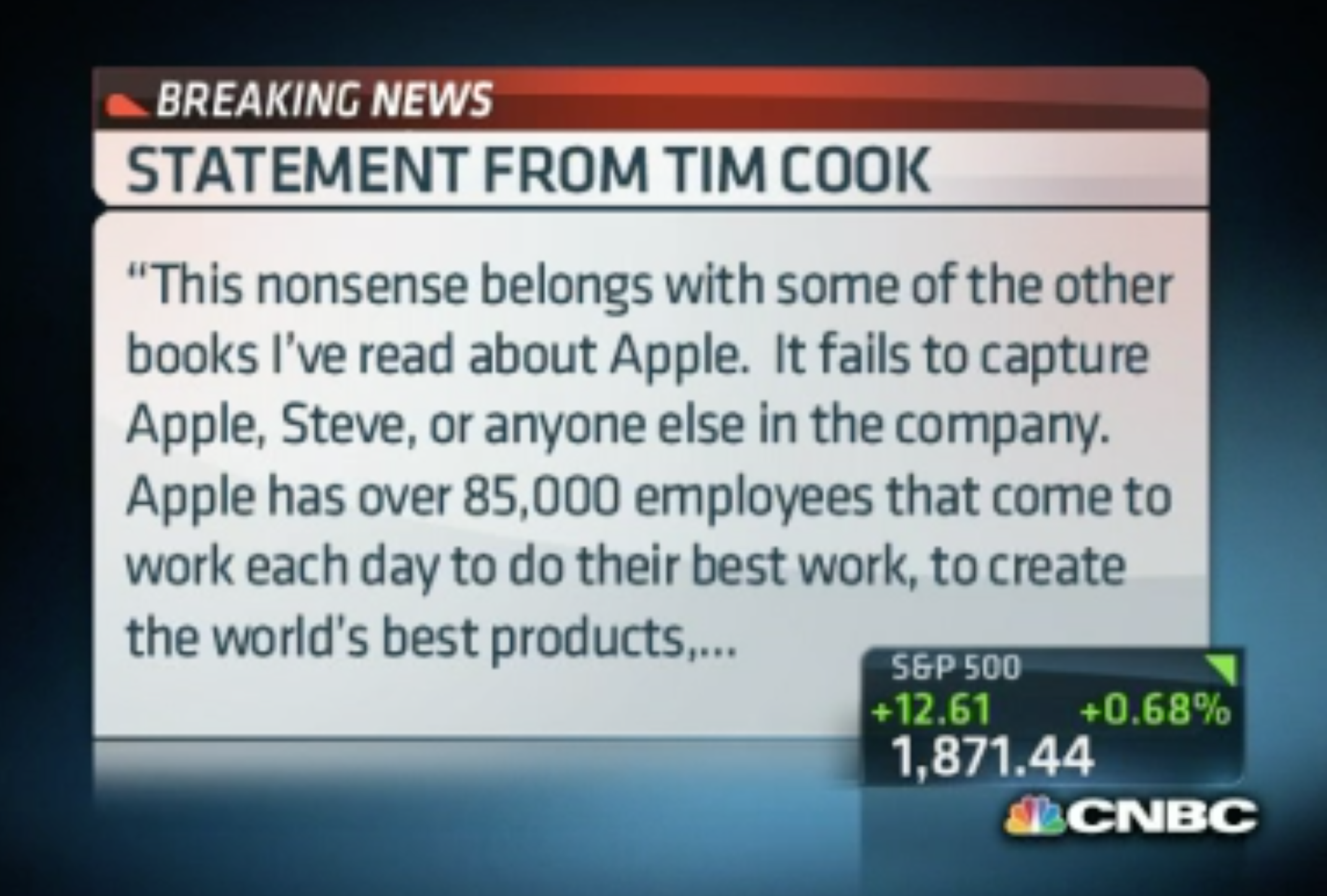
In a twist from the usual process, Apple PR did not respond to the book’s assertions via spokespeople; instead, Tim Cook and other Apple executives did so themselves. As a member of Apple’s PR team said, Apple’s executives were “personally affected” by the narrative and Cook “made the call” to respond himself. In an email sent to CNBC, Cook said:

“This nonsense belongs with some of the other books I’ve read about Apple. It fails to capture Apple, Steve, or anyone else in the company. Apple has over 85,000 employees that come to work each day to do their best work, to create the world’s best products, to put their mark in the universe and leave it better than they found it. This has been the heart of Apple from day one and will remain at the heart for decades to come. I am very confident about our future. We’ve always had many doubters in our history. They only make us stronger.”

In smaller jabs, Phil Schiller took to Twitter to dispute a comment from the book about his taste in cars, and Senior Vice President of Internet Software and Services Eddy Cue shot down a claim that Jobs had tossed a pen at Cue’s face. While Schiller and Cue disputing minor facts within the larger story may seem trivial, Apple executives rarely if ever personally respond to books and media reports publicly. The commentary from Cook, Cue, and Schiller represents Apple executives personally taking full control of the PR situation and not leaving it up to the PR team. Apple employees recall feeling that this was a very “Steve” move on Cook’s part.

Negative reviews of Haunted Empire quickly piled up on Apple-focused web sites. Whether Apple PR helped to coordinate some of those reviews remains a minor mystery.

— See Part 7) Product Reviews, Briefings, & Reviewer’s Guides

Site default logo image

Part 7) Product Reviews, Briefings, & Reviewer’s Guides

From Seeing Through the Illusion: Understanding Apple’s Mastery of the Media, a profile examining Apple’s PR strategy:

644144334_Ssnd8-X1-1

Pogue, Baig, former <em>Newsweek</em> columnist Steven Levy, and Mossberg (left to right)

Product Reviews, Briefings, & Reviewer’s Guides

The attention that Apple’s PR and Communications group puts into events can even be seen in the packages that reviewers receive with new iPhones, iPads, and Macs. Apple’s review units are considered the holy grails of pre-release technology products, and only a small number of hand-selected, generally positive writers are granted the first shot at reviewing the new gear. Former Apple PR representatives recalled being instructed to specifically inspect individual iPhone and iPad boxes for scuff marks and minor scratches before handing the units off to reviewers such as Walt Mossberg, David Pogue, and Ed Baig. Every unit had to be perfect.

Mossberg was the Personal Technology Columnist for the Wall Street Journal and is now Co-Executive Editor of Re/code. Pogue was lead tech reviewer for The New York Times and is now the chief of Yahoo’s tech section. Ed Baig is a long-time columnist for USA Today. These writers not only have a common denominator of working at major publications, but are also the only three U.S. journalists to have been granted early access to every new iOS device (including the first iPhone and iPad) since 2007. According to a report, Apple’s concern over these writers was significant enough that an engineer was reportedly pulled off vacation to personally help Pogue when he experienced a problem with an Apple TV before its debut in stores. Two of them were mentioned in Walter Isaacson’s biography of Steve Jobs as the only journalists Apple really cares about.


Expand
Expanding
Close

Site default logo image

Part 8) Steve Jobs and the Process Behind Press Releases

From Seeing Through the Illusion: Understanding Apple’s Mastery of the Media, a profile examining Apple’s PR strategy:

j06_1129759_

Steve Jobs and the Process Behind Press Releases

A former Apple PR member recalls that Steve Jobs once scrapped an entire Apple press release announcing a new partnership with another company solely because he did not like the name of the new partner. Apple ended up re-writing the entire press release to work around having to actually name the company. When Steve Jobs was at the helm, the buck stopped at his office for even the smallest PR minutiae. Even beyond the bigger picture deals like magazine covers and major interviews, Jobs was involved with Apple’s communications down to individual words in press releases.

It was Jobs who came up with the strategy of assigning an adjective to each Apple product for usage in press releases. For instance, the iPad is consistently referred to as “Magical,” while the App Store is “Legendary” and the iPhone is “Revolutionary.” These terms were not mentioned just once in a single press release, but are commonly used for those respective products across Apple’s marketing materials, internal presentations, and high-profile media events.


Expand
Expanding
Close

Site default logo image

Part 9) A Friendlier, More Transparent Future?

From Seeing Through the Illusion: Understanding Apple’s Mastery of the Media, a profile examining Apple’s PR strategy:

craig_federighi_photo_op

Post-Katie Cotton, members of Apple’s PR and Communications team are said to be excited about the new opportunities and tactics they will be able to execute under a friendlier, more transparent leader. Current and former employees say that Cook is likely looking at candidates with ties to world governments, expansive knowledge of labor force regulations, a deep understanding of China’s economics, and, of course, expertise in consumer technology and social media.

Cook has already expanded Apple’s executive team over the past year, adding leaders who fit those characteristics. For example, Cook hired former Environmental Protection Agency chief Lisa P. Jackson as an executive to run Environmental Initiatives. He has also hired a new retail executive with immense experience with China, Angela Ahrendts, as well as people like Musa Tariq with extensive knowledge of social media-based communication and marketing. Cook has also brought former Senate staffer Amber Cottle into the fold, and has met with government officials more frequently than his predecessor.


Expand
Expanding
Close

Latest close-up photos of space gray iPhone 6 vs. iPhone 5 (Gallery)

Site default logo image

Screen-Shot-2014-08-25-at-3.04.20-AM.png

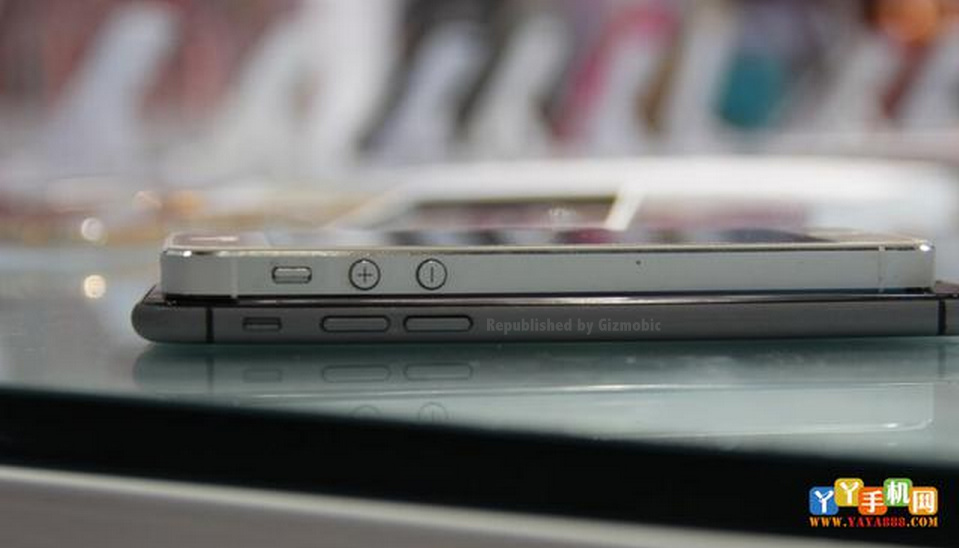
We’ve seen hundreds of iPhone 6-related part leaks, rumors, and claims, and of course lots of comparison photos. Below, via Yaya888 and Gizmobic, we have the latest. These shots compare the iPhone 5 to the space gray 4.7-inch physical iPhone 6 model. The new phone is expected to be introduced on September 9th.


Expand
Expanding
Close

Apple pushing Beats Music app via email to iTunes customers

Site default logo image

Screenshot 2014-08-24 17.42.02

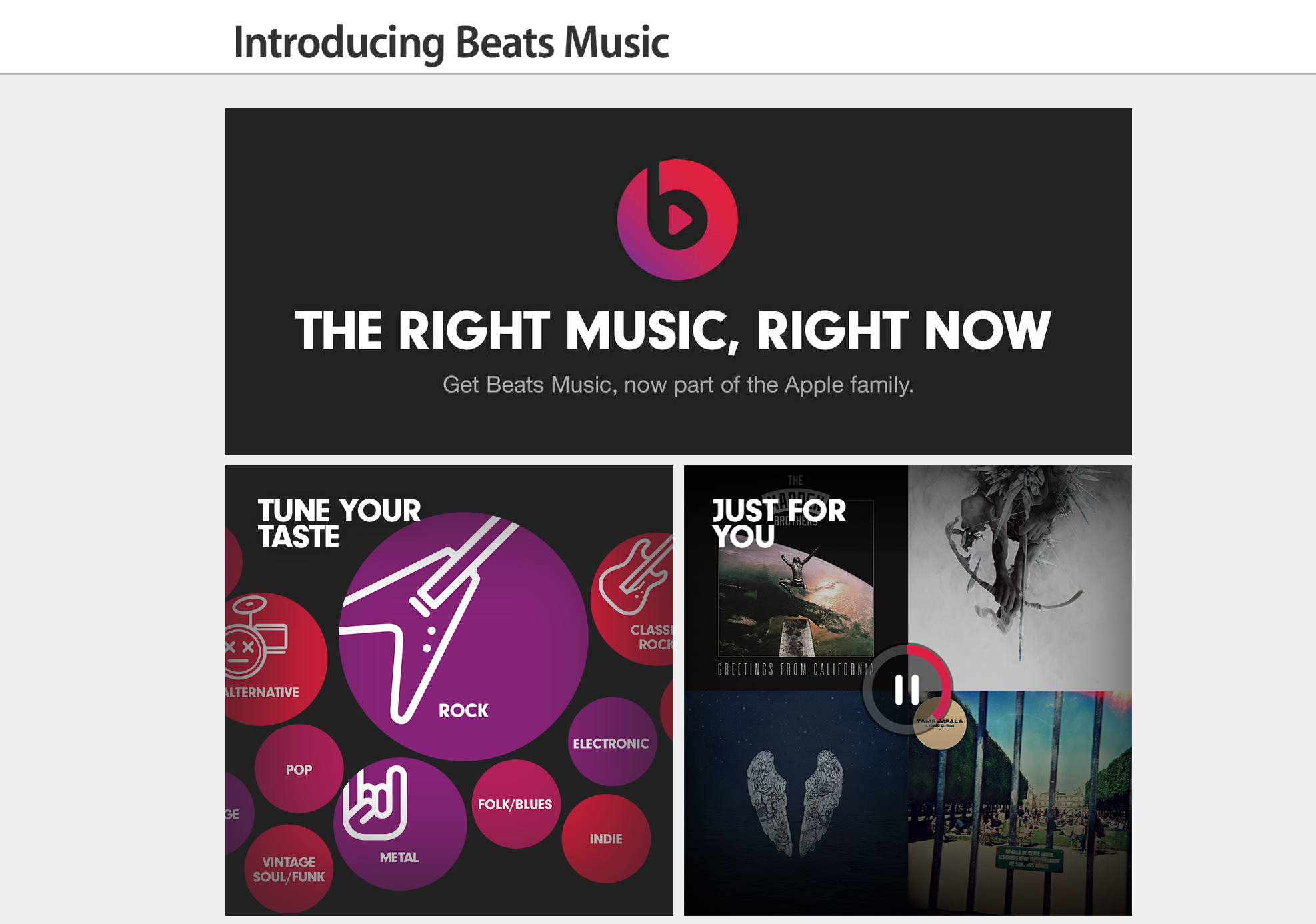
Apple has begun pushing the Beats Music streaming service via email to iTunes customers. The emails promote the free-to-download Beats Music app’s “Just For You” and “Tune Your Taste” features and note that Beats is now “part of the Apple family.” Apple finalized its acquisition of both Beats Music and Beats Electronics at the beginning of this month, and Apple has already begun promoting Beats Electronics via a new section on the online store and notable discounts. This email push is the second Apple promotion of the streaming app as the company has already integrated the app into the App Store’s “Apps by Apple” category. Full email below:


Expand
Expanding
Close

Apple finds some iPhone 5 units have battery problems, opens replacement program

Site default logo image

Apple-iPhone-Sales

This Friday afternoon, Apple has opened up an iPhone 5 battery replacement program after discovering that a “very small percentage” of units “may suddenly experience shorter battery life or need to be charged more frequently.” The iPhone 5 was originally launched in September 2012, and Apple says that the affected units were sold between that month and January 2013. Apple’s support website includes a tool to check if your serial number belongs to a faulty iPhone 5…


Expand
Expanding
Close

Apple talked HealthKit with insurance companies UnitedHealth and Humana

Site default logo image

Healthkit-WWDC-01

Bloomberg‘s Adam Satariano has an interesting profile out this morning regarding the usage of wearable fitness devices in work environments. The report says that some companies are offering devices, such as the FitBit, in order to track the fitness of its employees. With that information, companies are able to slice costs off of insurance plans if employees hit certain fitness data thresholds:


Expand
Expanding
Close

Apple releases OS X Yosemite Public Beta 2 & fresh iTunes 12 beta

Site default logo image

yosemite

Apple today released the second version of the OS X Yosemite Public Beta. The update is available via Software Update on the Mac App Store for those running the initial beta release; the first beta was released at the end of July. It appears Public Beta 2 is nearly the same build as the Developer Preview 6 (build r, up from f) released to Yosemite developers earlier this week. Apple has also released an updated version of the redesigned iTunes 12:


Expand
Expanding
Close

Apple files to kick off expanded, potentially ‘jewelry’-classified sapphire production this month

Site default logo image

Mesa-Arizona

Apple and State of Arizona filings have come to light today that indicate Apple is rapidly expanding its Mesa, Arizona operations and GT-Advanced sapphire crystal production. PTT Research Senior Analyst and GTAT investor Matt Margolis shared the new documents from his latest research with 9to5Mac. The first interesting piece of the filings is a letter from Apple’s Director of Global Trade Compliance James J. Patton from early July to the U.S Department of Commerce:


Expand
Expanding
Close