It turns out that his hobby 9to5Mac blog was always his favorite and in 2011 he went full time adding his Fortune Google followers to 9to5Google and adding the style and commerce component 9to5Toys gear and deals site. In 2013, Weintraub bought one of the Tesla’s first Model S EVs off the assembly line and so began his love affair with the Electric Vehicle and green energy which in 2014 turned into electrek.
In 2018, DroneDJ was born to cover the burgeoning world of drones and UAV’s led by China’s DJI.
From 1997-2007, Weintraub was a Global IT director and Web Developer for a number of companies with stints at multimedia and branding agencies in Paris, Los Angeles, New York, Sydney, Hong Kong, Madrid and London before becoming a publisher/blogger.
Seth received a bachelors degree in Industrial and Systems Engineering from the University of Southern California with a minor in Multimedia and Creative Technology in 1997. In 2004, he received a Masters from NYU’s Tisch School of the Art’s ITP program.
Hobbies: Weintraub is a licensed single engine private pilot, certified open water scuba diver and spent over a year traveling to 60 cities in 23 countries. Whatever free time exists is now guaranteed to his lovely wife and two amazing sons.
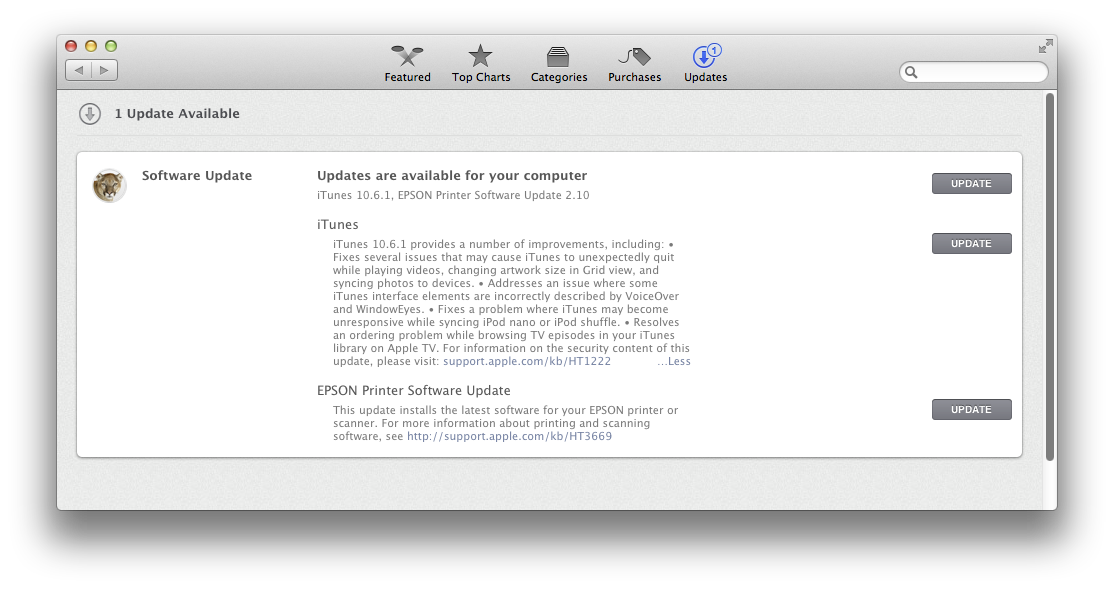
For the latest in iTunes software, hit your Software Update. You will receive iTunes 10.6.1, which makes everything better, including:
Fixes several issues that may cause iTunes to unexpectedly quit while playing videos, changing artwork size in Grid view, and syncing photos to devices.
Addresses an issue where some iTunes interface elements are incorrectly described by VoiceOver and WindowEyes.
Fixes a problem where iTunes may become unresponsive while syncing iPod nano or iPod shuffle.
Resolves an ordering problem while browsing TV episodes in your iTunes library on Apple TV.
Network World summarized a recent talk given by former Siri founder and subsequent Apple Engineering Director Dag Kittlaus (profiled here). Among the topics discussed were Steve Jobs’ dislike of the name “Siri” for the speech/AI interface. Jobs could not come up with anything better, so it stuck (Jobs also did not like “iMac”—he preferred “MacMan”). The best passage is the first face-to-face meeting between the two men, described as such:
Micro Systemation, a Swedish security firm that helps police and military around the world crack digital security systems, posted the above video about how its software works. According to Forbes:
[…] a Micro Systemation application the firm calls XRY can quickly crack an iOS or Android phone’s passcode, dump its data to a PC, decrypt it, and display information like the user’s GPS location, files, call logs, contacts, messages, even a log of its keystrokes.
The report said the firm uses the same kind of exploits that jailbreakers use to gain access to the phone. Once inside, they have access to just about everything.
Sometimes it is easy to forget how vulnerable data is on a smartphone.
Earlier today, we reported that the Australian Competition and Consumer Commission sought to have Apple drop the “4G” from the advertising/website of its new iPad products with cell modems…
The ACCC alleges that Apple’s recent promotion of the new “iPad with WiFi + 4G” is misleading because it represents to Australian consumers that the product “iPad with WiFi + 4G” can, with a SIM card, connect to a 4G mobile data network in Australia, when this is not the case.
Apple offered Australian customers the option to return their 4G iPads as a settlement if they believe they were misled into buying them with Apple’s 4G, according to ABC news (via Gadgetsteria, TNW).
Today Apple’s lawyers argued it was never specified the iPad could connect to Telstra’s network, but told the court the device is compatible with other networks that by international standards are deemed 4G.
Apple has agreed to publish a clarification that states the product supports ultra-fast mobile networks but is not compatible with the Telstra network.
The company says it will email purchasers offering a refund if they believe they have been mislead. Clarifications will also be made at point of sale.
Apple has entered into discussions with the watchdog and will return to the Melbourne Federal Court this afternoon.
Yes, any customer can return an iPad within 14 days regardless of the issue, so Apple is not really giving up too much in the way of leverage here. Also, most buyers were aware of the speeds that they were getting when they signed up.
Perhaps most importantly, the 42Mbps HSPA+ speed does pretty darn good (see video below where it schools U.S. LTE).
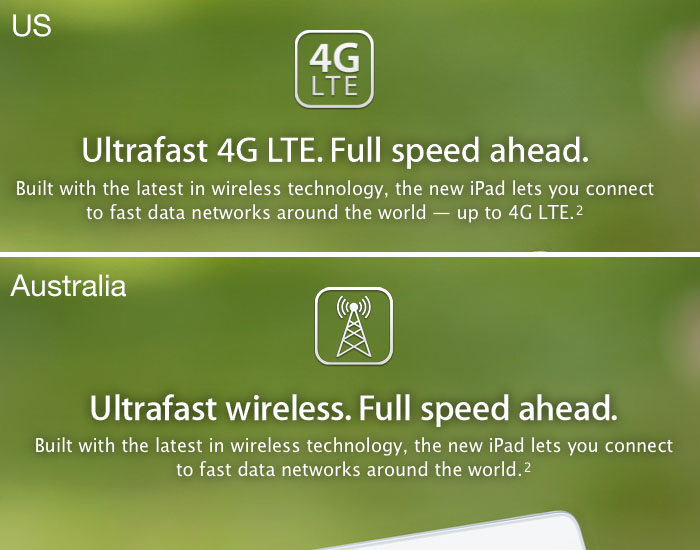
As of this writing, Apple.com/AU/iPad/4G still advertised its Australian iPads as 4G, but images like the one above have changed.
Apple is saying when it reads 100% the battery indicator reads 100%. It’s actually full enough to give you the kind of performance that they promise in their marketing. That’s ten hours of all-day battery life. They say if you charge it more than that, you could harm the longevity of the battery.
That last bit was a bit disconcerting, especially because it was not put into context correctly. Apple remained silent on the matter.
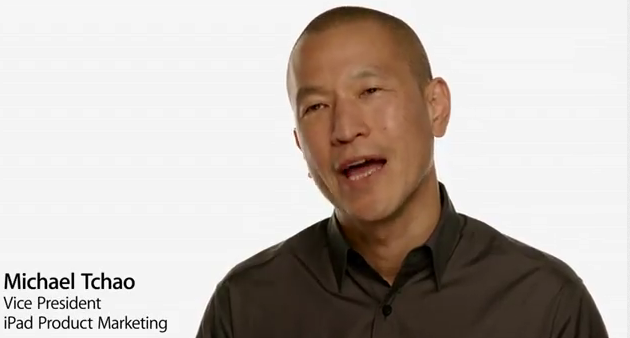
Today, AllThingsD got a response from Apple’s Vice President of iPad Product Marketing Michael Tchao that seems to clarify the issue and put it to bed:
Apple does in fact display the iPad (and iPhone and iPod Touch) as 100 percent charged just before a device reaches a completely charged state. At that point, it will continue charging to 100 percent, then discharge a bit and charge back up to 100 percent, repeating that process until the device is unplugged.
Doing so allows devices to maintain an optimum charge, Apple VP Michael Tchao told AllThingsD today.
“That circuitry is designed so you can keep your device plugged in as long as you would like,” Tchao said. “It’s a great feature that’s always been in iOS.”
The Australian Competition and Consumer Commission is seeking to have Apple drop the “4G” from the advertising/website of its new iPad products with cell modems…
The ACCC alleges that Apple’s recent promotion of the new “iPad with WiFi + 4G” is misleading because it represents to Australian consumers that the product “iPad with WiFi + 4G” can, with a SIM card, connect to a 4G mobile data network in Australia, when this is not the case.
Optus and Telstra do not use the compatible LTE radio frequencies as Apple’s iPad; therefore, new iPads are not compatible with the LTE 4G networks in Australia. Both mobile carriers already dropped the “4G” naming on the new iPad on their websites. However, Apple does display “iPad +4G” on the Apple.com.au website.
The speed that the iPad gets in Australia is pretty solid…
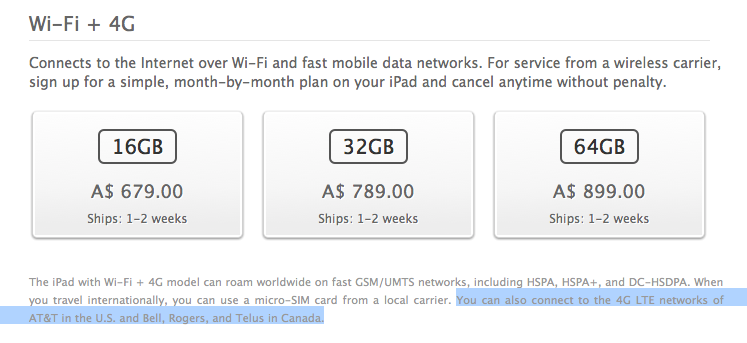
The iPad with Wi-Fi + 4G model can roam worldwide on fast GSM/UMTS networks, including HSPA, HSPA+, and DC-HSDPA. When you travel internationally, you can use a micro-SIM card from a local carrier. You can also connect to the 4G LTE networks of AT&T in the U.S. and Bell, Rogers, and Telus in Canada.
.
More importantly, it does not look like Australians play high and fast with marketing terms like “4G” as we do here in the United States, which now describes HSPA+ on AT&T iPhone 4S’s. Expand Expanding Close
Earlier today, we noted that PC World tested the new iPad against some Android tablets for heating during use and found it to be on the high-end but not always the hottest.
There are two interesting pieces of information this morning on the new iPad.
If used solely as an LTE MiFi, AnandTech got a mind-numbing 25.3 hours of Verizon LTE hotspotting out of the new iPad. That is equal to about five to seven MiFis.
Now for the killer. If you have an iPad on Verizon’s LTE network and use it as a personal hotspot (not currently possible on the AT&T version), it will last you roughly 25.3 hours on a single charge. Obviously that’s with the display turned off, but with a 42.5Wh battery driving Qualcomm’s MDM9600 you get tons of life out of the new iPad as a personal hotspot.
By my calculations, that means you could download 182GB of data at 2MB/sec on LTE through a single charge or over 18 times Verizon’s highest data plan in a single day.
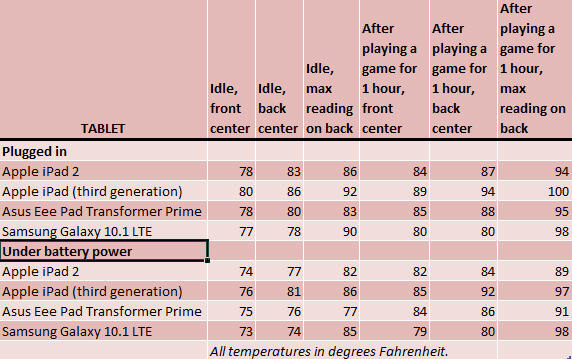
In addition, PCWorld tested the heat on the new iPad and compared it to the ASUS Eee Transformer Prime and Samsung Galaxy Tab under the same conditions. Without the charger plugged in, the new iPad was actually cooler than the Samsung Galaxy Tab—even with a bigger battery after playing a game for an hour.
The point is that the new iPad runs only slightly hotter than high-end Android tablets and only when charging. The cool champion is still the iPad 2 when playing graphic intensive games.
Skype for iPad got a Retina update this morning, meaning its icons and menus will not show pixelated fonts that will harm your new iPad Retina sensibilities. Unfortunately, the new iPad’s front-facing camera is still VGA, and we are pretty sure Skype is not pulling 2048-by-1500 pixel video feeds though your LTE connection just yet.
Still, it is exciting to see Skype updating for anything within months of release.
Mobile success is no longer measured in the millions. The platforms and scale are just getting too big. Now, to even get on the radar, an app has to hit the tens of millions as Rovio’s Angry Birds Space did today. [iTunes] Expand Expanding Close
China’s Twitter, Sina Weibo, is filling up with pictures of Tim Cook visiting the Beijing Apple Store this morning.
It is not clear if this is his first trip to China as CEO, but Cook has been to China many times in the past as COO and was last seen negotiating China Mobile’s contract in mid-June at the behest of former CEO Steve Jobs who, according to his biography, never visited the country.
Sina.com suggests it is the carriers who he’s in town for.
Update: the WSJ reports that Tim Cook was in town to meet government officials.
Cook, who is on his first trip to China since becoming chief executive of the Cupertino, Calif.-based company, “had great meetings with Chinese officials today. China is very important to us and we look forward to even greater investment and growth here,” said spokeswoman Carolyn Wu. She declined to identify any of the Chinese officials or give further details on the meetings.
Interestingly the Journal notes that Tim Cook is called ‘Captain Cook’ in China.
Cook, who serves on the board of Nike, is wearing a Nike LiveStrong jacket in the images above.
More pictures, including a hotel spotting, are below:
We are hearing additional little tidbits about the new iPad’s battery and its ability to charge beyond 100 percent. CNBC’s John Fortt reports Apple has stated that charging beyond 100 percent could somehow “harm the longevity of the battery.”
Apple is saying when it reads 100% the battery indicator reads 100%. It’s actually full enough to give you the kind of performance that they promise in their marketing. That’s ten hours of all-day battery life. They say if you charge it more than that, you could harm the longevity of the battery. So they say this isn’t just an issue with the new iPad. It was an issue with the previous ones well but this battery is 70% bigger so you’re more likely to notice it.
This would be extremely odd, so we are skeptical and looking for clarification on the issue. We already observed the new iPad continues charging for an hour beyond its 100 percent and noted you get longer battery-use if you let the iPad stay on those extra 60 minutes.
But are those extra minutes coming at a cost? It would be surprising if Apple wanted people to pull the plug on the new iPad when it hits 100 percent (especially because it now requires an overnight charge to fill it up).
Charge Cycles (Charge cycles vary by use, environment, settings, configuration, and many other factors.)
A properly maintained iPad battery is designed to retain up to 80% of its original capacity at 1000 full charge and discharge cycles. You may choose to replace your battery when it no longer holds sufficient charge to meet your needs.
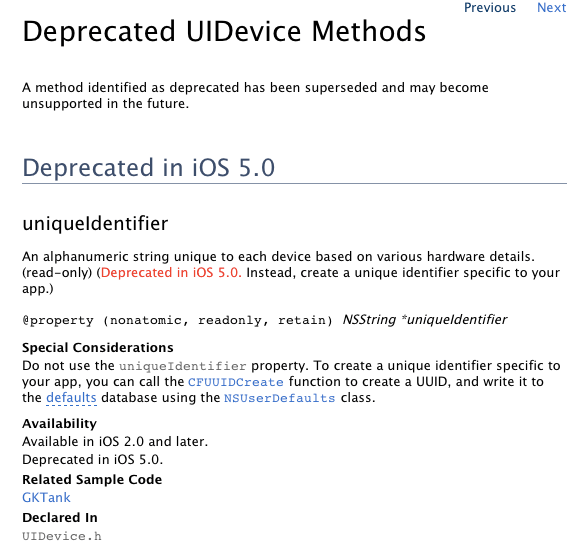
TechCrunch notes some of the Apple teams approving apps for the App Store are turning down apps that access the depreciated UDID identifier in iOS:
But this is the first time Apple has issued outright rejections for using UDIDs. “Everyone’s scrambling to get something into place,” said Victor Rubba, chief executive of Fluik, a Canadian developer that makes games like Office Jerk and Plumber Crack. “We’re trying to be proactive and we’ve already moved to an alternative scheme.” Rubba said he isn’t sending any updates until he sees how the situation shakes out in the next few days.
That’s something, because Apple announced the change in August. It is hard to feel for people who are “scrambling” just now.
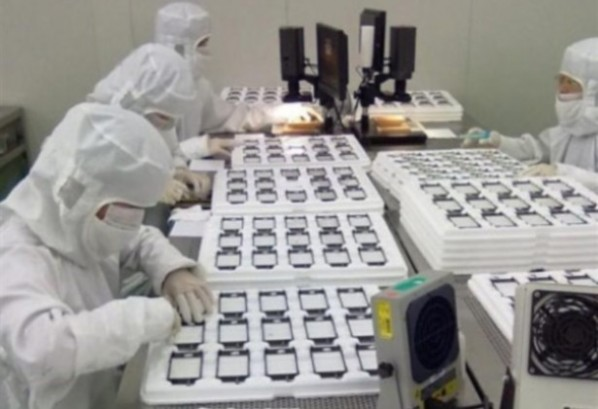
According to reports fromThe China Morning News (via MICGadget), Foxconn is in the midst of a huge hiring drive, hoping to increase numbers by 20,000 for production of the new iPhone in Taiyuan of the Shanxi Province in Northern China.
Foxconn in Tai Yuan is now building a new base for iPhone 5 production. The company is now in need of approximately 20,000 workers.
Mr. Yu, an insider at Tai Yuan Foxconn, says that the company still has tons of openings, especially front-line workers. “As long as they meet the basic standards, (we’ll) take as many as possible.”
Given Apple’s prominent position in the industry, Foxconn has made iPhone production its foremost priority in mainland China. Mr. Yu says that Foxconn gets about 85% of the total order of iPhone 5, which translates into about 57 million units per year.
One reason for heavy and perhaps unforecasted recruitment demand might be a strike that is currently happening at the plant. According to a separate report, workers left their machines and took to the streets over compensation. We are not going to pretend to understand the complexities involved, but it would appear the workers were promised a raise ahead of the next iPhone production and might not have received all that they asked for.
An entry-level worker at Foxconn is typically paid 1,550 yuan (US$245) per month, rising to to 1,800 yuan (US$285) per month after three months. When bonuses and overtime pay are included, a worker may typically earn between 2,200 and 3,500 yuan (US$345-$550) a month.
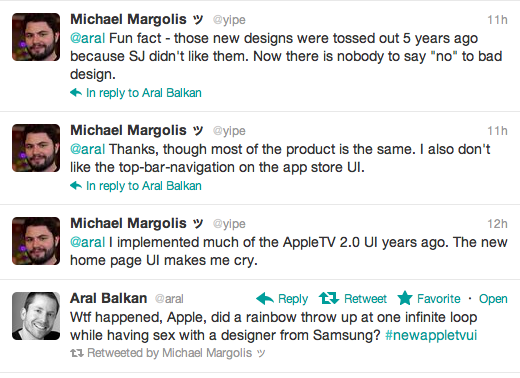
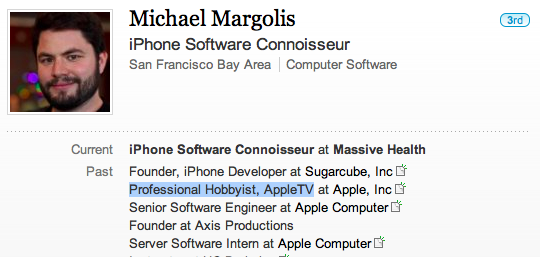
Former Apple TV UI designer and “Professional Hobbyist, Apple TV” Michael Margolis went vocal on Twitter (via Reddit) about the new Apple TV redesign last night. He says that Steve Jobs tossed out the new design five years ago. He adds, “Now there is nobody to say ‘no’ to bad design.”
.
The “new” Apple TV design received some mixed reviews, but most people appreciate the updated look and feel. The negatives, however, seem to focus on Apple’s limited access to services like Hulu, Amazon, VUDU, and other streaming services.
Apple is widely expected to release a full Apple HD product in the coming year. Jobs told biographer Walter Isaacson that he cracked the code to the TV, but it does not appear that Apple has yet implemented that vision.
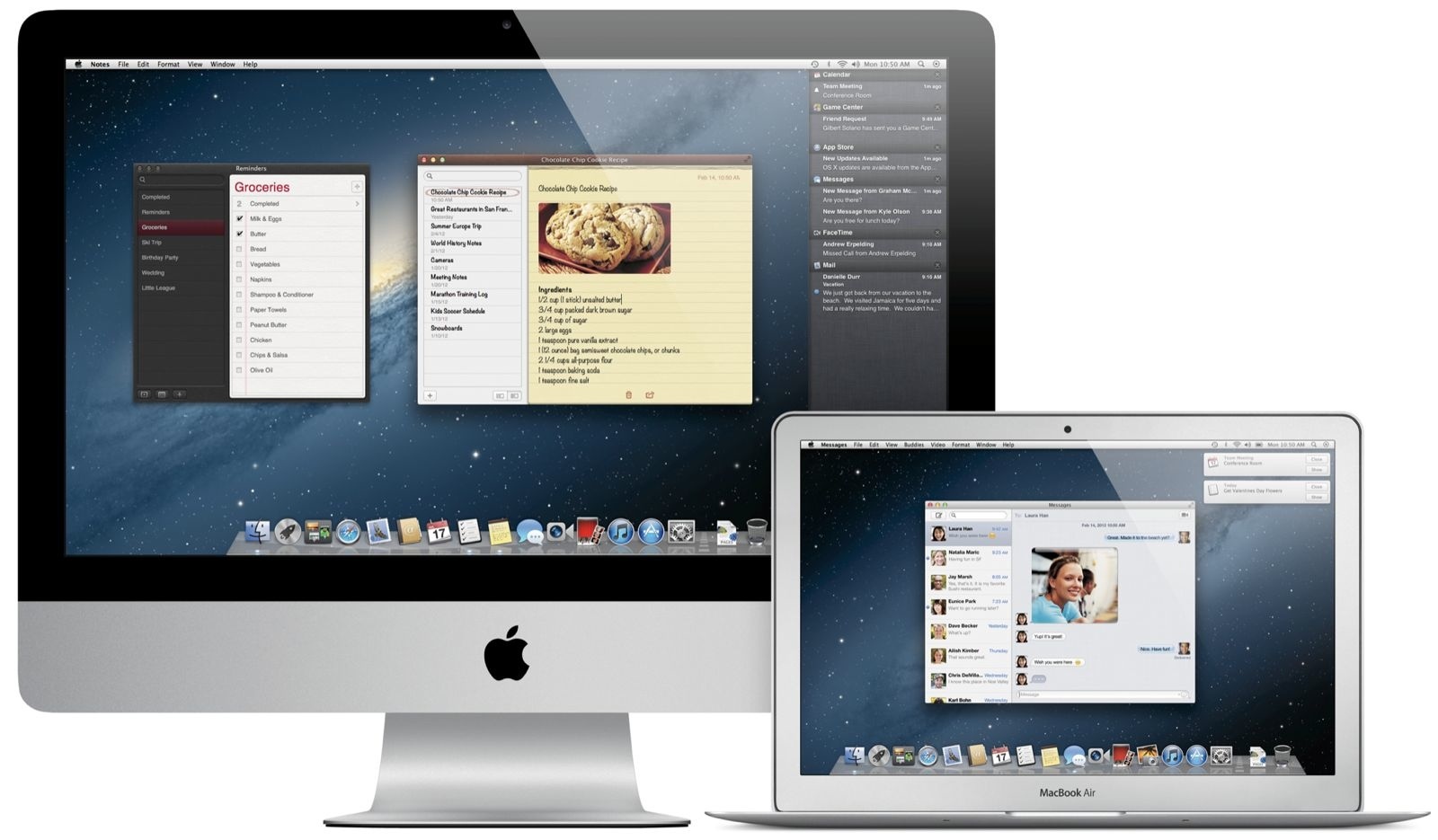
It has been clear for a while now that iOS devices are not the only Apple products to benefit from Retina displays. The Mac OS has teased us for a while with HiDPI Retina images, and the most recent is the inclusion of 2X images in Messages in Mountain Lion.
Contrary to the recent larger-screen iPhone rumors, iMoretoday says Apple is scheduled to release a 3.5-inch LTE iPhone in October of this year.
Similar—if not same-size—screen (currently 3.5-inch, but not set in stone).
4G LTE radio
New “micro dock” connector
Fall/October 2012 release
The timing of Apple’s new iPhone is also under question with iLounge, and then our sources put the release closer to summer. The new docking connector, or “new way to charge the iPhone,” was first reported by the Wall Street Journal and has since been reiterated in various ways. A micro-dock could manifest itself into something like a standard Micro-USB port. With the direction of technology heading to Wireless and iCloud more and more, going to the standard Micro-USB may make a lot of sense.
LTE is already a forgone conclusion at this point, but it will be interesting to see if Apple pursues the smaller, next-gen chips put out by Qualcomm or the current generation of chips that the new iPad enjoys.
9to5Mac readers seem to be in favor [see poll numbers below] of a bigger iPhone screen; although, making it much larger without increasing the amount of pixels would seemingly veer from Apple’s “Retina display” trend. Meanwhile, only 15 percent favor the current iPhone display size or shrinking it further.
MiYoung Kim of Reuterswrote a great profile of Samsung’s head mobile designer Lee Min-hyouk, a 40-year-old senior vice president. Some notables:
[Samsung’s] strategy has always been to be the “fast executioner”, the first in the market with a copycat product when a new opportunity is presented. But it is not known as a great innovator or a company like Apple that can literally create a new market with an iconic product.
Lee, who has acquired the moniker of “Midas” for his golden touch with the Galaxy series, has travelled to Brazil’s Iguazu Falls and the ancient city of Cuzco in Peru for inspiration. Samsung sends the design team on such trips across the world to stoke their imaginary fires. Images or emotions they pick up on these trips can be “naturally expressed in design languages or lines and colors”, said Lee, who started out designing cars for Samsung’s failed auto joint venture with Renault in the 1990s.
“I might not be at (Ive’s) level yet, but I believe Samsung will produce such iconic products one day. It’s not just effort that makes it possible for a new product to be a massive hit. It also has to be timely, and technology should be ready to make a certain design a reality.”
Still, Lee takes offense to the charges that the Galaxy line is an Apple copy, claiming: “I’ve made thousands of sketches and hundreds of prototype products (for the Galaxy). Does that mean I was putting on a mock show for so long, pretending to be designing?”
“As a designer, there’s an issue of dignity. (The Galaxy) is original from the beginning, and I’m the one who made it. It’s a totally different product with a different design language and different technology infused,” Lee contended.
We reported this week that Adobe was “wrapping up CS6 development and that a public beta was launching soon”. The review embargo has just lifted and the beta is out.
Apple has decided on the bigger 4.6-inch display for its next iPhone and started placing orders to its suppliers, the Maeil Business Newspaper said, quoting an unnamed industry source.
Samsung’s Galaxy Nexus and HTC’s upcoming HTC One both have 4.6-7 inch 720P displays. The Galaxy Nexus has a 316 PPI which is in Apple’s “Retina Threshold” but is a whole other 16:9 ratio.
Samsung, which is also the biggest challenger to Apple in smartphones, uses 4.6-inch OLED display for its flagship Galaxy S II smartphone, introduced in April last year.
Galaxy IIs have displays ranging from 4.3 to 4.5 inches.
We’re not putting a lot of faith in this report, even though we’ve heard that Apple has been considering a bigger display in its next iPhone.. Perhaps Apple is playing a joke on someone.
We polled readers on their screen size preference for the next iPhone. Results of 60,000 votes, below:
Although Apple makes the vast majority of its money selling hardware, it still makes a healthy profit on its software. With hundreds of millions of iOS devices in the wild, each app sold has the potential for big sales.
Apple announced today that it sold its one-millionth copy of the $4.99 iPhoto [iTunes] in under 10 days. While sales have been relatively brisk, reviews are somewhat mixed.
Apple’s Senior Vice President of Industrial Design Jony Ive took particular pride in the app: “The iPhoto app we created for the new iPad completely consumes you and you forget you are using an iPad.”
Twice the LEDs: That means more heat coming from more LEDs. This is especially a problem at full brightness.
2.5X the power needed: The brightness efficiency is lower, because the new iPad has more pixels (which means more transistors) compared to the iPad 2. More pixels and transistors take up more space, meaning less opportunity for light to pass. “So they basically have to blast light through the LCD to make it come out.” Soneira adds: “I measured the LED power at maximum brightness–it’s two and a half times greater than on the iPad 2.”
Battery generates more juice: The battery has to push out more power. This makes the battery warmer.
Traditional LCD technology: Sharp’s power-efficient IGZO technology was not ready for the new iPad, which forced Apple to use traditional —and less power efficient— amorphous silicon tech. [To be fair, the older iPads also used this tech. Perhaps Apple was hoping to go 100-percent IGZO to offset the above].
The biggest heater in the new iPad is the new processor that has four graphics cores. If you look at the heat maps Consumer Reports and Tweakers did, the center of the heat is right where that A5X sits on the left side of the device.
As a bonus, do not forget those hot and schweaty Qualcomm LTE chips that bring the “faster than home broadband” goodness directly to your 4G iPads.
With all the above said, it is a minor miracle Apple managed to keep temperatures within 10 degrees to 15 degrees of the earlier versions.





 .
.

 .
.