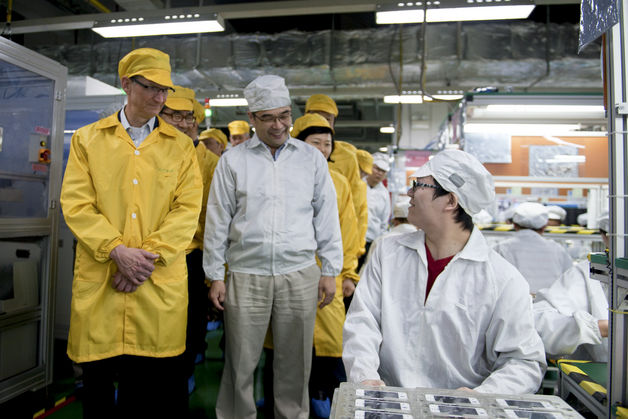
Apple updated the iPhone 5 section of its online store to show shipping estimates for the handset have improved from “3 -4 weeks” to “2 -3 weeks”. The iPhone 5 has seen shipping delays since it first went on sale in late September due to high demand and problems in production. Today’s improvements follow official word from Foxconn in October that production for the iPhone 5 has improved. Foxconn said the iPhone 5 is “the most difficult device that Foxconn has ever assembled,” and it added production is getting better day-by-day. During Apple’s Q4 earnings call, CFO Peter Oppenheimer said, “We’re working very hard to get more into customer hands as quickly as possible.” CEO Tim Cook added, “The demand for iPhone 5 is extremely robust. We are in a significant state of backlog.”
According to a report from Reuters, citing a statement from Foxconn Chairman Terry Gou, Apple’s assembler is having a hard time keeping up with iPhone 5 demand. Gou confirmed previous rumors that the company is indeed “falling short” of meeting supply for iPhones and its other unit, Foxconn International Holdings, is assisting with production:
“It’s not easy to make the iPhones. We are falling short of meeting the huge demand,” Foxconn Chairman Terry Gou told reporters after a business forum.
Following the launch of the iPhone 5, reports claimed employees at Foxconn’s Zhengzhou plant went on strike over quality control concerns and lack of training. The same quality control issues were linked to scratching found out of the box on some iPhone 5 units, but it’s unclear how much these setbacks have contributed to iPhone 5 delays. Another unnamed executive speaking to The Wall Street Journal last month said the iPhone 5 is “the most difficult device that Foxconn has ever assembled. To make it light and thin, the design is very complicated.”
To speed up production of new iPhones, specifically the production of display components, Reuters suggested Apple could provide cash incentives to Sharp, one of its keep suppliers that was thought to have contributed to initial low supplies. Following rumors yesterday that Apple might even be considering making further investments in the failing company, Asymco’s Horace Dediu (via Fortune) speculated today that a $2.3 billion discrepancy in Apple’s 2012 financials might have already went to Sharp: Expand Expanding Close
According to a report from IDG, Sharp has not so surprisingly announced in its recent earnings report there is “‘material doubt’ about its ability to continue operating.” While Apple’s manufacturing partner Foxconn previously agreed to buy an 11-percent stake in the company, today’s report noted those negotiations continue to drag on and risk falling through as Sharp’s stock price continues dropping. To turn the company around, rumor has it Sharp will focus on its IGZO technology and displays for smartphones and tablets, while possibly seeking investments from Apple in the process:
Sharp added, however, that it still believes it can cut costs and secure enough credit to survive. Its IGZO technology for mobile displays is likely to be a key element of its business strategy…The company, whose stock has been downgraded to junk status by ratings agencies, continues to seek investments from outside companies, with media reports in Japan linking it to companies including Apple and Intel.
As far back as November 2011, Apple was rumored to invest in Sharp’s display factories in Japan. Earlier reports indicated Sharp’s IGZO displays could possibly be used in Apple’s new 7.8-inch iPad mini, but recent teardowns of the device confirm Apple is using display components from Samsung, LG, Display, and AU Optronics. Sharp, however, remains a key Apple component supplier, and it recently confirmed it is back to producing “adequate volumes” of iPhone 5 displays after facing weeks of delays leading up to the device’s launch. In August, a report from Reuters suggested Apple could provide Sharp with financial incentives to speed up production and help with high costs cutting into the company’s margins on displays.
Sharp recently announced its first tablet to use the IGZO display technology. The displays are expected to go into mass production by the end of the year, so it’s certainly possible next generation iPads could take advantage.
The Wall Street Journal spoke with an unnamed Hon Hai executive today about why the iPhone 5 is experiencing supply shortages, and the Taiwanese manufacturer, also known as Foxconn, apparently blamed it on the smartphone’s complicated design and its subsequent assembly process.
“The iPhone 5 is the most difficult device that Foxconn has ever assembled. To make it light and thin, the design is very complicated,” said the executive to the Wall Street Journal. “It takes time to learn how to make this new device. Practice makes perfect. Our productivity has been improving day by day.”
The official did not wish to be named, but he admitted Hon Hai is attempting to better production capacity while apply more procedures to alleviate the reports of damages such as scratches to the iPhone 5’s metal casing.
MacRumors points to a WeiPhone.com forum thread [Google translation] this morning that purports to show details of a new iMac. The poster’s brother-in-law apparently works in the factory that builds the new Macs, and he snapped the above picture on his cell phone. The design was verified by iFixit to be similar to the internals of a current iMac with the plastic radio-transparent circle on the rear.
On the iMac, the poster says:
It should be announced this month or next month (likely at the Oct. 23th announement)
The design is of”epoch-making significance”
From side to side you “almost cannot see the new iMac’s thickness” and it is compared to a drop of water and “tetragonal” elements. Still has iMac ‘chin’ below display
It appears that the display is a “very pretty special glass glued directly” (perhaps like Retina MBP) to the machine rather than a separate display assembly
The 21-inch might be ready before the 27-inch
The more expensive iMac and redesigned screen might hint at Retina. However, strangely, the poster does not mention anything related to this.
The 13-inch Retina MacBook Pro:
Codenamed D1 (Which fits with Product D2 for the 15-inch Retina MacBook Pro)
Is seeing delays due to thermal issues
Interestingly, the poster mentions the 15-inch Retina MacBook Pro, aside from being produced in Mexico, will see a silent update for screen blur and cooling improvements.
In another post, the poster talks about trouble with the glue and Foxconn.
My uncle told me the newly launched products will have a lot of problem. This is because Tim Cook changed the way Steve Jobs used to do things which is having multiple suppliers. The problem with one sole supplier. Obvious example Foxconn!
Now a lot of more capable supplier is under Foxconn, other smaller supplier just can\’t cope with the demand. The new iMac is using a special \”glue\” to glue the display to the frame and is facing very strict quality control.
Products from Foxconn is having a lot of issues. In this case, after the glue dried, there will be minor air gaps. Apple had no choice but to use Foxconn because most of the capable manufacturer is now all under Foxconn. Therefore defects of the iPhone 5 is not that hard to understand(because Foxconn makes them all).
Although it isn’t going to change your life, it looks like a few iPhone 4s are coming off the assembly line with reversed volume buttons. Reader Eric sends us his which he says works like it should if the buttons were reversed.
Fast-forward a year:
.
Thanks Donut Bandit!
Those fine folks at Foxconn might have missed this one.
As noted by InsideFacebook, Facebook recently picked up former Apple employee Chris Weeldreyer as its new product design manager. Weeldreyer previously worked as the UI Design Manager at Apple for over eight years since joining the company in November 2003. According to his Facebook page, he officially started his new role at Facebook on June 18, 2012.
In May, the New York Times reported Facebook “has already hired more than half a dozen former Apple software and hardware engineers who worked on the iPhone”and tied it the old Facebook phone rumor.
As for Weeldryer’s work at Apple, he certainly worked on at least iWeb. He is listed as an inventor on several Apple Inc.-filed patents including iWeb for iPad, multi-touch and gesture-related inventions, as well as a number of security related patents. Weeldryer’s LinkedIn lists his specialties as: industrial design, interaction design, user interface design.
As you can see from the image above, TIME magazine’s cover story that hits newsstands tomorrow for both the U.S. and international editions is titled, “Made in China: Why Apple’s future depends on the world’s biggest market”. While noting increasing iPhone sales in China, Taiwan, and Hong Kong greatly contributed to Apple’s record earnings of $39.2 billion and ($7.9 billion for Greater China) reported in April, TIME’s Hannah Beech questions, “How much longer will an increasingly nationalistic government allow foreign companies like Apple to profit so handsomely on its shores?” The full story titled “The Cult of Apple in China” is available to TIME subscribers here. An excerpt is below:
The vast majority of Chinese aren’t up in arms about labor conditions at Apple’s supplier factories. A cluster of suicides by Foxconn workers a couple of years ago elicited much more coverage in the West than in China…. Yet Foxconn keeps signing on new workers, even though many other companies complain of labor shortages as Chinese youth increasingly eschew factory work. (Apple runs educational programs for workers in supplier factories.)… Even after all the criticism of Foxconn—the suicides, the industrial accidents, the punishing hours—young Chinese still want a job making Apple devices…
…Apple’s relationship with the People’s Republic embodies some of the global economy’s brightest opportunities but also its thorniest dilemmas. An American tech giant must decide how much to adapt its practices in a faraway land. Should Apple represent the best of the West in the Middle Kingdom, or must it conform to the less salubrious way China Inc. operates? From China’s side, how much longer will an increasingly nationalistic government allow foreign companies like Apple to profit so handsomely on its shores? Caught in the middle are 1.3 billion Chinese whose toil in factories and taste for luxury products will dictate the future of the world’s marketplace.
According to several local reports, Foxconn’s Terry Gou made some pretty bold statements at Hon Hai Precision’s annual meeting of shareholders on Monday. While there are a few translations, all seem to claim Gou urged customers to wait for the iPhone 5, “saying that the new model will put Samsung’s Galaxy III to shame.” A report from Focus Taiwan quoted China Times:
Gou said he has made it a lifetime goal to defeat Samsung — “a company with a track record of snitching on its competitors.”… He was referring to Samsung’s action in 2010 of snitching on four Taiwanese companies in an investigation by the European Commission on price-fixing in the flat panel industry…Samsung was exempted from the investigation by serving as a “tainted witness.” … Gou also urged consumers to wait for the launch of Apple’s iPhone 5, saying that the new model will put Samsung’s Galaxy III to shame.
Gou also apparently claimed that Foxconn’s Sakai plant “has an exclusive agreement with Corning Inc., an American manufacturer of glass, on large panel supply,” and his “competitors will not be able to secure any such material if they wished to.” We are going to wait to see if Foxconn issues a statement regarding these quotes, because we know a couple of stories in recent months misquoted Gou… Expand Expanding Close
We covered iFixit’s Retina Display teardown this morning, but the report left out one very important detail: Who makes the display? There had been some discussion by DisplayMate’s Raymond Soneira on whether Sharp’s IGZO display technology was used:
An IGZO Retina Display? Traditional high PPI displays (with amorphous Silicon) are inefficient with both brightness and power. As a result, the new iPad 3 with a Retina Display needs a 70 percent larger battery than the non-Retina Display iPad 2, but the MacBook Pro with Retina Display has only a 23 percent larger battery with the same 7 hour running time as the non-Retina Display MacBook Pro. How can this be? You may recall that IGZO technology has been making headlines for months, first rumored to be the technology used in the Retina Display for the new iPad 3. IGZO is significantly more efficient than amorphous Silicon. It wasn’t ready in time for the new iPad 3, but Sharp announced that production of IGZO LCDs with up to 300 PPI started in March of 2012… Just in time for the MacBook Pro… These facts lead me to speculate that the MacBook Pro is using a Sharp IGZO Retina Display…
Apple, Sharp, and Foxconn are rumored to be working together on something bigger as well.
We reported earlier this month that Foxconn announced it would share the initial costs of improving iPhone and iPad assembly plants with Apple following an agreement to improve working conditions based on recommendations from the Fair Labor Association. Today, according to a report from Reuters, labor watchdog Student & Scholars Against Corporate Misbehaviour released a report claiming Foxconn factories have not changed much since the FLA’s audits:
A fresh report released on Thursday by labor watchdog Student & Scholars Against Corporate Misbehaviour (SACOM), based on visits to several Foxconn factories and 170 worker interviews, found rights violations “remain the norm” including high production targets, inhumane treatment and signs of overall salary cuts.
“The frontline management continue to impose humiliating disciplinary measures on workers,” it said.
“The above findings demonstrate that Apple and Foxconn have not turned over a new leaf,” the report added.
Even after recently raising wages of some workers by 16 to 25 percent, Reuters’ report claimed average overall salaries decreased and some “had to work unpaid overtime after pay hikes.” A Foxconn worker in Guanlan told Reuters: “The work pressure is still great… There hasn’t been much change. We are still being pushed very hard.”
Foxconn responded to the SACOM report in a statement to Reuters:
“The welfare of our employees is without a doubt our top priority and we are working hard to give our more than one million employees in China a safe and positive working environment,”
Reutersreported today, while citing Japanese business daily Nikkei, that Sharp will supply its technology to Hon Hai for a new Foxconn plant that will produce panels for devices like Apple’s iPhone. The move follows an investment from Foxconn’s parent company Hon Hai Precision in March, which agreed to buy 46.48-percent of Sharp’s LCD plant in Japan and $844 million in new shares for an 11 percent stake of the company.
TOKYO (Reuters) – Japan’s Sharp Corp will supply technological know-how to Taiwan’s Hon Hai Precision Industry Co for a plant in China that will produce panels for Apple Inc’s iPhone and other consumer electronics products, the Nikkei business daily said on Thursday.
As for what technology Sharp will provide, the report only specified it will be “aimed at improving quality management” at a future plant in Chengdu. Sharp will reportedly receive “tens of billions of yen in fees” through the partnership, and it announced plans today to buy back Sony Corp’s 7.04-percent stake in its Sakai, Japan-based plant.
Update May 16, 2012: German publication Handelsblatt (via Bloomberg) quoted Chief Executive Officer Oliver Seidl of German TV manufacturer Loewe as saying the company has had “no contact” with Apple regarding an acquisition.
Less than a month after posting a false claim about Apple’s CEO Tim Cook visiting the Valve HQ, ole’ Danny Dilger claimed this weekend that Apple is moving to acquire a German TV manufacturer called “Loewe.” Again, we did not run with the story, because we preferred to mock it instead via Twitter. Not only has that story been debunked, but more allegations about Foxconn’s CEO Terry Gou having confirmed an Apple television are now being denied by the company. Oh, and Digitimes’ track record…
A Foxconn executive allegedly claimed that his company is “making preparations” for an Apple television, but development and manufacturing has not begun. English-language daily newspaper China Daily(via How To Arena) quoted, well, summarized Foxconn Chairman Terry Gou on Friday:
Gou said Foxconn is making preparations for iTV, Apple Inc’s rumored upcoming high-definition television, although development or manufacturing has yet to begin.
iTV reportedly features an aluminum construction, Siri, and FaceTime video calling […]
Foxconn’s recent 50-50 joint venture factory with Sharp in Japan is one of the preparations made for the new device, Gou added.
The report refers to the device as “iTV,” which is a common name circulating for the Apple television set. Despite no official confirmation from Apple, rumors persist that the product is edging closer and could feature a host of appealing characteristics, such as the ones mentioned in the excerpt above.
Apple plans to improve work conditions at its iPhone and iPad-assembling Chinese factories, and Foxconn executives announced today that it would share the initial price of that venture with the Cupertino, Calif.-based Company. According to Reuters:
Foxconn chief Terry Gou did not give a figure for the costs, but the group has been spending heavily to fight a perception its vast plants in China are sweatshops with poor conditions for its million-strong labor force. It regards the criticism as unfair.
‘We’ve discovered that this (improving factory conditions) is not a cost. It is a competitive strength,’ Gou told reporters on Thursday after the ground-breaking ceremony for a new China headquarters in Shanghai.
‘I believe Apple sees this as a competitive strength along with us, and so we will split the initial costs.’
It was unclear if the split would be 50/50 or in some other ratio.
Apple and Foxconn began bettering conditions for workers earlier this year by raising wages in mid-February from 16 percent to 25 percent, and then they hired thousands of new laborers the next month to reduce overtime in the factories.
The ever-sketchy DigiTimes does not have the best reputation when it comes to predicting Apple product launches, but today the publication is reporting Apple OEM Pegatron began receiving orders for a new iPhone and a next-generation 10-inch iPad. It also reported Apple plans to release a 7-inch iPad in August:
Pegatron Technology reportedly has landed orders for a new-generation iPhone to be launched in September and a 10-inch iPad to be launched in the fourth quarter, according to Taiwan-based supply chain makers. Pegatron is currently an OEM for the iPhone 4S and new iPad… A 7-inch iPad, which reportedly will be released in August, will be manufactured by Foxconn Electronics (Hon Hai Precision Industry).
With the release of Apple’s new iPad last March, we find it hard to imagine Apple plans to break its yearly release window with a new 10-inch iPad, in addition to a 7-inch variant in August. We heard many rumors lately about a 7-inch or 7.85-inch tablet, indicating Apple could be experimenting with smaller screen sizes. In April, a translated report from a Chinese publication claimed Apple was prepping 7.85-inch iPad minis to launch in Q3 for $250 to $300, but we have not heard anything concrete on Apple’s plans to release a 7-inch tablet. As for iPhone, we are still expecting an October launch at this point. Expand Expanding Close
Newspaper Jornal de Jundiai reports that workers at the plant will strike if issues surrounding severe water shortages, food, and transportation of employees are not resolved… In a statement the United Steelworkers of Jundiaí and Region said workers decided to give 10 days (from the Monday) for the company to resolve the issues raised in a meeting on Monday… According to the report by Jornal de Jundiai, a spokesman from the union said that lack of water as well as poor quality food was an issue for workers. As the number of employees at the plant grows, workers also complain that the infrastructure for transport has remained the same size, causing overcrowding in buses. Expand Expanding Close
According to a report fromThe Oregonian, power amplifier specialists TriQuint Semiconductor is facing a “challenging” quarter due to a temporary drop in revenues from its biggest customer, Apple. The report noted the company’s CEO Ralph Quinsey did not mention Apple by name, but that Foxconn was responsible for 35 percent of TriQuint’s revenue during 2011:
TriQuint said sales in the current quarter will fall at least 19 percent to the lowest point in at least two years… While Quinsey wasn’t specific about where the problem lies, Apple has incorporated TriQuint chips in the last several generations of the iPhone. Apple is approaching its annual iPhone upgrade — the last upgrade took place in October — and sales tend to fall off before new products launch.
We know from teardowns that Apple included TriQuint chips in many generations of the iPhone and iPad, including the most recent iPhone 4S and third-generation iPad. When iPhone component supplier Qualcomm announced last week it was having “trouble meeting demand” for LTE chips likely to end up in a next-gen iPhone, many analysts speculated that was a clear indication of an October iPhone launch.
Quinsey said in a statement to the publication that he expects to return to normal revenue and growth numbers in the second half of this year:
“I believe this dip will be temporary and remain confident about our long term position,” Quinsey said in a written statement. “We have achieved design win success with our new products and I believe we will return to normal revenue levels and growth in the second half of 2012.”
Marketplace reporter Rob Schmitz is the second reporter ever to get an inside look at Foxconn, the manufacturing plant where Apple’s products are made. Today, Schmitz posted a video showing our first-ever look at the assembly process of an iPad as it goes down the assembly line at the Foxconn plant in Shanghai, China. It is interesting to look at how machines streamline some of the process. Schmitz also noted a few other interesting points, such as workers switching positions every few days while making $14 a day when first starting.
A Japanese TV crew approached a booth at the Foxconn plant in the suburbs of Taiyuan in Shanxi Province and asked a woman manning the booth about the 18,000 people Foxconn is recruiting for the next iPhone (video here at 7:10 via Macotakara). She said something about “being built for June.”
That plant is hiring many workers (and facing strikes from current workers) for iPhone production, according to local reports.
While she seems to imply that Foxconn is ramping up for a June production or release (or it may not), we are not convinced this is a credible source with knowledge of Apple’s plans.
The results of the Fair Labor Association’s investigation into Apple’s suppliers beginning with three Foxconn facilities officially published yesterday. While finding excessive working hours and many violations of Chinese labor law, Foxconn and Apple agreed to reduce workweek and overtime hours within Chinese law to 49 hours per week and 36 overtime hours per month based on the FLA’s recommendations. Foxconn will also hire tens of thousands of new employees and implement a compensation package to make sure workers’ salaries remain the same amid reduced working hours.
In the interview above withReuters, head of the FLA Auret van Heerden talked about the investigation and noted the agreement could set a new standard for working conditions throughout China. One unanswered question is whether the agreement will lead to higher prices for consumers (which is not necessarily a bad thing)…
We knew the Fair Labor Association would publish the initial findings of its investigation into Apple’s Foxconn facilities, and now the report is officially available through the organization’s website. The full report released today and is here. The press release outlining the investigation is below. According to the recommendations, Foxconn committed to “bring its factories into full compliance with Chinese legal limits and FLA standards on working hours by July 2013.”
The last we heard from the FLA about its audits into Apple’s Foxconn facilities was that it found “tons of issues.” Apple became the first technology company accepted as a member into the organization after controversies surrounding working conditions in Apple’s supply chains abroad became mainstream. As for what the FLA found in its audits of the three Foxconn facilities, here is an excerpt from the report:
FLA’s investigation found that within the last 12 months, all three factories exceeded both the FLA Code standard of 60 hours per week (regular plus overtime) and the Chinese legal limits of 40 hours per week and 36 hours maximum overtime per month. During peak production periods, the average number of hours worked per week exceeded 60 hours per worker. There were periods in which some employees worked more than seven days in a row without the required 24 hours off.
The FLA said Foxconn’s commitment will “reduce working hours to legal limits while protecting pay, improve health and safety conditions, establish a genuine voice for workers, and will monitor on an ongoing basis to verify compliance.” This will lead to a maximum 49-hour workweek, including overtime for employees and a decrease in monthly overtime from 80 hours to 36 hours. While we reported some workers were unhappy with working fewer hours, Foxconn also committed to a compensation package for workers with reduced overtime:
With all the controversy surrounding Apple’s supply chains abroad, Foxconn, one of Apple’s biggest partners responsible for assembling the majority of its products, has received the brunt of criticisms. We already know what the Taipei-based assembler thought about Mike Daisey’s fabrications of working conditions at Foxconn plants, but today we get another first hand account from an actual Foxconn employee.
A report fromChina Business News(via MIC Gadget) profiled Foxconn worker and iPad assembler Wang Xiaoqiao (who opted to hide his real name). According to Wang, iPad line workers are beginning to work fewer hours and get more days off as supply meets demand. Wang said iPad production was ramped up in March, bringing assembly time from 10 hours a day down to 8 hours. However, he is not happy about working less. Wang explained:
In a statement to Businessweek, Louis Woo, spokesman for Taipei-based Foxconn said:
“I am happy that the truth prevails, I am glad that Mike Daisey’s lies were exposed. But I don’t think that the reports about this have gone far enough to find out what exactly is the truth. People will have the impression that Foxconn is a bad company, so I hope they will come and find out for themselves,”
Daisey was exposed via an NPR reporter that contacted his translator Cathey Lee who denied just about every part of Daisey’s story. Daisey, for his part, responded:
I stand by my work. My show is a theatrical piece whose goal is to create a human connection between our gorgeous devices and the brutal circumstances from which they emerge. It uses a combination of fact, memoir, and dramatic license to tell its story, and I believe it does so with integrity. Certainly, the comprehensive investigations undertaken by The New York Times and a number of labor rights groups to document conditions in electronics manufacturing would seem to bear this out.
Daisey has been forced to stop his show but did receive a standing ovation following its last performance this weekend.