iMac

See All Stories
iMac

Originally released in 1998. the iMac ($1,099 and up) started life as Apple’s fun all-in-one computer, evolving into a more serious “right for practically everyone” option over time. For Pro users, there is also an iMac Pro model as well.

Apple first introduced the aluminum iMac in August 2007 with 20-inch and 24-inch options. This was a major update compared to the previous plastic design of the machine, which was available in 17″, 20″, and 24″screen sizes between August of 2004 and August of 2007. The mid-2007 model, however, was only a stepping stone. Despite featuring an aluminum front-face, it still featured a back casing made of black plastic, which was a stark difference from the sleek aluminum front.

In 2009, Apple released a new lineup with aluminum unibody design in 21.5″ and 27″ screen sizes – introducing the two screen sizes that are still in use today. This design has ended up shaping the future of the iMac, with Apple focusing on revising it rather than completely redesigning.

In October 2012, Apple redesigned the iMac with an ultra-slim side profile and removed the SuperDrive. While the thinnest point measures 5mm, there’s still a bulge in the back to accommodate the iMac’s internals and cooling system. In 2015, the iMac was upgraded with a Retina display upgrade option.

In March of 2019, Apple released a minor upgrade to the 4K and 5K iMac lineup. The updates include new 6-core and 8-core Intel CPUs with Radeon Pro Vega graphics options.

The 21.5-inch iMac starts at $1299. The base model includes a 3.6GHz 8th-generation Intel i3 processor, 8 GB RAM, a 1 TB hard drive, and Radeon Pro 555X graphics.F or $1799, the base model 27-inch iMac includes a 3GHz 6-core 8th-generation Intel i5 processor, 8 GB RAM, 1 TB Fusion Drive, and a Radeon Pro 570X GPU. The Radeon Pro Vega 48 GPU upgrade costs $450 build-to-order, and is not offered on any base iMac configuration. The iMacs continue to feature spinning hard drives as the default with upgrade options for Fusion Drives and Flash storage.

Apple also sells a $1099 low end of the iMac, but it doesn’t include a 4K display and includes an older processor. For your money, it’s recommended to get at least the $1299 model. If you are considering any upgrades, the 256 GB flash storage upgrade will go a long way at improving long term durability and speed.

If you are looking to mount your iMac on a wall, Apple offers a model with a VESA compatible stand for a $40 upgrade.

If you are looking for the latest deals on Apple’s iMac, check out 9to5Toys.com

Need extra cash to upgrade? Sell your old Apple devices to 9to5Mac’s trade-in partner.

27-inch iMac with 3TB Fusion Drive can’t yet do Boot Camp, early adopters frustrated

Site default logo image

As customers begin receiving the new iMac this month, business-end users and gamers may find one issue when booting up their new machine. As reader Michael Verde first shared with us, the built-to-order 27-inch iMac configuration with a 3TB Fusion Drive (an extra $400) will not allow any Boot Camp use. This essentially cuts off access to a full Windows experience that some Mac users may want to benefit from. Many might consider this a bummer, as a sizable amount of users turn to Boot Camp to access necessary Windows programs or just simply enjoy Windows paired with Mac hardware.

Apple highlighted the issue on both its iMac configuration and Fusion Drive explanation page. “Boot Camp Assistant is not supported at this time on 3TB hard drive configurations,” Apple said in buried text. “At this time,” could mean the feature is enabled down the road in a software update, but it is non-existent as of now.

There are virtualization solutions, such as Parelles and VM Ware, that provide a Windows experience, but they do not offer a full experience that many may want. Boot Camp users include gamers who want to run games at full settings and business users looking to use specific business apps in a full Windows environment.

Right now it is not clear what the cause is, or if it has anything to do with Apple’s new Fusion Drive technology, but it seems that Boot Camp is limited to hard drive with less than 2TB of space (PC World has a good explanation for this). Announced in October and shipping in the new Mac Mini and iMacs, the top Fusion Drive configuration provides 128GB of flash storage coupled with 3TB of HDD space. The cheaper configuration, 128GB Flash Storage + 1TB HDD, supports Boot Camp. So, we have to wonder: what is holding back the more expensive configuration? We reached out to Apple for comment.


Expand
Expanding
Close

Site default logo image

Apple releases iMac EFI Update 2.0 bringing general fixes to sleep and Thunderbolt

Apple has released an update to the late 2012 models of the iMac, that owners will sure want to grab. The iMac EFI Update 2.0, weighing in at 4.32MB, brings general performance fixes to sleep and Thunderbolt, and additionally improves the compatibility when using 5GHz band Wi-Fi. As always you can grab the update directly from Apple or via Software Update. [Apple]

Don’t miss: Apple releases Mac Wi-Fi Update 1.0 improving 5GHz band compatibility


Expand
Expanding
Close

First round of 27-inch iMacs expected to arrive as soon as Dec.13

Site default logo image

Earlier today, a number of customers who ordered the new 27-inch iMac when it went on sale on Nov. 30 started receiving notifications from Apple that their orders have now shipped. Apple quoted estimated delivery dates for these customers ranging from Dec. 18 to the end of the month. However, it appears some might even receive their new iMacs earlier with one 9to5Mac reader receiving an estimated arrival date of Dec. 13.

Apple changed the availability estimates for new 27-inch iMac orders on its website last week from “3-4 weeks” to “January”, indicating some new orders might not be available to ship until the end of next month. Unlike some of the new 21.5-inch iMacs originating from Fremont in the United States, many report orders of the 27-inch models as shipping from Shanghai, China.


Expand
Expanding
Close

Site default logo image

Apple says new 27-inch iMac orders will ship in January

Earlier this month, Apple started pushing back the estimated shipping times for its new line of 21.5-inch and 27-inch iMacs. Apple CEO Tim Cook previously warned prior to the launch of the new lineup that the company expected significant delays leading into the holidays. While the 21.5-inch iMacs are still listed at “7-10 days” on at least Apple’s United States and Canada online stores, the 27-inch model is now listed as shipping in “January”. Apple previously displayed “3-4 weeks”.  While we are obviously now only three weeks out until January, the change could mean further delays for the new iMacs and possibly shipments late into January as opposed to at the start of the month.

Is there some secret iMac assembly plant in the US?

Site default logo image


iFixit

From iFixit’s ritual iMac dismemberment yesterday, we learn that the particular 21.5-inch iMac they bought says it was “Assembled in USA”. The moniker isn’t new—we’ve seen it since at least a few iMac models back on the packaging. But as far as we can tell, “Assembled in USA” wasn’t etched in the actual machine’s aluminum, leading people to believe that the iMacs that were shipped were “refurbished in the USA”. However, this forum shows that some were actually assembled and sold new with the “Assembled in USA” label (below—27-inch iMac, previous gen).

Regardless of previous endeavors, Apple is shipping new iMacs “Assembled in USA”.  PED at Fortune found one. Jay Yarrow at BI found one, too. This isn’t an isolated incident. We also heard that other new iMacs say “Assembled in China”, as you’d expect.

Still, it makes for an interesting question:  Is Apple building some of its iMacs in the United States? Is that percentage growing since it seems much of the first line of iMacs are coming with USA labels?

The “Assembled in USA” label doesn’t just mean that foreign parts screwed together in the U.S. either. The U.S. Federal Trade Commission assumes that a “substantial transformation” must happen in the U.S. for the label to be used.

Specifically, the FTC states that the label “Assembled in the USA” should be the following:

A product that includes foreign components may be called “Assembled in USA” without qualification when its principal assembly takes place in the U.S. and the assembly is substantial. For the “assembly” claim to be valid, the product’s last “substantial transformation” also should have occurred in the U.S. That’s why a “screwdriver” assembly in the U.S. of foreign components into a final product at the end of the manufacturing process doesn’t usually qualify for the “Assembled in USA” claim.

Example: A lawn mower, composed of all domestic parts except for the cable sheathing, flywheel, wheel rims and air filter (15 to 20 percent foreign content) is assembled in the U.S. An “Assembled in USA” claim is appropriate.

Here’s where it gets more interesting. The FTC gives the specific example of a computer manufacture:

Example: All the major components of a computer, including the motherboard and hard drive, are imported. The computer’s components then are put together in a simple “screwdriver” operation in the U.S., are not substantially transformed under the Customs Standard, and must be marked with a foreign country of origin. An “Assembled in U.S.” claim without further qualification is deceptive.

That means one of two things: Either Apple or its contractors have some sort of significant manufacturing operations in the U.S., or it is being deceptive in its marketing (something that sadly, isn’t out of character)…
Expand
Expanding
Close

Apple’s 21.5-inch iMacs shipping time now up to 7-10 business days from 1-3

Site default logo image

Apple’s entry level configuration of the new 21.5-inch iMac is now shipping in 7-10 business days from Apple’s online store. That shipping time is up from the 1-3 business days that the product was quoted as shipping in yesterday. The 27-inch iMacs were initially said to ship in 2-3 weeks, but they have since been pushed back to 3-4 weeks for new orders.

Notably, 3rd party vendors like Amazon are still guaranteeing delivery by December 4th while MacMall says 5-7 days. Check for lowest prices/ship times on our iMacs product page.

Update: Both 21.5-inch iMacs are now up to 7-10 days for shipping.

Thanks @TLDToday! 


Expand
Expanding
Close

iFixit iMac teardown reveals dual mics, difficult RAM upgrades and glued LCD

Site default logo image

While we had some pictures of a brief teardown earlier this week, iFixit has now completed its ritual teardown of the new 21.5-inch iMac that officially went on sale on Friday.

Unfortunately, iFixit described the process as an “exercise in disappointment,” noting the iMac’s new thinner design introduces new hurdles for repairability. Most notably, the device’s glass and LCD are now glued directly to the iMac’s frame, while accessing the RAM, CPU, and hard drive will now mean having to remove the entire logic board:

The late 2012 iMac 21.5″ — code-named EMC 2544 — is an exercise in disappointment for us. We were quite worried when we saw that super-thin bezel during Apple’s keynote, and unfortunately we were correct: the glass and LCD are now glued to the iMac’s frame with incredibly strong adhesive. Gone are the lovely magnets that held the glass in place in iMacs of yesteryear.

A few things noted in iFixit’s highlights: a new rubber housing that “dampens the vibrations from the spinning hard drive,” a new single fan layout, dual microphones, and a 5mm thinner LG made display. Those are some of the highlights of Apple’s new design, but iFixit is scoring the new iMac as a 3 out of 10 (down from 7 last year) due to the many issues with repairability. Here are just a few:


Expand
Expanding
Close

New 21.5-inch iMac now available through Apple’s online store, 27-inch models ship in 2-3 weeks

Site default logo image

.

The eighth-generation iMac was announced at the company’s late-October media event, where Apple Senior Vice President of Worldwide Marketing Phil Schiller called it, “the most beautiful iMac we have ever made.” Right on track, the 21.5-inch iMac is now available on the company’s online store and is available across a slew of third-party retail stores this afternoon. The 27-inch model will ship starting in “2-3 weeks” in the United States and Canada, while overseas (Australia/EU is “15-19 days”) is looking at up to 20 days—making a Christmas delivery tight.

(MacConnection has the best prices: $20 off, while MacMall knocks $5 off but adds Parallels ($79.99 value) and configuration/financing options. B&H Photo, Amazon, and  Best Buy also seem to be getting some stock soon. iMac Product page prices updated daily!)
Expand
Expanding
Close

New iMacs go on sale in Australia as U.S. stores prepare for limited launch

Site default logo image

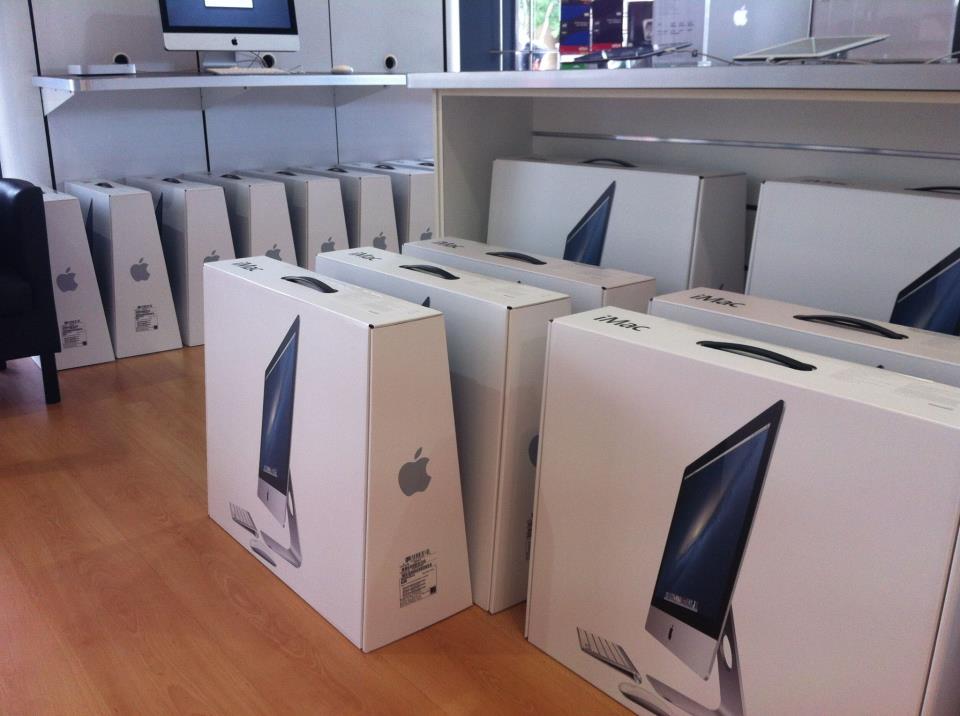
A reseller posted the image image to its Facebook page (thanks Westin)

According to Apple retail contacts, Apple’s thinner, redesigned 21.5-inch iMacs have begun arriving in small quantities to select U.S.-based Apple Stores, not to all stores, ahead of the Friday, November 30th launch. It is possible that stores that have yet to receive shipments will see their deliveries during the day tomorrow.

http://www.youtube.com/watch?v=_r3-pRIt51Y

The new 21.5-inch iMac will be available to order through Apple’s online store tomorrow as well per Apple’s announcement earlier this week.

Apple CEO Tim Cook previously said there would be iMac shortages into the new year:

On the iMac we’ll be constrained for the full quarter in a significant way… there will be a short amount of time to manufacturer and ramp those and i expect demand to be robust… we will have a significant shortage

Additionally, readers in Australia share that they have managed to purchase the computers at Australian stores this morning (seen in the image above). However, the new iMac is not on sale through the Australian online Apple Store yet.

The new 27-inch iMac will go on sale in December.

The new models include an all-new design with a complex manufacturing process, improved screen design, and a much thinner and light form-factor. The computer lacks an optical drive to make this happen.


Expand
Expanding
Close

Apple announces redesigned 21.5-inch iMac will be available Friday, November 30th; 27-inch models still on for December

After being unveiled in late-October, Apple has officially announced that the 21.5-inch iMac will become available this Friday, Nov. 30. The latest iMac is the eighth generation and “is the most beautiful iMac we have ever made,” according to Apple Senior Vice President of Worldwide Marketing Phil Schiller. It features a 5mm edge, edge-to-edge glass, LED-backlit display with IPS technology, a FaceTime HD camera, dual mics, four USB 3 ports, two Thunderbolt ports, OS X Mountain Lion, Bluetooth 4.0, and more.

The 21.5-inch iMac is available in two versions. The 2.7GHz quad-core Intel Core i5 model (Turbo Boost up to 3.2GHz) is available for $1,299, featuring 8GB of 1600MHz DDR3 memory, 1 TB (5400-rpm) hard drive, and a NVIDIA GeForce GT 640M graphics processor with 512MB of GDDR5 memory. The 2.9GHz quad-core Intel Core i5 model (Turbo Boost up to 3.6GHz) is available for $1,499, featuring similar specs, except a 1TB (5400-rpm) hard drive that can be configured into a Fusion Drive.

Apple also has a 27-inch version iMac on its way. As we reported earlier this month, the 27-inch version is still set to launch sometime in December, according to Apple. CEO Tim Cook has already discussed that the company is expecting shortages of iMacs. Our sources have indicated that the new iMac is in relatively short supply, mainly outside of the United States. Check out Cook’s comments below:


Expand
Expanding
Close

Site default logo image

Black Friday was bleak for Microsoft as Surface Tablet didn’t register a blip compared to iPad

Piper Jaffray analyst Gene Munster is out with a note today comparing foot traffic and sales per hour at Apple and Microsoft retail stores for Black Friday (via Fortune). Munster’s team apparently spent eight hours outside of the Mall of America Apple Store in Minneapolis to provide us with some good stats on how well Apple Stores did compared to the Microsoft Store at the same location. Munster found customers purchased 17.2 items per hour at the Apple Store, compared to just 3.5 products per hour at the Microsoft store. However, he also reported all but two of the Microsoft store purchases were Xbox titles.

During their eight hours at the Apple Store (and two hours at the Microsoft store), Munster’s team reported an average of 11 iPads per hour—compared to zero Microsoft Surface sales. Unfortunately, the chart above doesn’t track iPhones sales.

The positive take away was store traffic was up 31% y/y, likely driven by shoppers wanting to see the new iPad Mini. The negatives were that the most popular iPad Mini (16G) is in limited supply and Mac sales (~12% of revenue) continue to appear to be impacted by the iPad and a slowdown ahead of the new iMac.

Site default logo image

MacMall slashes prices on Apple products in their early Black Friday sale

From 9to5Toys.com:

.

MacMall starts its Black Friday early with discounts on a monster selection of Macs, hard drives, iPods, and more by up to $799 off.  Plus, all orders over $25 qualify for free shipping. We’ve already populated our new Apple Products section with all the new low prices so check them out.

Notables include AppleTV for $89, Retina MacBook Pros starting at over $100 off, MacBook Airs starting at $897.

That’s the biggest sale we’ve seen from MacMall this year. (We saw up to $675 off in February.) Deals ends November 24 at 3 am ET.

We’ll be updating 9to5Mac and 9to5Toys with deals this whole long weekend so stay tuned.


Expand
Expanding
Close

Announcement: 9to5Mac Apple Products pages

Site default logo image

.

It is the holiday shopping season again, and we know many of you will be looking to buy Apple- and Apple-related products this year. To help out, we’re compiling a new section of 9to5Mac called Apple products and separate sections for each of Apple’s lines. Elsewhere, we have seen buying guides, pricing guides, related news and predictions, but we’re wrapping them up into one page per product.

How it works:

1. With the help of our 9to5Toys editors, we’re finding the lowest prices on Apple products in the U.S. and keeping a matrix of the biggest retailers’ prices. Here’s the current static matrix of MacBook Airs.

2. For the last few months and going forward, every post we do on a related product will be propagated to the page so you’ll have a roundup of the latest information on each product line. Additionally, in every post on a topic, you’ll notice a new link to the product section on the right.

3. We’ll also have a record of Apple’s past updates on each product, which should help in estimating the next product cycle.

4. Finally, we have our best predictions on upcoming products from 9to5Mac’s editors headed by Mark Gurman.

Together—this information should help Apple product users and buyers make smart, informed decisions.

Enjoy!
Expand
Expanding
Close

Site default logo image

2012 Mac Mini found to support 450 Mb/s Wi-Fi

Past the new Fusion Drive, upgraded RAM, and speed, French publication Macg.co found the 2012 Mac Mini introduced in September also boasts upgraded Wi-Fi antennas. The upgraded antennas brings the desktop to a maximum Wi-Fi speed of 450 Mb/s, now up-to-par with the 2011 MacBook Pro and iMac.

Of course to reach 450 Mbits/s you need a router to support it, and luckily, both Apple’s latest Time Capsule and Airport Extreme. There’s also other factors such as room configuration, interference and so forth. As to why Apple isn’t advertising the speeds is unknown.


Expand
Expanding
Close

Site default logo image

Apple releases OS X 10.8.2 Supplemental Update 2 for 2012 Macs, fixing Keychain issues

Yesterday, we reported the 2012 Mac mini, Retina 13-inch MacBook Pro, and iMac were unable to update to OS X 10.8.2 after Apple pulled the first update from the App Store last Friday. Today, the folks in Cupertino have released their second supplemental update for OS X 10.8.2 that should allow those users to install the update. Additionally, Apple said the update “is recommended for all Mac systems introduced in 2012” and mainly “fixes an issue with Keychain that can affect 2012 Mac systems.” Grab it from the source link below, and let us know how the update experience fares in the comment section down south.

[Apple]
Expand
Expanding
Close

Apple’s redesigned iMac launches not delayed until 2013, still on track for November-December

According to our sources, Apple’s already announced plans for November and December launches of the redesigned 21.5-inch and 27-inch iMac lines are still on track. This refutes a report from French site MacBidouille which claimed that both the new 21.5-inch and 27-inch iMacs would see their respective launches delayed until 2013.

Our sources say that Apple is already shipping new 21.5-inch iMacs to its distribution hubs across the United States and several other countries across the world. These sources also expect the 21.5-inch computers to be available to order from Apple’s online store by the end of this month. It is also likely that the new models will reach Apple’s physical retail stores by the end of November. More details after the break:


Expand
Expanding
Close

Site default logo image

OWC is announcing a sub $100 16GB RAM upgrade. We go even further…

OWC today announced 16GB RAM upgrades for Mac mini, MacBook Pro, and iMacs all for just under $100, around a 66 percent savings compared to Apple’s own factory upgrade options. Full details on the new OWC upgrades are below, but we recently found a 16GB RAM upgrade for $60 on Amazon that will save you almost an extra $40 on top of OWC’s prices.

OWC is also offering Parallels Desktop 8 for Mac for $39 with the purchase of 16B Memory Upgrade Kits:

OWC Certified 16GB Memory Upgrade Kits:

Upgrades for all Mac mini models from $15.99
16GB Kit (8GB x 2) from $99.00 for maximum memory

Upgrades for all MacBook & MacBook Pro (non-Retina) models from $29.99
16GB Kit (8GB x 2) from $99.00 for maximum memory

Upgrades for all iMac models from $11.99
16GB Kit (4GB x 4) for 2009 models for $97.99 for maximum memory
16GB Kit (8GB x 2) for 2010(i5/i7) & 2011 models for $99.00 (can add to existing)
32GB Kit (8GB x 4) for 2010(i5/i7) & 2011 models for $197.99 (double the factory
offered maximum)

Upgrades Qualify for Special Parallels Offer
With the purchase of OWC 16B Memory Upgrade Kits, customers qualify to purchase
Parallels Desktop 8 for Mac for only $39.00…a savings of $40.00 off retail.

iMacs delayed until 2013? Update: Nope

Site default logo image

Update: Our own Mark Gurman seems to have put the kibosh on this one.

French language website MacBidouille claims to have some bad news from its retail sources. While they were expecting to see iMacs arrive Nov. 27 (we also heard a similar time frame—with availability beginning around Black Friday) for the 21.5-inchers and later in December for the 27-inchers, both may now miss the all-important holiday shopping season.

The source blames a welding process for the delays, which would push the iMacs into 2013. The new iMacs also have a redesigned display that features a new thinner lamination process.

We first noted the delays in new iMac production in October and questioned whether the devices would be announced at the iPad mini event. Interestingly, we also heard that Apple might introduce an updated Thunderbolt Display in the not-so distant future that may be tied to the launch of the 27-inch iMac. Stay tuned for more information on that soon.


Expand
Expanding
Close

Zorro Macsk Review: Instantly add touchscreen gestures to your iMac with infrared sensors (Video)

Site default logo image

For a few years now PC manufacturers have been attempting to pack a touchscreen into their all-in-one iMac competitors. It’s a feature Steve Jobs made clear back in 2010 that Apple had spent significant time testing on Macs before determining touch was “ergonomically terrible”  on a vertical display. Steve noted “you start to fatigue and after an extended period of time, your arm wants to fall off.”  While that does not mean Apple will never do it (see iPad mini), for now Apple has made its bet on hand gestures staying horizontal on Macs– trackpads in its notebooks, and multi-touch gestures with Magic Mouse and Magic Trackpad for desktops.

Third-party touchscreen solutions for Mac do exist: Troll Touch will install a resistive touch panel on your Mac for no less than $800 and up. However, with that price on top of the cost of the iMac itself… for obvious reasons it has not been an extremely popular solution. We’ve been playing with what appears to be the only affordable product on the market bringing touchscreen like gestures to iMac, the $199 Zorro Macsk from Shenzhen based TMDtouch.

Early reviews of the Zorro Macsk should perhaps be updated, as we’ve been playing with the product following an update at the end of October that the company said vastly improved performance and fixed many of the issues reviewers were experiencing. 
Expand
Expanding
Close

Site default logo image

Hands-on demo and speed tests of new Apple Mac Fusion Drive (video)

[youtube http://www.youtube.com/watch?v=d0M6pv9qAH4]

TLDToday put together a neat hands-on demo video of Apple’s new Mac Fusion Drive in a new Mac mini. The video walks through how the Fusion Drive is seen as a single volume in OS X. The drive’s speed is also compared to a 5400 RPM hard drive, and the speed tests do seem to live up to the benchmarks that Apple reports for the drive.

The Fusion Drive is currently available for the Mac mini announced in October and will also be available for the new iMacs coming in November and December. We recently noted that a developer enabled the functionality on an older Mac. The drive is a combination of both Flash and a traditional hard drive, providing the main OS and your most used files with the fast, efficient Flash experience, while also providing users with either 1 or 3 terabytes of hard drive storage for other data.

Update IGM puts together another video:

[youtube=http://www.youtube.com/watch?v=cE-m8DSzj7w]


Expand
Expanding
Close

Bob Mansfield’s new group implied to be heading transition away from Intel processors on Macs

Site default logo image

Apple allegedly plans to one-day abandon Intel to implement a version of chips into Macs that currently power its mobile devices.

Bloomberg first reported the story, citing “people familiar with the company’s research,” and said Apple believes mobile device chips will eventually run its computer lineup. Apple previously mentioned semiconductor development during its management shift announcement on Oct. 29.

Bob Mansfield, senior vice president of Apple’s new “Technologies” group, is apparently leading the chip research, and Apple specifically said its semiconductor teams have “ambitious plans for the future.”

The Cupertino, Calif.-based company first began using Intel processors for Macs in 2005, but two of Bloomberg’s sources noted Apple would continue to rely on the tech for at least a few more years:

As handheld devices increasingly function like PCs, the engineers working on this project within Apple envision machines that use a common chip design. If Apple Chief Executive Officer Tim Cook wants to offer the consumer of 2017 and beyond a seamless experience on laptops, phones, tablets and televisions, it will be easier to build if all the devices have a consistent underlying chip architecture, according to one of the people.


Expand
Expanding
Close

Site default logo image

Hands-on with Twelve South’s new HiRise adjustable MacBook stand

Twelve South already has its HiRise stand for iMac that we recently went hands-on with, but that product is aimed at increasing the height of your iMac or Thunderbolt display to a comfortable viewing level. Twelve South is launching HiRise for MacBook today—aimed at users who pair their MacBook with a display and/or keyboard and mouse at home. The stand adjusts from 3.7 inches to 6 inches, allowing you to easily align your MacBook screen with a paired iMac or Thunderbolt display (as pictured above) for a dual monitor setup. We’ve been playing with the new HiRise for MacBook over the past couple days and have nothing but great first impressions.

You can adjust the $70 stand’s height easily by loosening a screw at the back and pushing down on the spring-loaded arms. The arms cushion your MacBook with a layer of soft silicone that also provides traction and keeps your Mac from slipping off. We didn’t have any problems with the MacBook sliding, even when adjusting and moving the stand around, but Twelve South does not recommend typing on the device’s keyboard when mounted on the stand.

The stand has thin Teflon rails on the bottom, allowing you to slide it or adjust left to right without scratching your desk, but it’s quite a solid chunk of brushed metal at 1.75 pounds. It also resembles an iMac stand, which makes it fit in nicely next to an iMac or Thunderbolt display. If aligned just right, the stand seems to disappear and leave your MacBook floating next to the display.

If you’ve been looking for a product like this, you won’t be disappointed dropping $69 for the HiRise.

You can order it on Amazon or through Twelve South’s website today.

Site default logo image

Developer gets Fusion Drive functionality running on older Mac

There is still a lot we do not know about Apple’s new hybrid SSD/HDD Fusion Drive option available for the new iMacs and Mac minis. Today we get a little bit of insight into how Fusion Drive will function thanks to a few blog posts by developer Patrick Stein detailing how he was able to build his own Fusion Drive solution on his Mac Pro running 10.8.2 (via MacRumors). Stein was able to get OS X to recognize an attached 120GB SSD and 750GB HDD as a single drive using diskutil and, surprisingly, exhibit Fusion Drive-like functionality with little configuration. MacRumors explained:

Stein then proceeded to test the setup, writing data first to the SSD and then to the traditional hard drive once the SSD had filled up. By preferentially accessing data that had initially been written to the traditional hard drive, Stein was able to watch as the data was automatically transferred to the SSD for faster access. Upon stopping the process, the system automatically pushed the data back to the traditional hard drive, and in one final step Stein began accessing the data once more and after about an hour was able to see it pulled back onto the SSD.

Head over to Stein’s Tumblr for all the details. ArsTechnica also has an excellent breakdown of Fusion Drive:

Based on these findings, Fusion Drive is indeed a base operating system feature, either contained within Core Storage or built into OS X 10.8.x (Jollyjinx notes at the bottom that he’s using 10.8.2). It appears that Fusion Drive detects the SSD-ishness of a drive based on SMART info read across the SATA bus, though it’s possible that Apple might be using Microsoft’s SSD detection method and simply testing attached drives’ throughput. If a Core Storage volume contains an HDD and an SSD, Fusion Drive appears to be automatically activated.

Apple removing delivery dates for LTE iPad mini preorders

Site default logo image

When Apple originally announced the iPad mini, it said the LTE model would ship two weeks after the Nov. 2 launch date set for the Wi-Fi only models. It didn’t take long for Apple to extend estimated shipping dates to “2 weeks” following selling out of initial supplies. One lucky iPad mini user received their preorder already, but it appears Apple is facing major shortages leading up to the holidays. Especially for the cellular models…

As noted in the tweet below, several readers have noticed Apple has now removed the shipping date for their iPad mini LTE preorders. Previously, Apple provided a shipment date of November 23rd for many who preordered LTE iPad minis on day one. That date was already a week longer than Apple promised during the unveiling. Since providing that date, orders have now been updated to read “mid-November”, indicating Apple could be running into more delays than expected in manufacturing. Whatever the source of the shortage is, it looks like preorder customers might not receive their orders until after the 23rd.
Expand
Expanding
Close