Intel

See All Stories

Intuit debuts redesigned Quicken 2015 for Mac with free mobile apps

Site default logo image

Intuit is out today with a new version of its personal finance app with the release of Quicken 2015 for Mac. The latest version of Quicken boasts an overhauled design to simplify the app as well as “new investment capabilities”, Intuit says. The new Mac version is accompanied by a sync compatible, updated Quicken Money Management app for iPhone which supports snapping and saving receipts as well as displaying charts on-the-go…


Expand
Expanding
Close

Intel details MacBook-destined Broadwell 14nm chips, should ship by holidays

Site default logo image

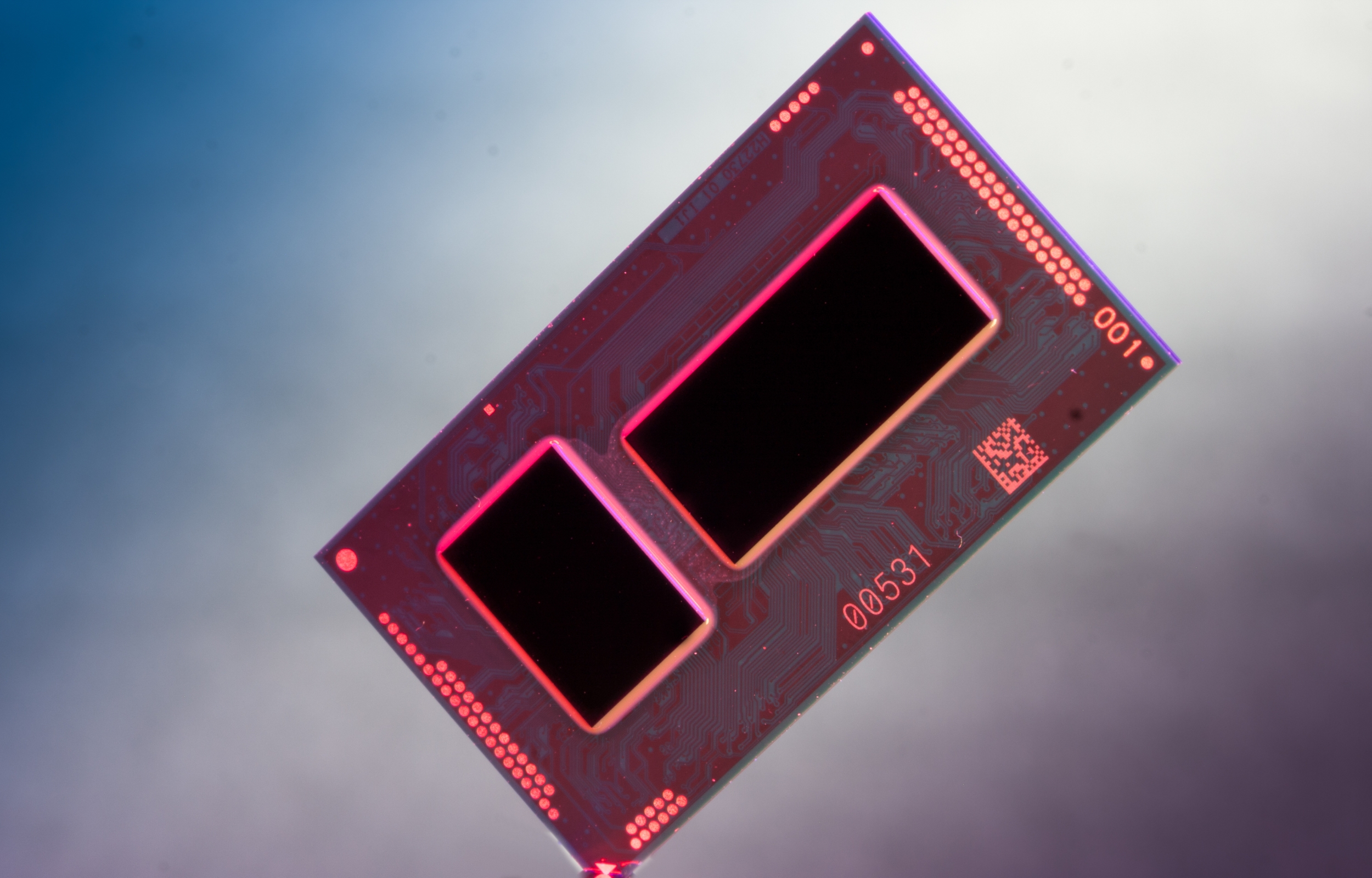
Apple has been developing some revamped Mac laptops for several months and years, such as an ultra-slim 12-inch Retina MacBook, and the key to shipping these products is the availability of Intel’s upcoming Broadwell chip. Why? Because the new 14nm Broadwell Core M chip is fanless, small, and according to Intel, the most energy-efficient Intel processor yet. These facts about the processor lineup directly with the rumors of a fanless and light MacBook. Today, Intel has disclosed some new key points about the Core M Broadwell processor:

  • The combination of the new microarchitecture and manufacturing process will usher in a wave of innovation in new form factors, experiences and systems that are thinner and run silent and cool.
  • Intel architects and chip designers have achieved greater than two times reduction in the thermal design point when compared to a previous generation of processor while providing similar performance and improved battery life.
  • The new microarchitecture was optimized to take advantage of the new capabilities of the 14nm manufacturing process.
  • Intel has delivered the world’s first 14nm technology in volume production. It uses second-generation Tri-gate (FinFET) transistors with industry-leading performance, power, density and cost per transistor.
  • Intel’s 14nm technology will be used to manufacture a wide range of high-performance to low-power products including servers, personal computing devices and Internet of Things.
  • The first systems based on the Intel® Core™ M processor will be on shelves for the holiday selling season followed by broader OEM availability in the first half of 2015.
  • Additional products based on the Broadwell microarchitecture and 14nm process technology will be introduced in the coming months.

Notably, as Intel executives hinted earlier this year, Intel is still on track to ship out chips in time for new products to hit this holiday season, and it seems likely that the new 12-inch MacBook will be one of the first major computer launches with the new processor. Intel says that increased availability for the Broadwell processor will occur in the first half of 2015, so it wouldn’t be a stretch to expect various other new Macs (perhaps MacBook Pros or Airs) with more powerful Broadwell chips to hit the market during that timeframe next year.


Expand
Expanding
Close

Court rejects earlier $324 million anti-poaching settlement between Apple, Intel, Google, and Adobe

Site default logo image

Image via <a href="http://www.businessweek.com/articles/2014-05-01/tech-hubris-the-silicon-valley-antitrust-hiring-conspiracy#p2" target="_blank">Bloomberg</a>

A judge has rejected a settlement that was reached earlier this year between employees of Apple, Intel, Google, and Adobe and their respective companies, CNBC reported today. According to reports from the courtroom, Judge Lucy Koh ruled that the settlement was not high enough and should actually be $380 million.

The lawsuit was brought against the tech giants in question by current and former employees who believed (correctly) that their employers had created agreements to avoid attempting to hire engineers from one another. The idea was that if no competitors were making offers, each company was free to pay its employees whatever it wanted without having to worry about them jumping ship for a better offer.


Expand
Expanding
Close

Apple support page also listed as yet unseen ‘mid-2014 iMac 27’

Site default logo image

The same Bootcamp support page that either reveals an upcoming Mac mini refresh or a misprint also listed an iMac 27-inch mid-2014′ model before the page was updated – spotted by French site Consomac.

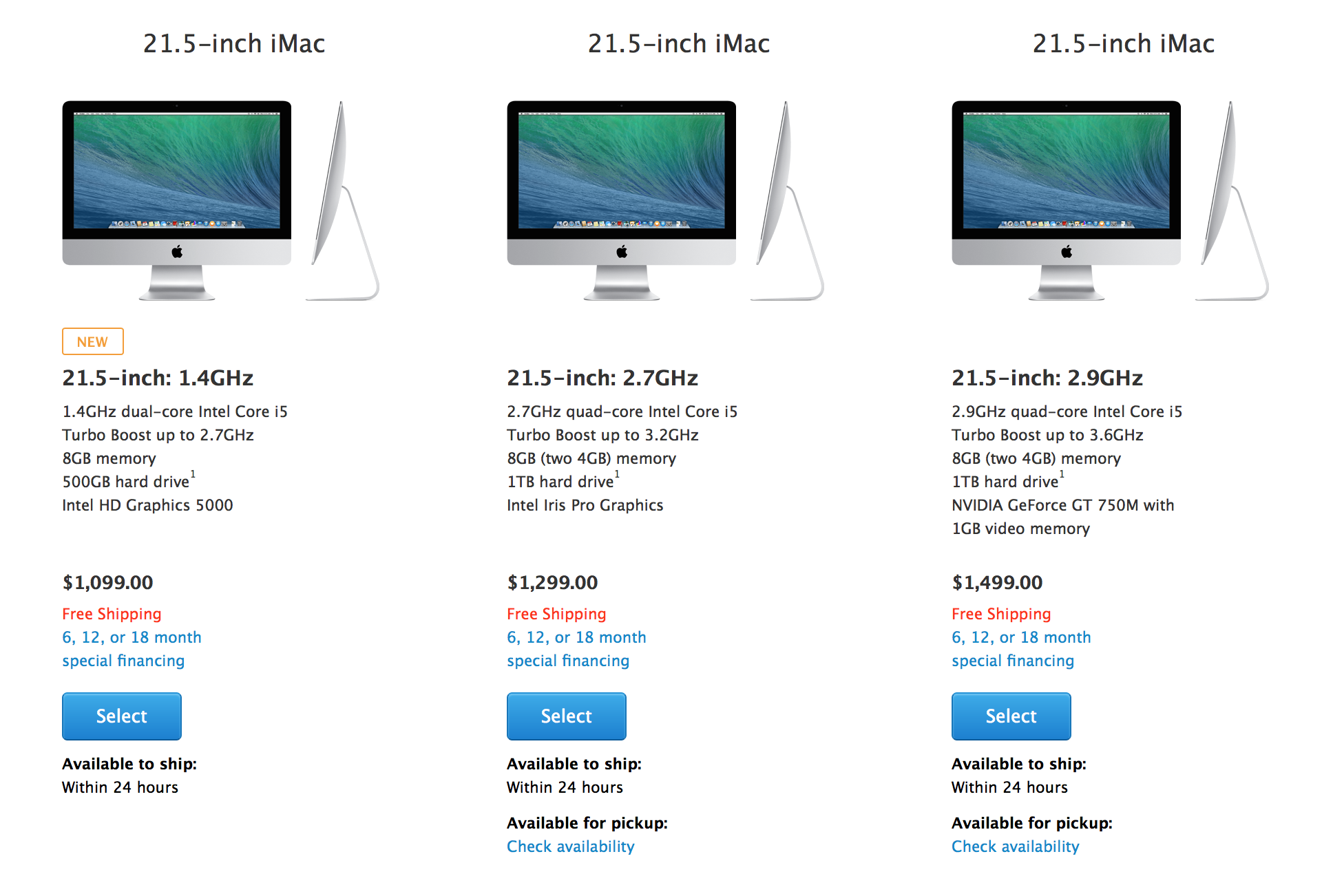
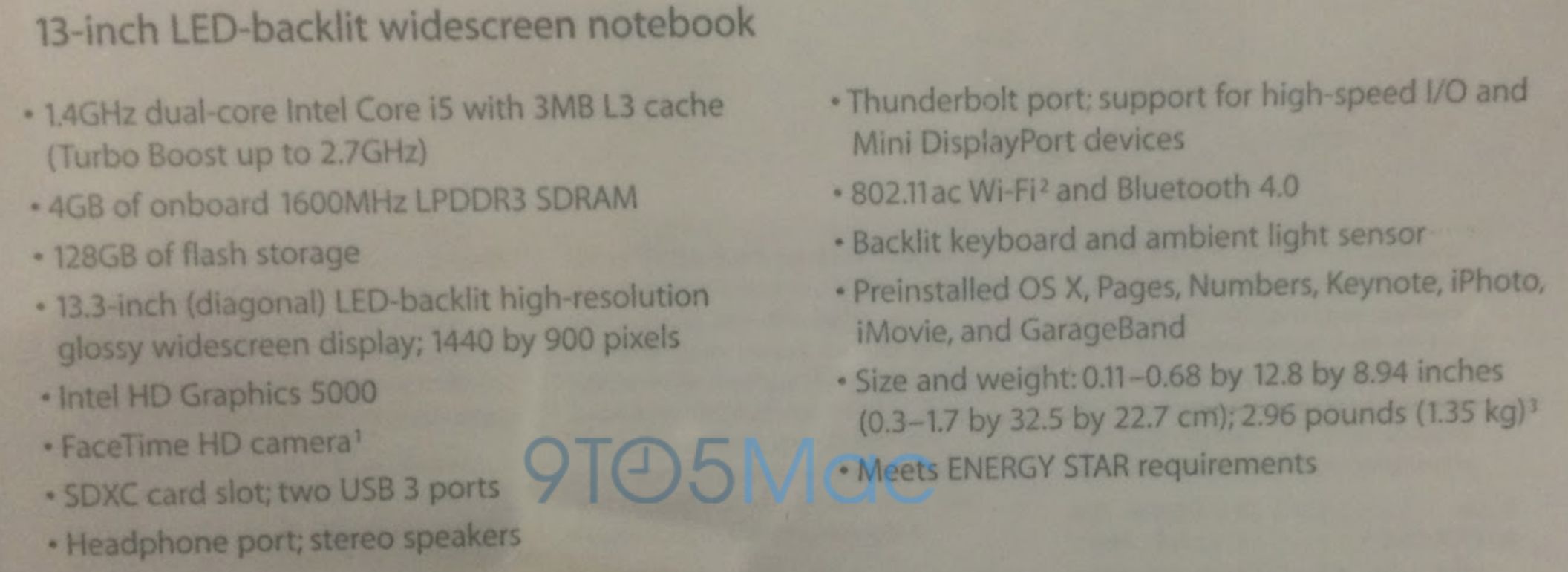
The model was listed above the 21.5-inch mid-2014 iMac released last month. That model was a low-end one, with a 1.4GHz dual-core i5 processor and 500GB hard drive. That might suggest a new entry-level 27-inch iMac is on the way – though Apple doesn’t generally offer a low-spec version of the larger iMac … 
Expand
Expanding
Close

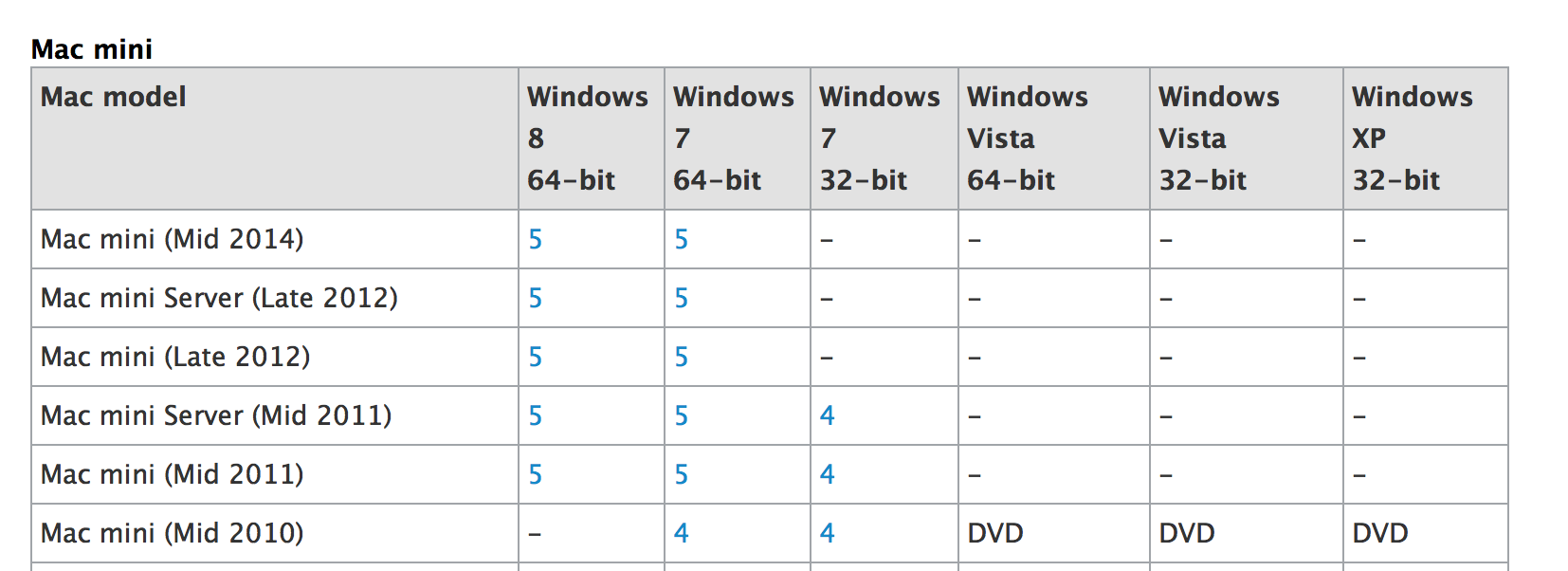
Mid-2014 Mac mini listed on Apple Support page, but no 2014 Mac mini in sight

Site default logo image


Apple seems to have inadvertently referenced a new model of Mac mini on an Apple Support page. The page was last modified yesterday, presumably to include information on the new MacBook Pro’s but instead lists “Mac mini (Mid 2014)” as a supported machine. There is a possibility that this is simply a human error on Apple’s part, of course, confusing the MacBook Pro and the Mac mini updates. There haven’t really been rumors of a new Mac mini being in the works, but due to the relative unimportance of the product in the Mac lineup, it is not of the question for it to have slid under the radar.


Expand
Expanding
Close

Modest Retina MacBook Pro refresh expected tomorrow, still with GeForce GT 750M but base RAM up to 16GB

Site default logo image

The unverified photo from a Chinese Apple Store appearing to show a slight refresh to the Retina MacBook Pro launch is accurate, claims French site MacG, citing a reliable source. The site claims that the refreshed models will go on sale tomorrow.

The refresh is a minor one, with a modest speed boost of 200MHz and an increase in RAM across the range to 16GB. Apple is also, for the first time, offering a 1TB SSD in a standard model … 
Expand
Expanding
Close

Faster Retina MacBook Pros w/ 16GB of RAM across the board teased by unverified Apple Store photo

Site default logo image

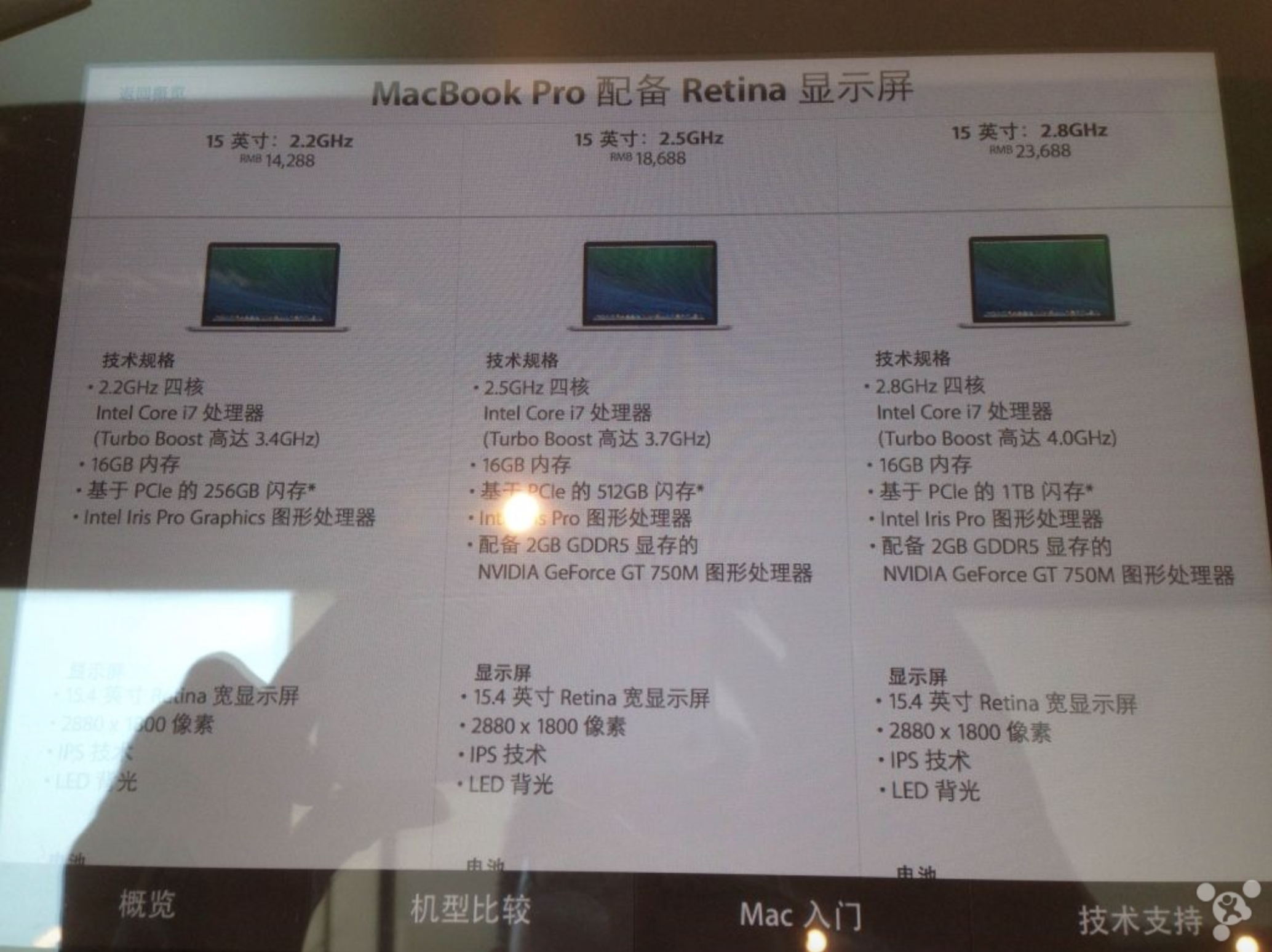
An image posted on a Chinese forum, claimed to have been taken inside of Apple’s new Paradise Walk store, indicates that Apple could be preparing to release an updated line of Retina MacBook Pros in the near-future. The image appears to be from one of Apple’s iPad Smart Signs within the store, and the sign advertises 15-inch MacBook Pros with technical specifications and features not found in the current lineup.

The first possibility is that this image is faked, but the other likely possibility is a system error on Apple’s part. There’s also room for this image to indicate an actual MacBook Pro lineup update coming in the near-future. The rumored specifications indicate that Apple will be bumping the standard 15-inch Retina MacBook Pro line from two models to three, and all will include 16GB of RAM as a standard option. Here are all the purported models:

  • 2.2GHz Intel Core i7 (Turbo Boost to 3.4GHz), 16GB of RAM, 256GB of storage, and Intel Iris Pro Graphics
  • 2.5GHz Intel Core i7 (Turbo Boost to 3.7GHz), 16GB of RAM, 512GB of storage, and Intel Iris Pro Graphics & NVIDIA GeForce GT 750M w/2GB Video Memory
  • 2.8GHz Intel Core i7 (Turbo Boost to 4.0GHz), 16GB of RAM, 1TB of storage, and Intel Iris Pro Graphics NVIDIA GeForce GT 750M w/2GB Video Memory

For comparison, here is the current MacBook Pro with Retina display lineup:


Expand
Expanding
Close

Intel launches updated Haswell chips, likely to appear in upcoming MacBook Pro spec bump

Site default logo image

Intel has debuted the next generation of its Core i5 and i7 processors, according to a report from CPU World. Each of these updated chips sports a 200 MHz speed boost over its previous incarnation, which can currently be found in the MacBook Pro lineup. It’s likely that these processors will be found in a spec-bumped version of the MacBook Pro later this year.

The current series of MacBook Pro processors are available at clock speeds of 2.0 GHz (in the lowest-end 13-inch model) up to 2.6 GHz (in the top-of-the-line, built-to-order 15-inch model). The next-gen models released this week range from 2.2 to 3.0 GHz, which will provide a decent speed boost to each model.


Expand
Expanding
Close

12-inch Retina MacBook now expected in late Q3 or 2015 as new 11 & 13-inch Airs enter production

Site default logo image

Apple’s upcoming redesigned 12-inch MacBook with a Retina display is expected to ship later than expected and new 11-inch and 13-inch MacBook Air models have gone into production, according to a pair of reports from Taiwan’s Economic Daily News. The first report says that updates to both current MacBook Air sizes have entered production with Apple partner Quanta Computer, and that the new computers will boost Quanta’s 2014 notebook shipment numbers by 15%. The new devices are said to sport new chassis, screens, and chipsets, and volume shipments are due in late-August barring any unforeseen component delays.

Speaking of part delays, Apple’s illusive 12-inch MacBook with Retina display is now expected to ship as early as the end of Q3 2014 or as late as early 2015. The computer was initially reported by multiple analysts and publications to hit the marketplace sometime in the earlier part of the third quarter. Why the apparent delay? Intel. According to the report, the new MacBook’s launch is glued to Intel’s power and performance-efficient 14-nanometer Broadwell part, and as we’ve heard multiple times, those chipsets will be short in supply into next year. Regardless, Apple has shown an ability to stock up on Intel’s latest chips months before the competition, so perhaps Apple will be able to avoid this reported delay…


Expand
Expanding
Close

Site default logo image

Supply-chain rumors support analyst prediction of Q3 launch for 12-inch MacBook Air

A prediction by KGI Securities analyst Ming-Chi Kuo that Apple would be launching an all-new 12-inch MacBook Air model in Q3 have been supported by supply-chain rumors cited by Digitimes.

Apple’s new 12-inch MacBook Air will enter mass production in the third quarter, filling the gap between the 11- and 13-inch MacBook Airs as well as enhancing Apple’s leadership in the small-to-medium-size ultra-thin notebook market, according to sources from the upstream supply chain.

Digitimes is not always the most reliable of sources, and its suggestion that Apple’s motivation is to establish a clearer differentiation from the 10-inch iPad Air makes little sense, but a fall launch would seem credible.

The typically-reliable Kuo suggests that the 12-inch model will have the same external size as the current 11-inch MacBook Air, and will have a Retina display. It has also been suggested that the machine might be made without a fan or mechanical trackpad button – perhaps by using a new Core M Broadwell processor announced by Intel.

(Image via notebookcheck.net)

Apple releases new cheaper iMac with low-end processor, priced at $1099

Site default logo image

As rumored last week, Apple has today released a new model of iMac. These machines are considerably cheaper than their predecessors, priced at $1099. Previously, the cheapest iMac SKU was priced at $1299 (which is now the mid-range model).

The cheaper iMac features a 1.4 GHz dual-core i5 CPU, which represents a significant worsening in performance over the previous base model of iMac, which featured a processor clocked at 2.7 GHz.  The CPU does Turbo Boost up to 2.7 GHz however, which does make up some of the difference.

Aside from the CPU, the hard drive has also been cut to 500 GB. The new model also features a lower-end integrated graphics chip. All other iMac models continue to use either Iris Pro integrated graphics or dedicated Nvidia cards. Otherwise, the internals of the new machine are unchanged.

Apple’s Press release below…


Expand
Expanding
Close

Site default logo image

Future Macs could lose the cables as Intel demos next-generation wireless charging, docking & displays

If you’re like me and love technology but hate the rats nest of cables it requires, we could be in for some good news. Intel has demonstrated a system that could be incorporated into future computers that allows wireless connectivity for power, displays, and connection to accessories like external drives.

Wireless charging is nothing new, of course, but existing systems are something of a mess. They rely on inductive charging, which is ultra-short range and only suited to low-power devices like smartphones, and there are several competing and incompatible systems in use.

The new system demo’d by Intel uses magnetic resonance charging, which can cope with the power demands of laptops, and works through up to two inches of wood – meaning that the charging plate can be hidden out of sight under a desk. The same charging plate can also charge multiple devices simultaneously, so a single installation under your desk could potentially power your Mac, iPad, iPhone and wireless headset.

For wireless connection to displays and accessories, Intel uses the Wireless Gigabit Alliance system WiGig, which allows speeds of up to 7Gbps over a distance of a few feet – good enough for a completely wireless desk, and rendering my home-brewed iDesk redundant.

The technology will be supported by Skylake, a chip that is currently two generations down the road, and likely to first appear in laptops in 2016. Apple has not yet signed-up, but Asus, Dell, Fujitsu, Lenovo, Logitech, Panasonic and Toshiba are all on board, so it is likely just a matter of time.

(Via CNET)

Intel’s Broadwell chip makes rumored fanless MacBook Air a real possibility

Site default logo image

Rumors of a fanless 12-inch MacBook have been doing the rounds for quite some time now, and Intel’s announcement last night of a new 14nm Core M Broadwell processor could make it a reality.

The Intel® Core™ M processor will deliver the most energy-efficient Intel Core processor in the company’s history. The majority of designs based on this new chip are expected to be fanless …


Expand
Expanding
Close

Rumor: Apple working on ARM-based Mac variants with larger trackpad built into keyboard

Site default logo image

MacBidouille is the source of an interesting new rumor [translation] that Apple is currently experimenting with new ARM-powered Mac variants that include a Magic trackpad built into the system’s keyboard. The company is also reportedly working on a new version of OS X that will be compatible with these ARM machines.

According to MacBidouille’s sources, Apple is developing three new machines with this configuration: the aforementioned iMac and Mac mini as well as a 13″ MacBook, presumably a MacBook Air. The iMac and notebook are both said to have “4 or 8” quad-core arm64 processors, while the Mac mini has only four.


Expand
Expanding
Close

New MacBook Airs likely launching tomorrow

Site default logo image

Update: Here are the specs…

Apple is preparing to launch a refreshed line of MacBook Air laptops as soon as tomorrow, according to multiple sources. These sources say that shipments of new MacBook Airs have begun arriving in large quantities to Apple Stores across the country. Another source adds that Apple Stores are scheduled to re-arrange the placement of Macs in stores to focus on the MacBook Air tomorrow morning…


Expand
Expanding
Close

Site default logo image

Apple declines further investment in patent assertion entity Intellectual Ventures

Apple and Intel both declined an invitation to invest in a new round of funding for patent assertion entity Intellectual Ventures, reports Reuters. Both companies had invested in the enterprise in the past. Intellectual Ventures did, however, receive further investments from both Microsoft and Sony.

Apple and Intel’s decision is significant because the biggest tech companies have supported IV in the past. “This would be a dramatic departure,” said Kevin Jakel, chief executive of Unified Patents.

Intellectual Ventures declined to discuss investments. Microsoft, Sony, Intel and Apple also would not comment. It is unclear whether Intel and Apple could still opt to invest in IV’s vehicle at a later time.

As a frequent target of patent trolls, it seemed an odd investment for Apple in the first place, and was most likely a simple protective measure: we’ll help fund you if you leave us alone.

An FTC filing revealed that Apple had been the target of a record 92 patent lawsuits in a three year period. Earlier this month Apple joined Microsoft, Ford, General Electric, IBM and other companies in forming a ‘Partnership for American Innovation’ to lobby against patent trolls.

Site default logo image

Next-gen faster Haswells chips out as soon as next month, could find their way into upgraded MacBook and iMacs

Intel’s next generation of its Haswell CPUs could be out as soon as next month, according to sources cited by TechPowerUp (via TonyMacx86).

According to sources in the IT retail, Intel could launch these new chips, led by the Core i7-4790K, on May 10th in most markets […]

 Intel Core “Haswell” Refresh processors offer marginally better performance over current Core “Haswell” chips, at existing price points (i.e., they will displace existing chips from their current price-points).The 9-series chipset offers features such as M.2 SSD support, making you ready for a tidal wave of 1000 MB/s SSDs that will launch around Computex.

Apple now uses PCIe SSD interface  even in its base model MacBook Air so the mSATA improvement will only benefit PC users and Hackintoshers but the mildly improved performance might find its way into updated iMac or MacBooks due ’round WWDC.

RIP Mac optical drives? Rumor suggests Apple to drop last non-Retina MacBook Pro this year

Site default logo image

DigiTimes is claiming that Apple will cease production of the non-Retina version of the 13-inch MacBook Pro this year as it prepares to launch refreshed Retina models toward the end of the year.

Apple is expected to stop production of the 13-inch MacBook Pro in the second half of 2014 and will replace the product line with thinner models equipped with a Retina display. Meanwhile, Intel will offer second-generation ultrabooks in the fourth quarter of 2014, pushing the notebook industry further into the ultra-thin era, according to Taiwan-based supply chain makers … 
Expand
Expanding
Close

Tired of waiting for Apple to upgrade the Mac mini to Haswell? Make your own …

Site default logo image

If you’ve decided you’ve waited long enough for Apple to update the Mac mini with a Haswell processor, you can always create a Hac mini.

A user posting on the Hacintosh site tonymacx86.com has documented his successful squeezing of an Intel DH61AG motherboard with i3-3225 CPU (55w TDP), 4GB Ram, 128GB mSATA SSD, half mini PCIe Wifi and an external Dell laptop power supply into a 2010 Mac mini case … 
Expand
Expanding
Close

Site default logo image

Mac mini could finally see refresh next month according to retailer

Last year came and went without as much as a mention from Apple about the fate of its Mac mini line of desktop computers. The Mac mini lineup currently on sale through Apple, Amazon, and other retailers last saw its hardware updated in late 2012 at the original iPad mini event.

So it’s not too unreasonable to believe that a placeholder entry found online at computerstore.be, a Belgium retailer, found in MacRumors forums could be a genuine preview of what to expect in the updated hardware. The specs reference everything we would expect for a hardware updated Mac mini: Intel Iris graphics, 802.11ac wireless networking, Gigabit LAN, and more. 
Expand
Expanding
Close

Site default logo image

USB to go both ways in next gen revision

No, Apple isn’t redesigning its charging & data cable again – but a proposed change to the USB standard will allow future USB cables to be plugged in either way up.

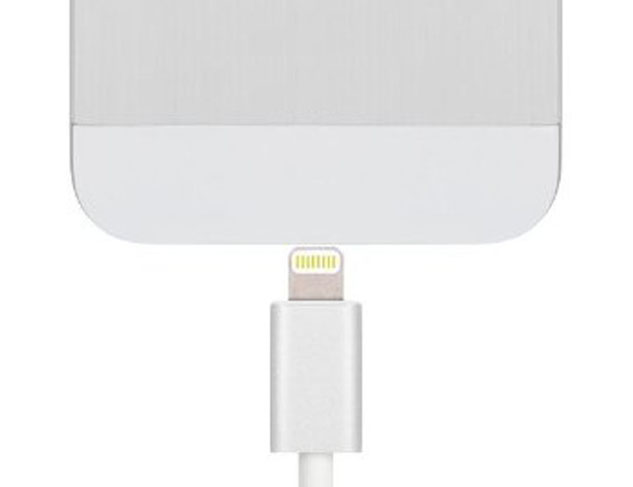
Existing USB cables have a top and a bottom at both the computer/power and device ends. The new USB 3.1 standard calls for the same plug – known as type-C – to be used at both ends of the cable, and for it to work either way up. iDevice cables will have the new type-C connector at the Mac/power end, and the existing Lightning plug at the other.

Computers – including Macs – will need to switch to the new type-C socket, but adapters will allow existing sockets to be used with existing computers.

Full usb.org press release below … 
Expand
Expanding
Close

Thinner, lighter, FASTER: Early benchmarks show 50-65% improvement in MacBook Pro’s Iris graphics

Site default logo image

Macworld’s benchmarks

…less expensive, better battery life too

Apple’s relentless improvement iterations continue unabated. Macworld’s early benchmarks on Apple’s new base model 13″MacBook Pro with built in Intel Iris Graphics are in and show huge speed gains in graphics performance:

The most impressive improvements in the new laptops came courtesy of the new Iris graphics. Compared to the HD 4000 graphics in the early 2013 13-inch Retina MacBook Pro, the Iris graphics posted between 45 and 50 percent higher frame rates in Cinebench r15’s OpenGL tests and the Unigine Valley Benchmark. Unigen’s Heaven benchmark showed the new systems with about 65 percent improvement in frame rates over the earlier model.

Iris Graphics also support displays up to 4K at 24Hz, a first for Apple’s entry level Pro laptops.

CPU performance improvement is slight but the Intel Haswell architecture adds a few hours of (Apple’s estimated) battery life while the machine actually got thinner and lighter. Meanwhile, Apple loaded up faster 802.11ac Wifi and speedy Samsung PCIe SSDs up to 1TB and Thunderbolt 2.0.

Price? Dropped $100  to $1299. (we are already seeing discounts/tax advantages in our Products section).
Expand
Expanding
Close

Opinion: Is Thunderbolt doomed to be the new Firewire, or can the new Mac Pro save it?

Site default logo image

I’m a huge fan of Thunderbolt. A single wire carrying both DisplayPort and high-speed PCIe data is an incredibly elegant approach to minimising cable clutter even if you don’t need the blistering speed, especially when you can use an Apple Thunderbolt Display as a hub for your USB devices.

I also admire clever tech. The reason you can daisy-chain up to six separate devices is because Thunderbolt automatically multiplexes and de-multiplexes the signals as needed. Thunderbolt 2 takes this approach one step further, combining two 10Gbit/s channels into a single 20Gbit/s connection, with the the Thunderbolt controller again doing all the work. It’s impressive stuff.

A fast, clever technology developed by Intel and enthusiastically marketed by Apple ought to stand a fighting chance at mass-market adoption. Sadly, there’s so far not much sign of this happening. It’s all looking rather reminiscent of Firewire … 
Expand
Expanding
Close