Microsoft


http://www.youtube.com/watch?v=-J09HaPkExA&feature=youtu.be
Following its string of ads pinning up Windows 8 tablets against the full-sized iPad, Microsoft has just posted a new ad that pits the 8.1-inch Acer Iconia W3 against Apple’s 7.9-inch iPad mini. The point of this ad is to demonstrate that Windows 8 can even handle Microsoft Word documents and powerful gaming even at the small screen…

http://www.youtube.com/watch?v=wE7AQY5Xk9w&feature=youtu.be
Despite Microsoft’s disastrous quarterly earnings report, in which it took a $900M writedown on discounted Surfaces, the company has just pushed out a new ad for its Surface v. iPad campaign.
As with its previous advertisements, Microsoft bashes the iPad’s inability to perform certain tasks that the Surface is specifically designed to handle. This particular ad highlights the iPad’s lack of built-in back stand, USB port, and keyboard accessory, all of which are not built-in to or included with the iPad.
Interestingly, in this ad, the Siri-inspired voiceover says, “This isn’t going to end well for me, is it? Nope definitely not ending well,” which is particularly intriguing given yesterday’s financial results. As evidenced by these results, it would appear that Microsoft’s Surface is in a precarious position, and not Apple’s iPad.
Expand
Expanding
Close

This morning, Microsoft announced the launch of their new iOS application, “OWA” or Outlook Web App. Specifically for Office 365 subscribers, this native application brings notifications and other features that are not available through the web application:
Our goal is to help our customers remain productive anytime, anywhere. This includes providing a great email experience on smartphones and tablets. Windows Phone 8 comes with a top-notch native email client in Outlook Mobile, and we offer Exchange ActiveSync (EAS), which is the de-facto industry standard for accessing Exchange email on mobile devices. In order to better support many of our customers who use their iPhones and iPads for work, we are introducing OWA for iPhone and OWA for iPad, which bring a native Outlook Web App experience to iOS devices!
OWA for iPhone and OWA for iPad are both free, but require a paid Office 365 subscription.
Last month, Microsoft Office 365 made its debut in the App Store, but the reviews have been less than stellar.

[youtube=http://www.youtube.com/watch?v=zXKqIr4cjyo]
A series of reports from Israeli publication Calcalist.co.il claims PrimeSense, the company behind the original Microsoft Kinect’s technology, is in acquisition talks with Apple, somewhere near a valuation in the $280-300M range. According to the report, a delegation of PrimeSense senior executives visited Apple’s engineering offices in recent days. The purchase would bolster Apple’s living room TV interface offerings and allow Apple to add controls with body movements and hand gestures to its products.
Apple purchased Israeli Flash chip optimization company Anobit in late 2011 for $400M+, also originally reported by Calcalist. The company now functions as one of Apple’s R&D centers in country.
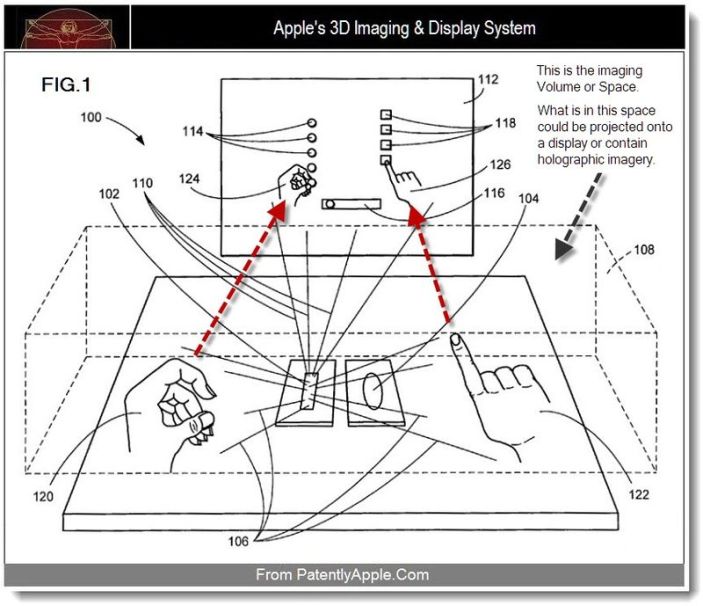
We’ve heard previously that Apple is working on such 3D gesture interface and may have already been licensing IP from the Israeli firm and/or its competitors. At $280M, Apple may believe it’s better to own this IP and technology rather than let others have access to it in the future.
Apple has its own patents on similar 3D technology and has been working on its own gesture-controlled OS (below).
Microsoft used the sensor technology that PrimeSense developed for its original Kinect, previously known as Project Natal, but has since replaced the technology with its own in-house technology for 3D body mapping and movement.
PrimeSense went on to work with Asus on its WAVI Xtion living room home media controller (video) and has since shrunk chips down to be used in tablets and phones (another area of Apple interest)
PrimeSense was founded in 2005 and is a founding member of OpenNI, an industry-led non-profit organization formed to certify and promote the compatibility and interoperability of Natural Interaction (NI) devices, applications and middleware.
Update: PrimeSense has issued a denial that it is currently in talks to be bought by Apple. As we know with past history surrounding these type of matters, the company’s claims might not mean much.
PrimeSense denies that it's in talks to be acquired by Apple. Story to come.
— Seth Fiegerman (@sfiegerman) July 16, 2013

Much like Apple organizes its executive and engineering teams around functions and services rather than specific products, Microsoft is today unveiling its plans to reorganize its divisions and bring together its various hardware and software teams. According to an email sent to employees from CEO Steve Ballmer and published on the company’s website, the move will see Microsoft bring together its separate teams from Windows, Xbox, Office and elsewhere and reassign managers to oversee broader engineering, marketing and finance groups:
Expand
Expanding
Close
http://www.youtube.com/watch?v=oG0yZLEPN_Y&feature=youtu.be
Microsoft is continuing its Windows 8 vs iPad TV commercial series by airing a new ad squarely focused on the multitasking capabilities in Windows 8 (via Tom Warren). On Windows 8 tablet devices, users can work in two apps side-by-side. Microsoft demonstrates this comparison in terms of work: agents communicating about baseball player prospects to their offices. Interestingly, MLB.com digital head said this earlier this year: “There’s no other [mobile platform]. It’s Apple and it’s Android.”

http://www.youtube.com/watch?feature=player_embedded&v=vZviDTuaVlA
In a post on the official Office blog, Microsoft has announced a major new version of OneNote for iPhone, iPad, and iPod touch.
First off, the update adds a much more rich editing experience. Now, files and formatting look the same across all devices. This includes things such as text, graphs, tables, borders, and more. If you draw on a note with a Windows tablet, the markings are then visible on your other devices, as well. All devices now support the ability to sync notebooks with Office 365 and SharePoint, as well as the ability to share files with other Office users. OneNote also now lets multiple people edit a note at the same time, much like Google Drive.
Expand
Expanding
Close
According to a report from Nikkei (via Reuters), Microsoft has signed up Japan-based game developer Klab Inc to bring some of its console and PC games to the iPhone and Android devices. There aren’t many other details, but the report claims Microsoft’s next title to arrive on smartphones will be a free-to-play version of Age of the Empires:
Microsoft’s “Age of the Empires” will be available as a free-to-play game worldwide on smartphones by the end of the fiscal year 2013 and other titles will follow, the report said.
KLab is behind a few titles already on the App Store and Google Play, including Arcadia, Gigabot Wars, Eternal Uprising, and Lord of the Dragons.
It actually wouldn’t be the first game that Microsoft has published for iOS devices as it recently brought its previously Windows Phone only title “Tentacles: Enter the Dolphin” to the App Store for both iPhone and iPad.

Apple’s head of iTunes Eddy Cue is live on stage during Apple’s WWDC 2013 keynote presentation today and just unveiled a brand new, revamped version of Siri that includes a lot of new features on top of a redesign that fits in with the rest of the new look for iOS 7. It also announced a new service dubbed “iOS in the car” that will bring more functionality to the consoles of some vehicles through a partnership with several car manufacturers. The integration will allow you to place calls, have more control of Siri, and view maps, much of which we already revealed leading up to today’s event.
As for Siri, the app now has an all new voice and users will also have the ability to change the voice between male and female. New highly quality voices in both male and female will initially be available only in English, French, and German, but Apple plans to add more over time. That’s not all, however, Siri is also getting a bunch of new features and integration with other web services such as Wikipedia.
Eddy Cue noted during his demo of the redesigned Siri that you’ll now be able to control a lot more functions on your iPhone with Siri, such adjusting the brightness of your display, enabling Bluetooth, or playing a voice mail. The just unveiled iTunes Radio will also have Siri integration.
"Surprise: Apple’s Siri adopts Microsoft @Bing for web search" http://t.co/fHXrpjZOoD via @GeekWire
— Microsoft Stories and News (@MSFTnews) June 10, 2013
Microsoft is happy about Apple’s decision to include Bing web results (and not Google) in Siri for iOS 7.
Siri will also be able to answer a lot more questions in iOS 7, which is in part thanks to the integration of new web services including Wikipedia, Twitter (to view Twitter account updates through Siri), and web search results from Bing.
The new in-car features through ‘iOS in the car’ will be arriving in vehicles from several car manufacturers in 2014.
Expand
Expanding
Close
Question is 36:38 in
With Tim Cook teasing the Jony Ive redesign of iOS 7 that we exclusively told you would be introducing a new flat design for iOS, we thought it would be interesting to get former Windows lead Steven Sinofsky’s opinion on the changes. While Sinofsky left Microsoft after 20+ years back in November of last year, he was involved in the latest releases of Windows 8 that many argue helped pioneer the flat UI design Apple is now moving towards. Our own Mark Gurman asked Sinofsky his thoughts on a new flat iOS 7 during his interview at the D11 conference earlier today.
Expand
Expanding
Close

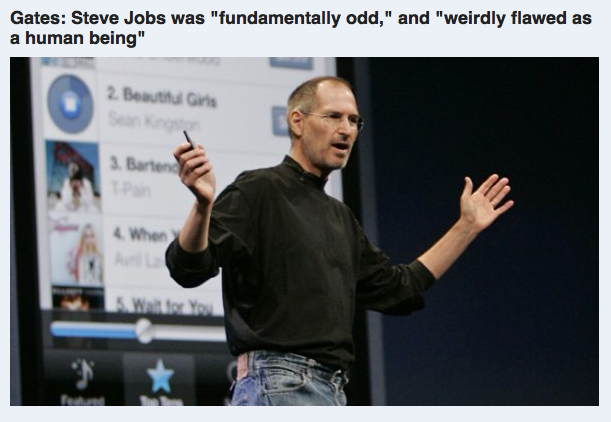
Business Insider has gathered together a fun little collection of quotes by Steve Jobs and Bill Gates on each other, taken from Walter Isaacson’s biography of Steve Jobs …
Expand
Expanding
Close
Optical illusions? The iPad screen on the left is actually bigger
Earlier today Microsoft unleashed its second ad in what appears to be a new campaign focusing on directly comparing iPad to Windows 8 tablets side-by-side– not unlike Apple’s own very successful ‘Get a Mac’ campaign. However, it appears that some of Microsoft’s claims are turning out to be quite inaccurate.
To go along with the two videos posted to its YouTube channel and currently running on TV, curi.us (Via DaringFireball) points us to a comparison Microsoft has posted on its website pitting iPad against the ASUS VivoTab Smart Windows tablet. In the ad, Microsoft claims that the Windows tablet “has a bigger touchscreen,” but Elliot Temple from curi.us breaks down why it just isn’t true:
The iPad screen is 7.76 by 5.82 inches. The ASUS screen is 8.8 by 4.95 inches. ASUS is larger in one direction but smaller in the other direction, and has 3.55% less area than the iPad, not 36% more as Microsoft depicts.
How can the screen with a larger diagonal measurement be smaller? Because it’s a different shape. Long and thin gets you a bigger diagonal but a smaller screen, for the same diagonal inches.
While Microsoft might not have all its facts straight on display size, it using the fact it still hasn’t delivered an Office app for iOS as major part of its new campaign…
Expand
Expanding
Close
[youtube https://www.youtube.com/watch?v=zgu9uo2UpPg?rel=0]
Following up on its ad from yesterday claiming that the iPad is not a productivity device, Microsoft has posted a new ad pitting Windows 8 tablets against the iPad. Today’s ad focuses on expressing that Windows 8 tablets are better productivity devices with the full Microsoft Office suite rather than just OneNote and multitasking capibilities. Additionally, the Redmond-based company pits a single ASUS tablet’s weight and thinness against the iPad. Additionally, Microsoft shows how that single ASUS tablet includes an SD card reader, and the company claims that Windows 8 printing is more versatile than Apple’s AirPrint. Thanks, Matthew!
[youtube http://www.youtube.com/watch?v=86JMcy5OqZA?rel=0]
Microsoft’s latest television commercial for Windows 8 tablets uses a Siri voice-over to mock the iPad’s pricing and capabilities. The ad appears to frame Windows 8 tablets as more capable for productivity and more valuable for the price (via The Verge). What’s somewhat comical here is that one of the few advantages Microsoft touts for its tablets is the ability to run PowerPoint, something Microsoft has clearly been holding back from the iPad for some time now. Would it surprise anyone to see another couple of ads in this series focusing on Word and Excel?
Oh, and how much of that 64GB of space on the Windows tablet at the end is free for media? You’re lucky to get half of the space.
Microsoft’s ad is in similar style to Apple’s late 2012 advertisement to introduce the iPad mini. Apple’s ad below:
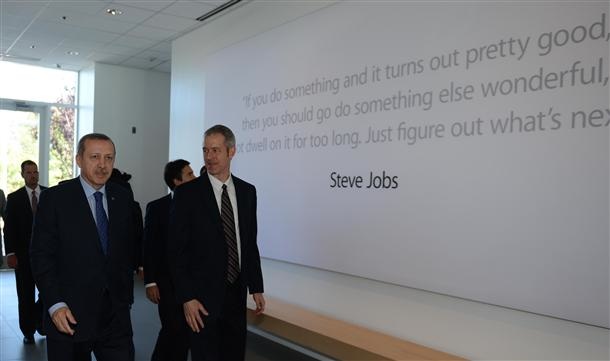
Turkish Prime Minister Recep Erdoğan has visited Apple, Google and Microsoft in the run-up to a tender for 10.6 million tablets for use in Turkish schools as part of a major modernization program in which textbooks will be replaced by tablets and chalkboards by electronic whiteboards …
Expand
Expanding
Close
[youtube=http://www.youtube.com/watch?v=u4AXaFlIFQA&start=29]
“It’s like giving a glass of ice water to somebody in hell”
That’s what Steve Jobs said of iTunes for Windows when asked why Apple made its software for competing Microsoft users in 2007.
But times have changed. Apple continues to make/support iTunes for Windows desktop computing environments, but it doesn’t need Microsoft’s outlier tablet users who now represent the third largest share of tablet OS behind iOS and Android (by the way, don’t expect iTunes for Android any time soon either).
In fact, the iTunes ecosystem is a competitive advantage as Apple sells its iOS tablets, smartphones and TVs against Android and now Windows 8 devices. Where Windows dominated the userbase in the early 2000s, Apple now is the leader in the current ecosystem race.
That’s why it comes as no surprise that Microsoft’s Windows division CFO Tami Reller is telling folks not to expect a Windows 8 ‘Metro’ iTunes app:
“You shouldn’t expect an iTunes app on Windows 8 any time soon,” said Tami Reller, chief financial officer of Microsoft’s Windows division. “ITunes is in high demand. The welcome mat has been laid out. It’s not for lack of trying.”
It should be noted that Microsoft has been dragging its feet in delivering the once ubiquitous Office Suite of applications for iOS which is now letting competitors (Like Pages/Numbers/Keynote and Google Apps) thrive on the now dominant iOS and Android touch platforms.
Expand
Expanding
Close
Research firm Canalys is out today with its latest report tracking worldwide smart mobile device shipments for Q1 with Android accounting for almost 60% of smart mobile devices shipped by OS. That’s compared to a 19.3% share for Apple and approximately 18.1% for Microsoft. Keep in mind Canalys’s report also includes notebooks, in addition to tablets and smartphones, which account for the majority of Microsoft’s share. When looking at tablets alone, Apple continued its lead with 46.4% share in the quarter, although Canalys warned Apple “lost share to its Android-based rivals for the third consecutive quarter.”
Though Apple continues to lead in the tablet space with a 46.4% share, it lost share to its Android-based rivals for the third consecutive quarter. ‘Spearheaded by Google and Amazon, the commoditization of the tablet market has happened far quicker than that of the wider PC market,’ said Canalys Senior Analyst, Tim Coulling. ‘Profit margins are being squeezed and vendors without a low cost structure will find it hard to compete. A solid range of must-have accessories and a software and services strategy are vital as vendors will increasingly need to make revenue around their devices.’
When it comes to smartphones, the report has Android at roughly 75.6% of shipments with around 32% of those shipments coming from Samsung. We know Apple sold around 37 million iPhones in the quarter but, as always, we warn that the stats from Canalys don’t include shipped vs sold data.
Expand
Expanding
Close


Frustrated with your iPad’s lack of Office and no physical keyboard? Probably not but that doesn’t stop Bill Gates from believing it.
Serving as the lone hero for Microsoft’s compromise PC-tablet (the Surface Pro even has a fan, you know, like a PC), the Microsoft co-founder cited users’ growing frustration with the software and hardware limitations of the iPad as we move further into the post-PC reality.
The problem with this notion, as we all know, is that no shortage of keyboard cases for the iPad exists and productivity users have long since found a solution for their Office needs.
Microsoft has been rumored to launch Office for iOS for a while now, but it is hard to recall why it matters anymore with so many other solutions available.
Check out the 7:30 mark in the video below:
Previously only available to Chromebook users, Google announced today on its Chrome blog that Mac and Windows users will now have the ability to open Microsoft Office files directly within Chrome. The functionality works for users running the latest Chrome Beta and requires installation of the Chrome Office Viewer (Beta) extension.
In addition to saving you time, the Chrome Office Viewer also protects you from malware delivered via Office files. Just like with web pages and PDFs, we’ve added a specialized sandbox to impede attackers who use compromised Office files to try to steal private information or monitor your activities.


Logitech makes some pretty amazing iPad keyboards and now they can pretty much say the cover the spectrum of what’s out there. Today the company announced new $149 Logitech FabricSkin Keyboards that look and act like the keyboard case that comes with the Microsoft Surface. Even better? These guys are waterproof so you can just wipe away the coffee that you just spit out.
“We’ve combined design cues from the world of high fashion with the unbeatable typing experience you expect from Logitech to bring a new level of self-expression to iPad protection,” said Mike Culver, vice president of brand development for tablet accessories at Logitech. “TheLogitech FabricSkin Keyboard Folio and Logitech Folio give you more than just a protective case for your iPad, they add a distinctive accent to your iPad that reflects your personal style.”
Logitech worked with world-class designers to identify chic fabrics and a bold color palette and combined them with a clean design. As a result, both the Logitech FabricSkin Keyboard Folio and Logitech Folio are offered in a range of colors from Electric Blue and Sunflower Yellow to Mars Red Orange, and in an array of on-trend fabrics from matte leather to finely woven cotton.
“By developing color and material options that evoke our senses and speak to our individuality, Logitech has made owning an iPad unique again,” said Beatrice Santiccioli, world-renowned color expert and designer. “I brought my knowledge in color and design to Logitech to help inspire the selection of materials and develop a color palette that builds a strong emotional connection to people’s lifestyles.”
Don’t want the keyboard but still want the case? Have an iPad mini? The Logitech Folio is keyboardless, fits both iPads, and costs $70.
http://www.youtube.com/watch?feature=player_embedded&v=KD5uWfq42YY
They are available for pre-order at Logitech and will start shipping next month.
Full-sized image gallery, another video and press release follows:
Expand
Expanding
Close
Since we first heard rumors that Microsoft was working on Office for iOS as far back as 2011 and got a look at alleged leaked images of an iPad app that Microsoft later denied were real, every couple of months we’ve seen reports that say the app is coming soon. First it was November 2012, then early 2013, and others claimed “sometime after” March 2013. The latest rumor: Microsoft has Office for iPhone and Android is scheduled for fall 2014.
ZDNet claims to have got its hands on Microsoft roadmap for next year and says on it is “iOS/Android support for Office”:
Expand
Expanding
Close
Update: Microsoft provided us with the following comment noting that “people interested in buying additional storage will do so via the web versus in the app.” In other words, it doesn’t look like Apple will be getting a cut of additional storage purchased, but users won’t be able to do so via the iOS app:
We worked with Apple to create a solution that benefited our mutual customers. The SkyDrive app for iOS is slightly different than other SkyDrive apps in that people interested in buying additional storage will do so via the web versus in the app.
Back in December we heard reports, later confirmed by Microsoft, that Apple was delaying updates to its SkyDrive iOS app. The delays were apparently over a dispute regarding whether or not Apple should receive its usual 30% cut for additional storage that users purchased through the app.
While there is no word yet on exactly how Microsoft and Apple resolved the issue, Microsoft announced today on its Windows SkyDrive blog that a new update is available for the iOS app via iTunes starting today.
Version 3.0 of the app, the first update to SkyDrive for iOS since June, brings support for iPhone 5 and iPad mini, a revamped user experience, enhancements to photo features such as the ability to download full res photos to iPad and iPhone, and much more:
Expand
Expanding
Close
Apple is the target of a new patent infringement suit filed today by Intertrust—a company backed by Sony and Philips that has licensed its patents to many companies in the past including Samsung, Nokia, Microsoft, HTC, Motorola, and others. The Wall Street Journal noted Philips and Sony each hold a 49.5-percent stake in the company that previously settled with Microsoft in 2004 for $440 million related to a patent infringement case.
The announcement from Intertrust on its website doesn’t mention the specific patents or technologies involved in the suit, but it claims Apple products, including iPhone, iPad, Apple TV, Macs, iCloud and iTunes, infringe on 15 Intertrust patents related to “security and distributed trusted computing.”
The lawsuit accuses Apple of making products and services that infringe on 15 Intertrust patents on security and distributed trusted computing. The lawsuit covers a broad range of key Apple products and services including iOS devices such as the iPhone and iPad, Mac computers and laptops, Apple TV, and services including iTunes, iCloud, and the Apple App Store.
“Apple makes many great products that use Intertrust’s inventions,” said Talal Shamoon, Intertrust’s chief executive officer. “Our patents are foundational to modern Internet security and trusted computing, and result from years of internal research and development. We are proud of our record of peaceful and constructive licensing with industry leaders. We find it regrettable that we are forced to seek Court assistance to resolve this matter.”

Nick Hayek, CEO of Swiss watchmaker Swatch, said today during a press conference for the company’s annual results that he doesn’t see a smart watch product from Apple being the “next revolution.” We can’t help but be reminded of Palm CEO Ed Colligan’s comments before the iPhone hit:
“We’ve learned and struggled for a few years here figuring out how to make a decent phone,” Ed Colligan apparently laughed about with John Markoff last Thursday morning. “PC guys are not going to just figure this out. They’re not going to just walk in.”
Hayek’s main reasoning is difficulty delivering compelling content on such a small display, something the company has explored with its Paparazzi line of watches in collaboration with Microsoft:
“Personally, I don’t believe it’s the next revolution,” the chief of the largest Swiss watchmaker said at a press conference on annual results in Grenchen, Switzerland. “Replacing an iPhone with an interactive terminal on your wrist is difficult. You can’t have an immense display.”
Hayek also reasoned that consumers often buy watches as a piece of jewelry and like to change them on any given day. The CEO claimed that Swatch has had talks with Apple over the years regarding “materials for products and so-called energy harvesting technology that would generate energy from physical movement.” Bloomberg reported earlier this year that Apple had a team of over 100 product designers working on a wristwatch-like device and more recently said Apple would launch its watch product some time this year.