Microsoft

[youtube=http://www.youtube.com/watch?v=CQO0hzKFHiw&context=C47a510dADvjVQa1PpcFMSCsaAUS5ozxlAxBOlWOizoy3tZSlgrKg=]
We told you in May 2011 that a new company called “Taposé” aimed to bring functionality from Microsoft’s dual-screen Courier tablet concept to the iPad. The iPad app was still early in development then, but has since reached its funding goal on Kickstarter. It also received backing from Microsoft’s J Allard who headed the Courier project at Microsoft, and now Apple finally approved it for the App Store:


For a couple of seconds this morning Apple’s stock hit 600. It is currently dropping slightly, but we imagine some of you aren’t about to sell your yachts.
Expand
Expanding
Close


Microsoft issued the Windows 8 Consumer Preview today for everyone to download and try. Demonstrating the operating system’s ability to scale from the smartphone screen all the way to high-end PCs and beyond, the Redmond, Wash.-headquartered software giant showcased Windows 8 on a monstrous 82-inch display that is capable of detecting up to 100 simultaneous touch events or 10 simultaneous users.
Unfortunately, AnandTech, which reported the story, does not have a video online yet. However, I think it is safe to take Microsoft’s word. Now, if the operating system only ran Apple’s Keynote, the ninja PC-plus-Windows 8 combo coupled with a huge projector-based display would make for an impressive keynote rig.
By the way, we would love to hear impressions from our tech-savvy readers that have managed to dual-boot Windows 8 Consumer Preview alongside OS X using Boot Camp (go here for the FAQ detailing system requirements).
The Windows 8 Consumer Preview product demonstration video is right below the fold.
[youtube=http://www.youtube.com/watch?v=aebfjzdLxJA#!]
Update: And one more:
[tweet https://twitter.com/MSFTnews/status/172098558017810432]
Microsoft attempted to kibosh the news surrounding its Microsoft Office app for the iPad started by The Daily earlier today. It told The New York Times:
“The Daily story is based on inaccurate rumors and speculation. We have no further comment.”
It also told Mary Jo Foley of ZDNet:
A Microsoft spokesperson said the screen shot accompanying The Daily’s story is not a picture of a real Microsoft software product. But the spokesperson also said Microsoft is declining to comment as to whether or not the company has developed a version of Office for the iPad and/or when such a product may come to market.
She later added this communication from Hickey:
“Right now, someone with a mid-level job at Microsoft is being yelled at. To that person: I’m sorry, I owe you a beer. But say it however you want to, we both know that Office for iPad is on its way. And if it’s as cool as the version I’ve seen, you’ve got a winner.”
A Microsoft employee released a third statement to the MacObserver:
Danell Arvberger, Sr. Category Manager – Office for Mac, said, “Interesting, this is the first I’ve heard of it. Thanks for sharing the article. If I find anything out and able to share I will let you know.”
It sounds like Microsoft is doing a non-denial denial. But wait, Hickey has more:
Update: Whooooaaaaa…hold your horses. Microsoft says it ain’t so:
A Microsoft spokeswoman issued this statement: “The Daily story is based on inaccurate rumors and speculation. We have no further comment.”
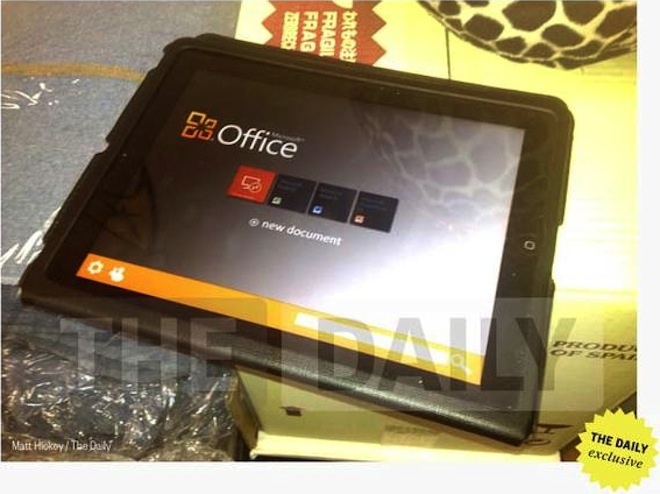
Corroborating earlier reports, Rupert Murdoch’s tablet-only magazine The Daily apparently saw a work-in-progress version of Microsoft’s native Office app for iPad, and the publication posted the above screenshot to prove it exists. The Daily’s first impressions?
The app’s user interface is similar to the current OneNote app, but it has hints of Metro, the new design language that can be seen in Windows Phone and in the as-yet-released Windows 8 desktop operating system. Word, Excel and PowerPoint files can be created and edited locally and online.
According to unnamed sources, the team wrapped up the project and will soon submit the app for approval. An Android version of Office is not in the works, “sources familiar with the matter” said, but the Windows maker is putting the finishing touches on the new OneNote iOS app said to sport the Metro user-interface overhaul. When Office for iPad finally arrives, it will compete with the likes of Documents to Go, Quickoffice and Apple’s own Pages, Keynote and Numbers apps, which at $9.99 each might be hard to beat.
Software giant Microsoft will release in the second quarter a high-profile productivity tool for Android-toting business professionals. Accompanying Microsoft’s CRM Dynamics 2012 platform update is a preview guide that specifically mentions Android support, as noted by ZDnet. The document also includes a screenshot depicting Dynamics CRM mobile client for iPad (as seen on the right). In addition to native clients for Android devices and iPads/iPhones running iOS 5.x, Dynamics CRM will also be available on devices powered by Microsoft’s Windows Phone software.
As opposed to a web client that comes with significant limitations, the mobile client comes with all the bells and whistles so it should be Godsend for road warriors. Many businesses rely upon Dynamics CRM to manage their interactions with customers, clients, and sales prospects. Dynamics CRM mobile client will be priced at $30 a month per seat versus rival Salesforce’s mobile client which starts at $65 a month per seat.
Expand
Expanding
Close
Robin Burrowes, the person in charge of Xbox Live marketing in the EMEA region, left Microsoft for Apple and is now charged with heading the App Store marketing initiatives for iTunes Europe. Burrowes led Xbox Live marketing for seven years and were responsible for product, business and marketing management as well as planning, strategy and leadership of Xbox Live across regions, according to his LinkedIn profile. Prior to joining Apple, the executive was involved with Microsoft’s MSN online operation as events/B2B marketing manager, British retail chain HMV (promotions manager) and Tennent Caledonian Breweries (brand marketing manager).
Burrowes graduated from University of Strathclyde in 1991. Apple fashionably would not comment on its new hire. Hiring yet another games veteran indicates Apple’s desire to expand on iTunes gaming initiatives in Europe. Apple’s business in the region and around the world is booming on strong iPhone sales. Interestingly, a recent job listing on Microsoft’s website for a software development engineer possibly hinted at Xbox Live games for iOS devices. A spokesperson for the Windows maker told Forbes they are “working to extend a few of our Xbox experiences and titles to other platforms.”
[vodpod id=Video.16004136&w=650&h=425&fv=allowFullScreen%3Dtrue%26bgcolor%3D%23000000%26autoPlay%3Dfalse%26screensLayer.startScreenOverId%3DstartScreen%26screensLayer.startScreenId%3DstartScreen%26]
The Steve Jobs segment begins at mark 3:35. Flashless version is here.
Microsoft cofounder and former CEO Bill Gates sat for an interesting interview with Yahoo! and ABC News. The public face of Microsoft responded to a wide range of questions, including those touching on his final conversation with Steve Jobs and how his passing affected him. Contrary to the popular belief, the two Silicon Valley luminaries kept in contact with each other throughout their respective careers. What were the topics of their friendly chats?
He and I always enjoyed talking. He would throw some things out, you know, some stimulating things. We’d talk about the other companies that have come along. We talked about our families and how lucky we’d both been in terms of the women we married. It was great relaxed conversation.
How did Jobs’ death affect Gates? Read on…
Expand
Expanding
Close
[slideshow]
All the talk about Microsoft bringing its Office suite to the iPad has thus far failed to develop into a tangible product—at least as native apps. In the meantime, many virtualization apps cropped up on the App Store, allowing you to share a desktop virtual machine with your tablet. OnLive today jumped on the bandwagon with an interesting cloud-based solution stemming from their expertise as a provider of streaming gaming experience through their OnLive cloud gaming platform.
The OnLive Desktop app provides access to a seamless Windows desktop experience sporting Microsoft Office applications and 2GB of free cloud storage. It leverages OnLive’s video compression technology to run the Office suite in the cloud and stream rendered video onto your iPad. This is the same technology used by OnLive’s cloud-gaming platform, meaning your experience may wary depending on your broadband Internet speed, congestion and other factors affecting video streaming.
OnLive Desktop for iPad is a free download from the App Store. You will need a free account with OnLive to use the program. Both free and paid plans are available, offering up 50GB of storage, more apps, and priority access and collaboration features for businesses…
[youtube=http://www.youtube.com/watch?feature=player_embedded&v=jdzmBCH24_Q]

The iPhone 4S is one of the first devices to support Bluetooth 4.0. Today, the first accessory to take advantage of the new technology is a new Kickstarter project called Find My Car Smart.
Find My Car Smart uses a Bluetooth 4.0 powered dongle to transmit the location of a car that can then be picked up by an iOS app, letting a user find a car in a busy parking lot on a map. Due to it being a Kickstarter project, it will need to get enough backers to see the light of day. It’s pretty cool, nonetheless. So, if you’re interested make sure you pledge.
Microsoft is also getting in the Bluetooth accessory game with the release of a new tablet keyboard. The Bluetooth Mobile Keyboard 5000 is portable and it will hook up with an iPad, Android tablet or any other device that supports Bluetooth.
Microsoft makes the Bluetooth Mobile Keyboard 5000, available for $49 on their hardware store. If you can’t look past that Windows logo, you could always just buy an Apple wireless keyboard for $68,or even try Apple’s iPad Keyboard dock.
Whoa, Microsoft is definitely on a roll today. In addition to the Xbox Live client for iPhone and the Halo Waypoint companion app for their popular gaming franchise, both of which were recently released on Apple’s iOS platform – and on top of today’s release of Kinectimals, their first-ever game for the iPhone, iPod touch and iPad, the Redmond, Washington-headquartered software giant just outed another iPhone app.
If you’re a fan of 25 gigabytes of free storage from Microsoft (a 100MB individual file limit) , Christmas definitely came early with today’s release of the official SkyDrive for iPhone . A free download from the App Store, it lets you access all of your content (including files shared with you) stored on SkyDrive cloud storage. You can also upload photos or videos from your iPhone to SkyDrive, view your recently used documents, share a link to any file using email and create/delete folders.
So Microsoft, how about that Office for iOS?
[slideshow]
Expand
Expanding
Close
[youtube=http://www.youtube.com/watch?feature=player_embedded&v=vnhzuKcDo6A]
According to Winrumors, you can take out a Windows Phone 7 device (they say various Windows Phone 7s on any carrier) with a single, solitary SMS message with a [redacted at request of Winrumors]. Worse (or better?) yet, it doesn’t have to be a text, it can be a Facebook message or Windows Live chat.
The flaw works simply by sending an SMS to a Windows Phone user. If the SMS contains a particular string of text then Windows Phone 7.5 devices will reboot and the messaging hub will not open despite repeat attempts. We have tested the attack on a range of Windows Phone devices, including HTC’s TITAN and Samsung’s Focus Flash. The attack is not device specific and appears to be an issue with the way the Windows Phone messaging hub handles particular characters. The bug is also triggered if a user sends a Facebook chat message or Windows Live Messenger message to a recipient.
And you don’t just get a reboot. When your phone comes hobbling back to life, the Messaging hub no longer works. And other parts of the OS are wonky.
If a user has pinned a friend as a live tile on their device and the friend posts a particular string of text on Facebook then the live tile will update and causes the device to lock up.
The fix? Hard reset of the device. Ouch.
In a totally unrelated note, the head of the Windows Phone 7 division was fired today.
Expand
Expanding
Close
Microsoft today introduced an iPad version of their OneNote mobile app previously only available to iPhone users. The new app has of course been given a facelift for the iPad with a two-pane view and also includes a tabbed user interface, quick note creation, tables in notebooks, and the ability to sync notebooks over WiFi.
Additionally, the iPhone app has also been updated to version 1.3 and both apps support several new languages including English, Chinese, Czech, Danish, Dutch, Finnish, French, German, Greek, Hungarian, Italian, Japanese, Korean, Norwegian, Polish, Portuguese, Russian, Spanish, Swedish, and Turkish.
*With the free version of OneNote for iPad you can access, create and edit up to 500 notes. Once you reach this limit you can still view, delete, and sync your notes. To continue taking and editing notes, you can upgrade OneNote for iPad to unlimited use through an in-app purchase.
Expand
Expanding
Close
A Windows 8 tablet mockup
If you believe today’s Forrester Research report, a Window of opportunity is closing fast as customers are losing interest in the forthcoming Windows 8-powered tablets. Microsoft on its part previewed Windows 8 two months ago and won praise for its touch interface. To be perfectly honest, the UI does look nice and interesting and support for ARM/x86 architectures and app market makes it better suited to compete in the post-PC era. But timing is everything and “Windows 8 is going to be very late to the party”, Forrester argued. Here’s the gist of their report:
For tablets, though, Windows really isn’t a fast follower. Rather it’s (at best) a fifth-mover after iPad, Android tablets like the Samsung Galaxy Tab, HP’s now-defunct webOS tablet, and the BlackBerry PlayBook tablet. While Windows’ product strategists can learn from these products, other players have come a long way in executing and refining their products — Apple, Samsung, and others have already launched second-generation products and will likely be into their third generation by the time Windows 8 launches. Meanwhile, newer competitors like Amazon (Kindle Fire) and Barnes & Noble (Nook Tablet) are reshaping consumer expectations in the market, driving down price points (and concomitant price expectations), and redefining what a tablet is.
Interestingly, Microsoft has a web tool that, when accessed on one’s iOS or Android device, lets one run an emulation of Windows Phone 7. In what some might dub a sign of desperation, Microsoft is reportedly readying a version of the Office suite for iPad – an ironic move, really, as they didn’t even announce Office apps tailored for Windows 8 tablets.
Announcing Windows 8 well ahead of the promised late-2012 release may have backfired as the excitement surrounding Windows 8 tablets wore off and competitors like Apple and Google can close any perceived advantages. In the first quarter, 46 percent of U.S. consumers yearned for a Windows tablet, Forrester noted (your chart goes right after the break). Last quarter, consumer interest plummeted to just 25 percent. Apple went from 16 percent to 28 percent and Google from 9 percent to 18 percent. But even though more people yearned for a Windows tablet than an Android one, Forrester notes:
Microsoft has missed the peak of consumer desire for a product they haven’t yet released.
Of course, gauging demand for an unreleased product can be misleading and even Forrester analysts were forced to change their ideas of how the market works when early iPad sales caught everyone flabbergasted. On the other hand, we do know Windows 8 tablets won’t ship in volume before this time next year. And herein lies the problem…
[youtube=http://www.youtube.com/watch?v=osa1ZXZaaWM]
Expand
Expanding
Close
.
Curious to see how Windows Phone feels, but don’t have a device around to do so? Us neither. But Microsoft has just released a new HTML 5 website that allows iPhone and Android users to get a taste of the Windows Phone 7 (Mango 7.5) operating system. The trial requires no downloads or registration, and you can try it out by just going to the webpage http://aka.ms/wpdemo on your mobile device.
While it doesn’t use any of the data on your phone like your contacts, the demo does give you a pretty comprehensive look at all of Windows Phone’s features. Microsoft uses a blue dot to guide you around the operating system, and obviously some features like voice recognition just don’t work in the browser. Drat, that’s something we really wanted to try.
Will this draw users over to the Windows Phone platform? Probably not, but it’s always cool to see what the competition is up to.
[youtube=http://www.youtube.com/watch?v=SHoukZpMhDE]
Microsoft’s Craig Mundie shoved his foot knee deep in his mouth this week when he said that Siri was nothing special, and Microsoft’s own voice capabilities have been around for over a year. The reason for Siri’s success? Marketing, of course.
People are infatuated with Apple announcing it. It’s good marketing, but at least as the technological capability you could argue that Microsoft has had a similar capability in Windows Phones for more than a year, since Windows Phone 7 was introduced.
To be fair, Siri isn’t even about the Voice Recognition, it is what the iPhone does with it. The voice recognition is outsourced to Nuance’s engine. The Microsoft Phone barely made it to the point where you could make sense out of what its engine produced.
If you were Microsoft, would you rather Mundie be so out of touch with the technology he is talking about that he can’t tell the difference, or that he’s just flat out shamelessly lying?
[youtube=http://www.youtube.com/watch?v=8akOCfqe-v0]
Microsoft and Apple tackled touch interfaces in diametrically opposing ways. As Apple set out to bring multitouch on mobile devices to the masses with the 2007 release of the original iPhone, Microsoft created a blown up version with its Surface multitouch tabletop (which can now be yours for a cool $8,400, shipping in early 2012).
Microsoft also progressed natural user interfaces with the Kinect motion controller for the Xbox 360 console while Apple charted its way into the future with an artificial intelligence-driven personal assistant dubbed Siri.
So, when Microsoft’s chief strategy and research officer Craig Mundie sat down with Forbes’ Eric Savitz to talk the company’s planned expansion of the new user interface, he did what Microsoft executives typically do when challenged with a cool tech developed outside the Windows maker’s labs: He stuck his foot in his mouth over Apple’s groundbreaking digital secretary exclusive to the iPhone 4S.
In the above clip, he said (mark 1:45):
People are infatuated with Apple announcing it. It’s good marketing, but at least as the technological capability you could argue that Microsoft has had a similar capability in Windows Phones for more than a year, since Windows Phone 7 was introduced.
Windows Phones, seriously? Mundie couldn’t acknowledge Siri as an ace up Apple’s sleeve and barely accepted that Microsoft could learn a lesson or two about “productizing” technology. He then went on to describe how their version of Siri works on Windows Phones:
Expand
Expanding
Close

[youtube=http://www.youtube.com/watch?feature=player_embedded&v=KQlPCflWP9k]
Last month, after the passing of Steve Jobs, the media exploded with stories and interviews of the former CEO of Apple. In the 60 Minutes interview with Walter Isaacson, Steve Jobs had some rough things to say about his competitors Google and Microsoft. However, in an outtake that didn’t make the televised segment, Steve Jobs expressed some respect for Mark Zuckerberg and his social networking giant Facebook.
“We talk about social networks in the plural,” Jobs said to Isaacson, “but I don’t see anybody other than Facebook out there. Just Facebook, They are dominating this. I admire Mark Zuckerberg . . . for not selling out, for wanting to make a company. I admire that a lot.”
In an interview with Charlie Rose that’s airing later today, Facebook’s Mark Zuckerbeg reveals that Steve Jobs didn’t just respect Zuckerberg, but coached him on how to build the right management team and focus his company. “I had a lot of questions for him,” Zuckerberg says. The topics include, “how to build a team around you that’s focused on building as high quality and good things as you are.”
Expand
Expanding
Close
[youtube=http://www.youtube.com/watch?v=PtILiyMGl84&start=360]
Gates defends himself slightly but seems smart enough (and secure enough) not to handle the tough words head on.
“Well, Steve and I worked together, creating the Mac. We had more people on it, did the key software for it.”
“So, over the course of the 30 years we worked together, you know, he said a lot of very nice things about me and he said a lot of tough things. I mean, he faced several times at Apple the fact that their products were so premium priced they literally might not stay in the marketplace. So, the fact that we were succeeding with high-volume products, including a range of prices, because of the way we worked with multiple companies, its tough.”
“At various times, he felt beleaguered. He felt like he was the good guy and we were the bad guys. You know, very understandable. I respect Steve, we got to work together. We spurred each other on, even as competitors. None of that bothers me at all.”
It is getting harder and harder to hate Bill.
From 9to5Toys.com:
Looking to get a free Audio copy of the Steve Jobs book (or any book for that matter)? If you don’t feel like shelling out the $35 in addition to whatever you paid for the paper/digital version, Audible.com offers a free audio book with a 14-day membership which allows you to pick up the book for free.
The 3x110MB download is DRM free and can be played on any iOS device or in iTunes among others. Audible.com does offer many membership benefits…
[youtube=http://www.youtube.com/watch?v=ghdTqnYnFyg]
Among other interesting tidbits on Steve Jobs, technology investment pioneer Ben Rosen reveals that the new Apple CEO invited the then Compaq Chairman and CEO to Silicon Valley in 1999 to inquire about licensing Mac OS X:
After we finished with the amenities and reminiscences, we got to the purpose of the meeting. Steve wanted Compaq to offer the Apple operating system on its PC line, adding to the Microsoft OS that had always been our sole OS. At the time, Compaq was the world’s largest manufacturer of PCs. Our adopting the Apple OS would be seen as a feather in Apple’s cap (and a pretty visible slap at Microsoft). The catching up with Steve was fun, the food was great, but the OS idea never gained traction. Upon further analysis, it didn’t make sense for either Compaq or Apple. Compaq wasn’t about to declare war on Microsoft, our partner from our birth in 1982, and Steve had second thoughts about licensing their crown jewels.
What’s interesting here is this is a year after the introduction of the iMac and more than a year after Jobs had terminated Mac Clone licensing deals with Power Computing, Motorola and others. This was something else entirely.
This is also around the time OS X was being tested (the server version which was a NeXT port was released that same year). From the Intel transition announcement (4:40 above) we know Apple always had an Intel version of the Mac OS X being built alongside the PowerPC version (codenamed Marklar) but it now appears that Apple was seriously considering licensing the Intel version alongside the PowerPC version when the Mac OS X client was released way back at the turn of the decade.
Imagine an alternative universe where Compaq Macs competed with Apple’s Macs through the last decade. Weird.
Also, Rosen has a warm email contact with Steve Jobs where he reveals that though he was a Compaq CEO and Chariman for 20 years, he’s back to using a Mac as of 2007, below:
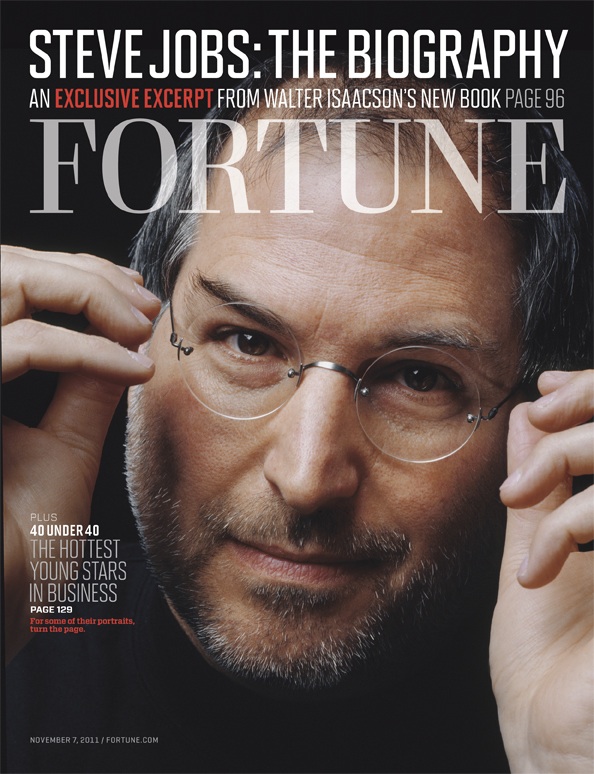
Fortune Magazine will have an exclusive excerpt of the Walter Isaacson biography Steve Jobs which is due for publication on Monday, the 24th. The excerpt is said to focus on the Frenemy relationship that Jobs had with Microsoft Founder Bill Gates.
The magazine has secured exclusive rights to the sections in Walter Isaacson’s Steve Jobs devoted to Jobs’ relationship to Bill Gates.
The excerpt will hit newstands and the Fortune iPad app on Monday and an ‘excerpt of the excerpt’ will be published online. Most 9to5Mac readers will probably prefer the book which will be released to the public the same day in both hardcover and electronic formats.
Isaacson will also go on 60 Minutes on Sunday promoting the book as well. Steve Jobs is available from Amazon for $17.88 for hardcover, $16.99 for Kindle and $19.79 for CD Audiobook. It is also available online at the iBookstore for $16.99 for iOS devices.
Shawn Blanc (via The Next Web) calculated this morning that Apple is selling 16 iPhone 4Ss a second, or roughly 1,000 a minute. Blanc’s figuring comes after Apple announced this morning that there were 4 million iPhone 4Ss sold its opening three-day weekend. Figures are also expected to expand as the iPhone 4S is introduced in 22 more countries on the 24th.
Reaching this milestone, Apple is on tract to pass Microsoft’s Kinect as the fastest selling consumer device of all time. Microsoft sold 8 million Kinects in the first 60 days, a number Apple could theoretically pass in the first two weeks.
The success of the iPhone 4S is most likely helped by a few factors:
We’re sure to hear more in Apple’s FYQ4 earnings call tomorrow afternoon.

As part of the Senate Judiciary hearings today, former FTC official (and new Google employee) Susan Creighton, testified under oath today that Google, Microsoft and Yahoo! all bid to become the default search engine on iOS’s Mobile Safari Web Browser. As we know, Google won, and as we can infer, Apple gets some revenue from Google for making it its default search engine. As we know from Apple being Apple, the quality of the search results was probably as big a part of the decision as the relatively small bits of revenue.
But as part of the testimony, Creighton said briefly (before she was cut off) that 2/3rds of mobile search comes from Apple iOS devices. That’s pretty interesting considering the share of Android devices in the market. But not altogether surprising considering the web browser market share which includes those millions and millions of iPads.
Video at 2:24.00 (during very interesting testimony around Apple picking Google as default search)