Microsoft

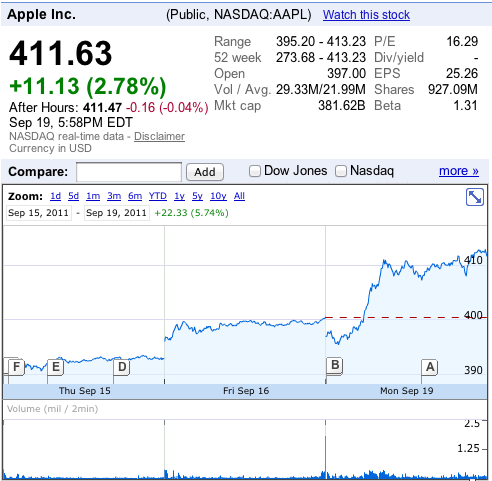
We’re not sure exactly what caused today’s spike, but Apple stock had a huge day ending up 2.8% at $411.65 a share for a Market Cap of $381.62B against a down market. It had reached as high as $413.23 from a morning low of $395.20. Notably, Apple is now worth over $23B more than Exxon and is approaching the combined value of Microsoft and Google.

[youtube=http://www.youtube.com/watch?v=ntSdfGzF60M]
Winrumors has posted a very thorough 11 minutes of an iPad 2 running iOS 5 compared to a Windows 8 Slate. The video above goes over almost every feature that these tablets offer, from lock-screen to social network integration.
Biggest difference? One has been available for a year and a half, the other won’t be ready for another year.
Expand
Expanding
Close
Announced on the Skype Blog, Microsoft-owned Skype now integrates with (5% Microsoft-owned) Facebook on Mac. With the update, your Facebook friends will be able to see your online status and Skype you without leaving the Skype application. As per usual with Microsoft applications, the Mac version trails behind the Windows version…and as a bonus, non-paying Skype users will now see ads.
Today we’re launching Skype 5.4 for Mac Beta. The launch introduces the same Facebook integration found in Skype 5.5 for Windows. We are excited to finally deliver Facebook integration to our Mac users.
Just like in our Windows client, you will now be able to IM and connect with your Facebook friends without leaving Skype. You will also be able to read and update your News Feed, as well as comment and ‘Like’ your Facebook friends’ posts – all within Skype for Mac. To connect to Facebook, simply sign into Skype, click on the Connect to Facebook tab and enter your Facebook sign in details.
We are also introducing an advertising platform in this new release, but if you are a paying Skype consumer or have Skype Credit, you won’t see any display ads; similar to the model that is currently being used in our Skype for Windows client.
Download Skype 5.4 for Mac OS X Beta. We’re sticking to 2.8, in case the snarkiness didn’t tip you off.
Expand
Expanding
Close
 Today was Microsoft’s Windows Tablet 8 unveiling. The product on the surface looks cool, people are hyped, but alas it will be a year before real products are given to real people. The iPad 3 with its Retina Display will have been on the market for months and Google will have iterated 10,000 Beta releases of Android before then on 200 different pieces of tablet hardware.
On top of that, this new OS is really just smashing together Windows Phone 7 Metro UI Windowing (some admittedly nice UI features) with Windows 7 applications. Real world use of Windows 7 apps in tablet form isn’t going to be fun. I’ve tried using Windows on the Parallels iPad app – and it is OK in a pinch, but apps need to be redesigned 100% to work in tablet mode effectively. Try entering data into Excel on a tablet for instance. Then try Numbers on an iPad – it is slightly better.
Luckily, just about every iOS app was designed or redesigned first for touch over the past four years. Microsoft is, today, telling its developers to do the same for their Windows apps.
How long can Microsoft keep up its “next year” strategy? Windows 8 tablet isn’t the only thing coming “Next Year”.
Two years ago, Microsoft made the decision to scrap Windows Mobile and said: “Next year we’ll have Windows Phone 7”. When Windows Phone didn’t grab much attention at the end of last year, Microsoft ‘bought Nokia’ and said, by the end of this year we’ll have some top quality phones from Nokia. We’re waiting to see how that pans out, but by the time Nokia can produce anything with a Windows logo on it, it will have fallen from #1 in the world in smartphones to #4 or #5 behind Apple, Samsung and probably HTC and RIM. But Windows Mango devices are coming to AT&T, have you heard?
How did this “wait until next year” thing become business as usual for Microsoft?
Expand
Expanding
Close
[youtube=http://www.youtube.com/watch?v=59mP3R4I8wU]
Joanna Stern at the Verge does an overview of the Windows 8 Samsung tablet that Microsoft is displaying at BUILD today.
One caveat noticed by DF:
However, fan noise is very noticeable, as is the heat coming out of the top vent, and a fast boot doesn’t excuse the slow wake-up times compared to ARM-based cellphones and tablets.
Tablet devices running Windows 8 should be showing up next year and look to take on Apple’s dominance in tablets with its iPad (which should be on version 3 by then).

This is a Samsung-branded Windows 8 tablet Microsoft is giving away to BUILD attendees today.
The latest in the ongoing patent saga involving Apple, Google, Motorola and Samsung includes an unexpected twist as Samsung goes after iPhone and iPad with a complaint filed before a Paris district court in July. The filing alleges infringement of Samsung’s three technology patents, reports AFP. The first hearing is expected in December of this year.
Meanwhile, patent expert Florian Müller notes on his blog FOSSPatents that Apple has filed motions to temporarily halt two Motorola lawsuits until Google completes its $12.5 billion acquisition, which shook the technology world last month. Put simply, Apple argues Motorola waived its rights to sue when it transferred patents to Google. Apple wrote:
To further its pending acquisition by Google, Motorola has surrendered critical rights in the patents-in-suit, such that Motorola no longer has prudential standing to pursue this action. According to the publicly-filed Merger Agreement, Motorola has ceded control of the most basic rights regarding the patents-in-suit
As you know, Google has transferred some of the Motorola patents to HTC, in addition to the ones acquired from Palm and Openwave Systems. HTC then used those patents to counter-sue Apple. Back to Apple vs. Samsung…
Financial Times today opined that Samsung needs to hit the reset button, predicting a licensing agreement of sorts provided Apple succeeds in blocking Galaxy products in the U.S. next month. Contrary to the reports, the publication thinks “Apple is restricted from taking its chip business to Samsung’s rivals in Taiwan because Samsung offers a complete package of components that other firms cannot match”. However, there are indications that Apple’s been lowering Samsung orders for some time and it’s widely believed the company is eager to take its silicon business to TSMC beginning next year.
TechCrunch points us to this amusing Microsoft blog post articulating the decision to put just about every possible item in the future Windows Explorer 8 bar.
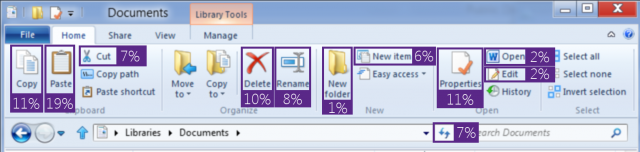
This is clearly an example of trying to put everything somewhere with no regard for clutter or usability or design. It is hard to imagine a better example of why Apple’s ability to say no to extraneous features is better for usage.
Assuming Android goes proprietary to Motorola, it falls behind Apple in market share by 2012 and Windows Phone (the Other category) gulps up nearly half the mobile phone market.
There’s a good reason why Apple’s products “just work”. But it’s been a bumpy road for the Cupertino, California company because right from the onset competitors were ridiculing its vertically integrated approach to business. Apple’s supposedly ‘closed’ ecosystem is a major weakness, critics cry. The past decade, however, saw the marketplace validate the strategy through booming sales of Apple gear. But what if GOOG actually tried the AAPL model with Motorola, which today makes about one in ten Android smartphones?
That’s the dilemma Piper Jaffray resident Apple analyst Gene Munster set out to explore in his Friday note to clients. In short, making Android proprietary and exclusive to Motorola would add about 35 percent to operating income for Google, the accidental hardware company. By 2015, the phone biz would add $10.5 billion in operating profit and $56 billion in revenue, resulting in a per-share earnings of $25.16 by 2015. There’s just one problem with this hypothetical strategy:
Expand
Expanding
Close


It’s no secret patent-related legal disputes have become the subject of most media coverage lately…Whether it’s Apple halting sales of Samsung’s tablets, HTC going after Apple, or Google snatching up Motorola to beef up their patent portfolio, it’s clear the company with the most patents will have an advantage over others in the legal proceedings that we’re bound to continue encountering down the road. This is why we’re intrigued by the graphic above (via GigaOM) from mobile analyst Chetan Sharma charting the number of issued patents (in the US and Europe) between 1993 and 2011.
While these estimates of mobile communications related patents don’t take the quality of patents into account (which is obviously a huge factor in determining their long-term value), you can see from the breakdown below that Nokia and Samsung top the list, with the other expected players including IBM, Microsoft, Sony, Motorola, and Intel following.

Noticeably far down the list is Apple, the one company who seems to have had more success than others fighting patent-related issues recently. Again, these numbers in no way represent the quality of patents and the ability for companies to protect their IPs in the courtroom… which is also a good indication that perhaps we should be looking more closely at the quality of patents rather than the sheer number.

Recently patent expert Florian Mueller took to Twitter following the Google/Motorola acquisition saying he“would caution everyone against overestimating the strength of Motorola Mobility’s patent portfolio,” he continued, “Apple and Microsoft sued Motorola Mobility anyway”. Remember kids… all patents aren’t created equally.
Expand
Expanding
Close
Apple, Microsoft and Intel are locked in a bid for a contract to supply Turkish schools with up to fifteen million iPads. The government-funded project is nick-named “Fatih”, a Turkish word for “conqueror”. The government will require the winner to build the tablets and/or peripherals in the country, however. This little nugget has been officially confirmed to Anatolia news agency by the country’s trade minister Zafer Caglayan. Bloomberg has the story:
Apple officials told Caglayan during his visit to the U.S. that the Cupertino, California-based maker of smart devices may also decide to use some Turkish manufacturers to make some peripheral equipment such as covers, earphones for its iPad and iPhone models, Caglayan said at a news conference with Turkish reporters in Seattle, according to the Ankara-based agency.
Frankly, we somehow don’t see Apple building fifteen million iPads in Turkey as the country may lack the manufacturing capacities necessary to produce such a precisely engineered gadget that is the iPad. As for Microsoft and Intel, the Windows maker “may inquire about the project” and Intel could be interested in opening a research and development center in Turkey.
Facebook isn’t fantastic at hiding secret stuff in their Apps. Just last month, its iPad ambitions were outed by some folks rummaging around in the App. Today, Facebook released their Messenger app and seconds later, we see that there is a video component to the application:

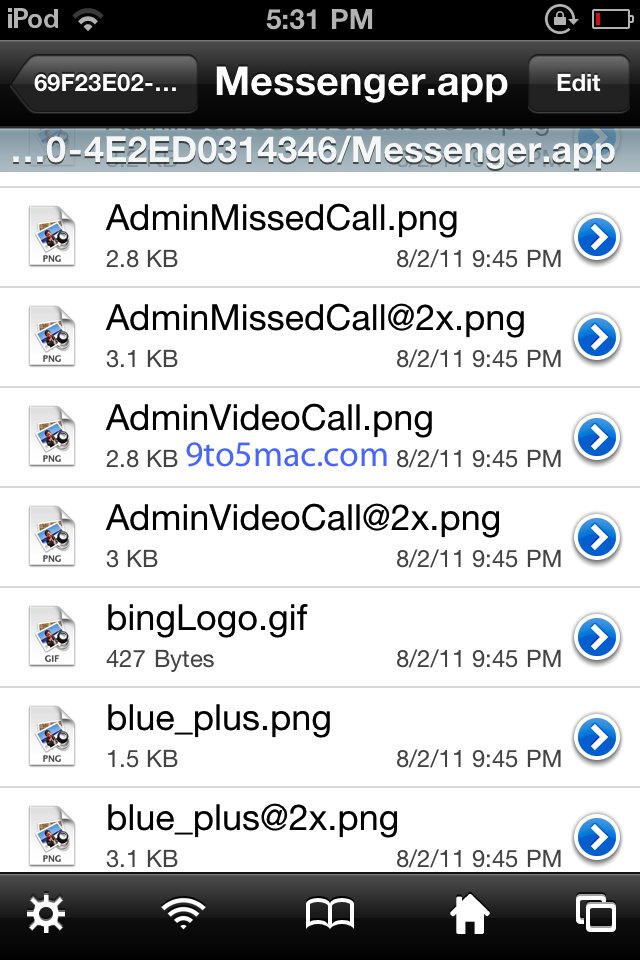
The video component would seem to work on both Android (yep) and iPhone and would likely tie in with their recently announced Skype desktop video conferencing service as well. The code looks very rudimentary at this point so it isn’t certain that the video can be enabled like the iPad version was with just a few tweeks. Thanks Caleb!
The eye-popping chart above (via Fortune) shows Apple is on course to take control of global market share for portable computers (laptops, notebooks, and tablets) in the second quarter of 2011 – but that’s only as some analysts switch to accounting iPads as computers. Deutshe Bank’s Chris Whitmore, author of the chart, describes his findings:
Within the computing market, we see significant opportunity for Apple to take meaningful share in the second half as the Microsoft / PC ecosystem is relatively stagnant, lacking meaningful new offerings.
Many will be quick to point out the spike is due to taking iPad sales into consideration, a device that many analysts debate shouldn’t be considered as a competitor to notebooks and other portable PCs. However, Apple is steadily gaining ground on Dell, Hewlett-Packard, and Microsoft even without the iPad. Whitmore explains:
On the other hand, Apple will be competing with an upgraded Mac OS, new MacBook Airs (and other forthcoming Macs) and a new iPad iOS. Within the Tablet market, the iPad remains the Gold Standard as competitors struggle for mindshare and traction (note HP’s price cuts on the TouchPad). Meanwhile, competing PC manufacturers have suggested Ultrabooks won’t ramp in material volumes until 2012 due to challenges driving price points meaningfully below Apple’s Air. As such, Apple appears particularly well positioned for more share gains heading into the back-to- school and holiday selling season.
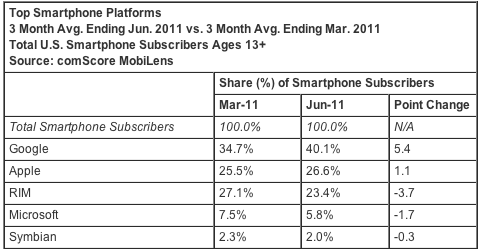
While Google passed the 40% smartphone share (Microsoft must be happy!) in the US threshold, Apple continues to outpace the industry as a whole posting modest 1 point gains in the US smartphone category according to comScore. Apple moved up from 25.5% in March to 26.6% in June on the year old iPhone 4 model which also saw its US debut on Verizon.
Apple also moved up in the hardware category, below:

Skype dropped a new Mac Client on us today, a day ahead of the Super “Awesome” Facebook announcement that is rumored to include Skype. New features for the unpaid version include “super awesome” background video chatting control bar. Pony up a few bucks and get yourself up to Windows level (they got a head start on Microsoft tactics!) with Group video conferencing that looks and acts nothing like Apple’s built in iChat group teleconferencing (this was in 5.1Beta as well). Also, screen and document sharing.
The Windows version – just to make sure it is one step ahead of the Mac version – got Facebook integration with the 5.5 update.
If you aren’t still at the standard 2.8 like us, have a look at the tips and tricks to see if you’re a good update candidate (we’re staying put).

We were pretty stoked two weeks ago to see the iPad version demoed only to have Skype go silent on the product last week. We’re thinking it might be happening at the Facebook introduction on Wednesday….about the same time as the Google Plus App hits. Via TechCrunch
Expand
Expanding
Close

A consortium including Apple Inc, Microsoft, EMC Corp, Sony, Ericsson, and BlackBerry maker Research In Motion bought bankrupt telecommunications gear maker Nortel Networks Corp’s remaining portfolio of 6000 patents for $4.5 billion, in an auction that began early this week.
RIM reportedly paid $770 million, Ericsson paid $340 million. It wasn’t immediately clear how much Apple paid.
Google had originally opened bidding with a $900 million bid. The consortium of strange bedfellows will split up the portfolio based on the split of the purchase price.
The sale is subject to Canadian and U.S. court approvals which will be sought at a joint hearing expected to be held on July 11. Full press release follows:
. .
.
At this point, it seems pretty obvious that Google means business with the Google Plus platform. Besides all of the other areas Plus has engulfed, it looks like Google is heading into the gaming realm. The above snippet was found in the Plus web page code
“have sent you invites and more from Google+ Games”
So now Google is taking on Microsoft’s Xbox and Apple’s Gamecenter? Perhaps Google might want to lower the barrier to entry.
Expand
Expanding
Close
[youtube=http://www.youtube.com/watch?v=xwnJ5Bl4kLI]
You have to be intrigued by Google’s ambitious attack on Facebook here, in much the same way they are competing with Apple in mobile devices, Microsoft in DesktopOS and Office and Oracle/Microsoft in Enterprise Apps. It feels like if there is a big market in technology, Google is there.
More coverage at 9to5Google.com
Expand
Expanding
Close

Nortel decided to extend the deadline for the start of the auction for its patents until June 27 citing “significant interest” from third parties. Today we learn that two Silicon Valley giants are significantly interested in Nortel’s war chest of more than five thousand wireless patents said to be worth well over a billion dollars. They are Apple and Intel, reports The Wall Street Journal.
Other bidders include Ericsson AB and a company called RPX Corp which “defensively buys up patents on behalf of other companies to stop them from being used against them by investors”.
Expand
Expanding
Close
More trouble in Microsoft land as Bloomberg reports that Microsoft device manufacturers are complaining about the software giant’s meddling in their affairs:
Microsoft Corp. is putting “troublesome” restrictions on makers of processors used to run the coming Windows tablet-computer operating system, Acer Inc. Chairman and Chief Executive Officer J.T. Wang said.
“They’re really controlling the whole thing, the whole process,” Wang said at the Computex trade show in Taipei without identifying the restrictions. Chip suppliers and PC makers “all feel it’s very troublesome,” he said.
Can you even imagine a PC manufacturer standing up to Microsoft publicly in a pre-iPad world? While Acer is moving to Google for many of their tablet products, and even ChromeOS for one of their notebooks, Acer is still one of the three biggest Windows PC manufacturers on the planet and of course is expected to make Windows 8 slates…
Expand
Expanding
Close
http://www.foxcharlotte.com/v/?i=119900869
Charlotte local news channel WCCB-TV did some snooping around the new Apple Maiden, NC data center and details the facility including the possibility that Apple may open a campus in the area on another 70 acres they’ve purchased.
Expand
Expanding
Close
The above video pits browsing capabilities of Windows Phone’s Internet Explorer 9 mobile running on a “Mango” device against iOS’ Safari browser running on an iPhone 4 and Android’s WebKit-based browser running on a Samsung Nexus S. The results clearly show IE taking the lead in terms of speed. WinRumors explains that the Windows Phone browser came in first with 20 frames per second versus only two frames per second for mobile Safari, or ten times slower. Android came in second with 11 frames per second.
Naysayers are free to test their device themselves by visiting said benchmark in mobile Safari. Something’s fishy here, if you ask me. The HTML5 speed reading test comes from the Microsoft-operated ietestdrive.com site and it’s just one of many available tests. How do we know the test wasn’t specifically designed to favor Microsoft’s mobile operating system? It wouldn’t be the first time flawed testing was used to bash Apple’s browser. Read on…
Expand
Expanding
Close
Here’s some interesting news from the periphery. In Europe, where Microsoft was forced to institute a ‘browser ballot ‘upon the installation of Windows (giving Opera, Safari, Chrome, Firefox and IE equal billing), Firefox has just passed IE as the most popular browser on the continent.
That’s according to Statcounter who told Reuters “This appears to be happening because Google’s Chrome is stealing share from Internet Explorer while Firefox is mainly maintaining its existing share. We are probably seeing the impact of the agreement between European Commission competition authorities and Microsoft, to offer EU users a choice and menu of browsers from March last year.”
Given equal footing with other browsers, users just don’t pick IE (remember this ballot is only a year old and it will likely get much worse for Microsoft.
Full graph below:
Expand
Expanding
Close
Apple isn’t at CES once again this year and as per usual Cupertino’s shadow looms above the giant US trade show, where it seems competitors, including Microsoft, intend introducing their own iPad competitors, even as we learn that existing Android tablets may never get a software upgrade. Some highlights:
Expand
Expanding
Close
Bloomberg today reports what would have seemed unthinkable a year ago. Microsoft is building a version of its Windows OS (not Phone 7) for the ARM processor design, the very same that powers Apple’s lineup of iOS devices.
The operating system would give Microsoft another way to attack the market for tablets and phones, where it’s lost ground to Apple Inc. and Google Inc. ARM chips — made by Qualcomm Inc., Texas Instruments Inc. and Samsung Electronics Co. — are used in most smartphones, as well as Apple’s best-selling iPad. A full-featured version of Windows for ARM chips is the best way for Microsoft to make a dent in the iPad’s lead, said Robert Breza, a Minneapolis-based analyst for RBC Capital Markets. While Windows is dominant in the personal-computer market, it hasn’t parlayed that into tablet success yet. “They’ve got to come back with a product that’s better than ‘me too’ and is equal if not better in features,” Breza said. He has an “outperform” rating on Microsoft’s stock, which he doesn’t own. “A lot of tablets today are inferior to PCs.”
Microsoft became a licensee of the ARM architecture earlier this year but at the time it seemed to be for embedded devices such as the Zune. Apple is also an ARM licensee and builds its A4 lineup of chips using ARM designs.
Is this really a good move for Microsoft? The problem with Windows 7 on tablets hasn’t really been an Intel problem necessarily. Whatever the case, this has to be bad news for Intel/AMD who now may see competition from ARM processors like the Nvidia Tegra 2 in netbooks running Windows.
Another Question: Will Apple port Mac OS to ARM?
Expand
Expanding
Close

