patents

See All Stories

Obama administration vetoes Apple iPhone 4, 3G iPad 2 U.S. import ban

Site default logo image

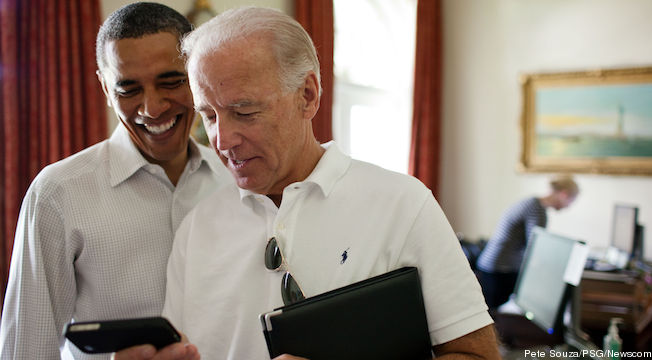
President Obama and Vice President Biden with an iPhone

United States President Barack Obama and his administration have issued a veto on a potential ban for iPhone 4 and 3G-capable iPad 2 models in the United States. The news comes by way of a notice from the U.S. Government. The official ruling comes from Michael Froman, a trade representative for the United States:

In addition, on January 8, 2013, the Department of Justice and United States Patent and Trademark Office issued an important Policy Statement entitled “Policy Statement on Remedies for Standard-Essential Patents Subject to Voluntary FRAND Commitments” (“Policy Statement”).2 The Policy Statement makes clear that standards, and particularly voluntary consensus standards set by standards developing organizations (“SDO”), have incorporated important technical advances that are fundamental to the interoperability of many of the products on which consumers have come to rely, including the types of devices that are the subject of the Commission’s determination. The Policy Statement expresses substantial concerns, which I strongly share, about the potential harms that can result from owners of standards­essential patents (“SEPs”) who have made a voluntary commitment to offer to license SEPs on terms that are fair, reasonable, and non­discriminatory (“FRAND”), gaining undue leverage and engaging in “patent hold­up”, i.e., asserting the patent to exclude an implementer of the standard from a market to obtain a higher price for use of the patent than would have been possible before the standard was set, when alternative technologies could have been chosen. At the same time, technology implementers also can cause potential harm by, for example, engaging in “reverse hold­up” (“hold­out”), e. g., by constructive refusal to negotiate a FRAND license with the SEP owner or refusal to pay what has been determined to be a FRAND royalty.

The would be, no-longer affected Apple devices include the iPhone 4, iPhone 3GS, iPad 2 3G, and the original 3G-capable iPad. This ruling mostly affects the iPad 2 and the iPhone 4 as those are the pertinent products that Apple actually currently sells in the U.S. The President’s block of the ITC ban is the first block of this kind since the 1987 Reagan administration.

Newer iPhone and iPad models, such as the iPhone 5 and 3rd/4th generation iPad, are not affected because they use a different cellular chipset design.

Both Apple and Samsung have both responded to the news. 

You can read the full letter from the government below:


Expand
Expanding
Close

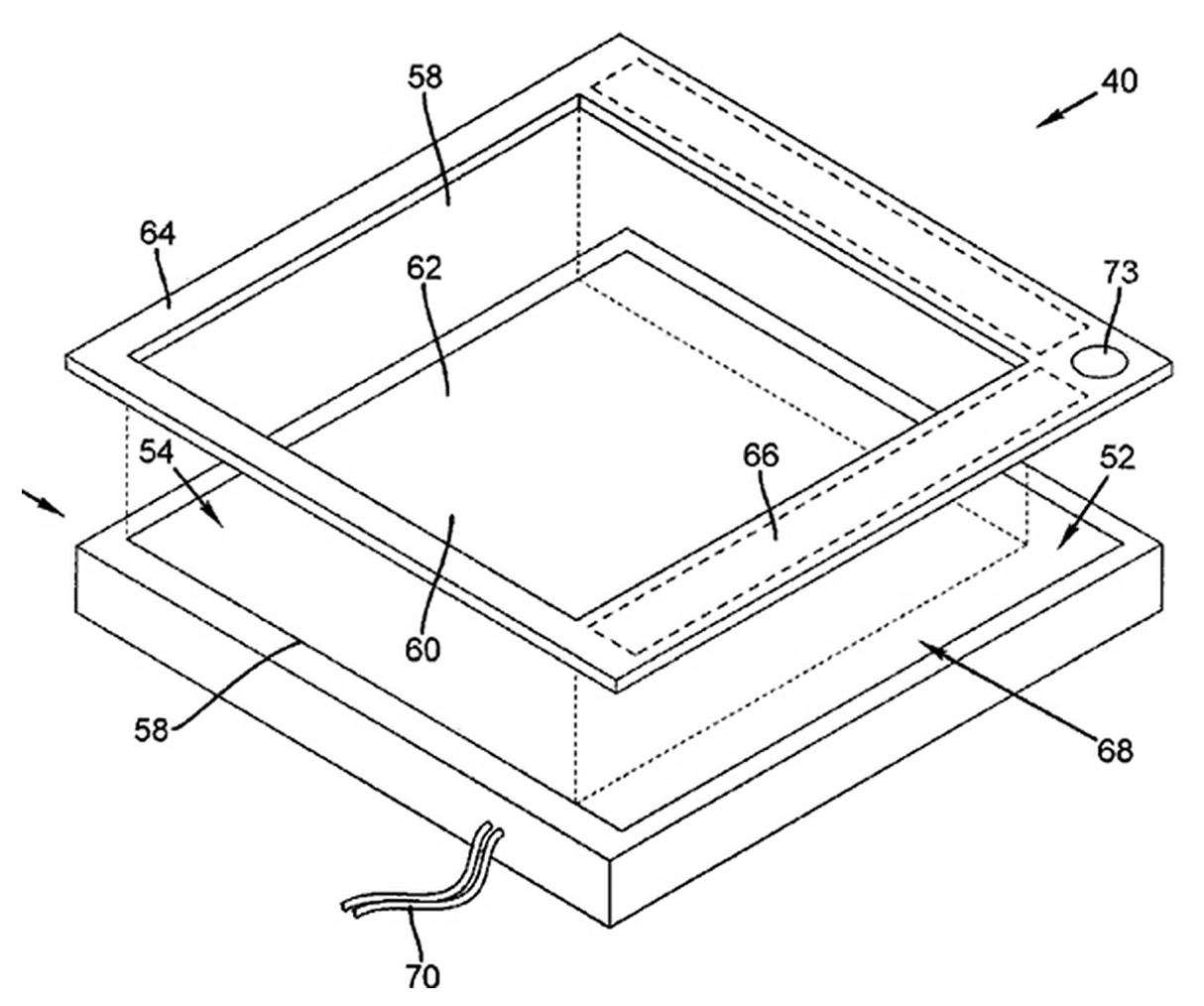
Apple picks up Digital Dash touch screen dashboard patent that could improve iOS in the Car

Site default logo image

A new Apple patent published today by the United States Patent and Trademark office (via AppleInsider) could show some of Apple’s future plans for bringing iOS to the car through its partnership with various car manufacturers. Earlier this year at WWDC, Apple showed off its new iOS in the Car feature that will bring enhanced iOS integration for apps such as Maps and Siri to select vehicles sometime next year. Today, Apple describes how it could also be doing some work on the touch panels that will control these new in-car features. 
Expand
Expanding
Close

Apple details Waze-like crowd-sourced route ratings and incident reporting for real-time traffic alerts in Maps

Site default logo image

According to a new Apple patent application published today by the U.S. Patent and Trademark Office (via AppleInsider), Apple is looking into new mapping features that would integrate real-time, crowd-sourced traffic and navigation data through ratings and user reporting.

At first glance the features appear to be similar to those included in the community-based mapping app ‘Waze’, which is one of the reasons that Google just acquired the company last month. The patent application, titled “User-Specified Route Rating and Alerts,” describes a system for users to “provide ratings for routes, streets and/or locations.” In other words, users can rate a suggested route when getting directions in order to provide crowd-sourced feedback to Apple and in return Apple will provide the most efficient and accurate routes to other users based on the ratings:

Particular implementations provide at least the following advantages: Route determination is improved by accounting for real-world considerations and concerns of travelers. Real-time user-generated alerts allow for faster and more accurate notification of events within proximity of a user that might hinder the user’s progress as the user travels… In some implementations, rating database 110 can store information related to users’ ratings of routes and/or locations. For example, a user of mobile device 102 can interact with navigation engine 104 to provide ratings for routes and/or locations. The ratings information provided by the user can be transmitted to navigation service 106 through network 114. Navigation service 106 can store the ratings information in rating database 110 and route engine can determine routes based on the ratings information stored in rating database 110.

Apple also walks through a process of gathering user-generated alerts for routes including accident reports, road closures, etc. Apple plans on taking all the alert and route rating data and providing it to other users in real-time to improve route directions. In other words, if your device is detected to be in the same location as a user-generated alert, Apple will be able to push that alert to your device or suggest an alternate route based on the incident that’s been reported:


Expand
Expanding
Close

Apple granted new patent that could add touch controls to the bezel

Site default logo image

Apple has just been granted a patent for a new technology that could bring touch controls to the bezel of a device with a small display (via AppleInsider). The technology would be able to dynamically change between a place to simply hold onto the device with and an area for controls. Apple describes it as an “Electronic device, display and touch-sensitive user interface” and says the technology is centered around a layered stack of touch sensors and displays around the edge(s) of a device that could be selectively activated and deactivated.

For example, with the iPad mini, Apple wanted to get the 7.85-inch display in as small a package as possible, which meant a smaller bezel. A smaller bezel meant that it would be harder to hold without accidentally touching the display. To solve this, Apple developed a technology that was able to detect accidental touches versus intentional touches. This new patent could lead to a bezel that could only be present when needed and other times it could be used for controls or could even blend in with everything else and create a true full-screen appearance, ideal for gaming and consuming content. 
Expand
Expanding
Close

Site default logo image

Samsung could settle in EU antitrust case over use of essential patents against Apple

Reuters reports that Samsung is currently in preliminary discussions with EU regulators regarding a possible settlement related to charges that it abused its market dominance by blocking Apple from fairly using its essential patents in various ongoing patent disputes:

The talks came after the European Commission, which acts as EU competition regulator, told Samsung in December that it was acting unfairly by seeking injunctions against Apple over use of the essential patents.

“Samsung has been involved in settlement discussions for several months now. Samsung wants to settle,” said one of the sources, who declined to be identified because of the sensitivity of the matter.

If Samsung does settle in the case, it could avoid as much as $17.3 billion in fines. However, it would presumably have to agree to license its essential patents on fair terms, which could have an impact on current cases related to the European Union’s 3G UMTS standard.

Apple patent application describes fingerprint sensor tech rumored for iPhone 5S

Site default logo image

There have been no shortage of fingerprint sensor rumors surfacing since Apple acquired Authentec last year. According to several reports from analysts, including the often reliable Ming-Chi Kuo and the not as reliable Topeka Capital analyst Brian White, Apple’s next-generation iPhone is likely to include a fingerprint sensor. We’ve discussed how it could certainly make a stand out hardware feature for Apple’s expected “S” upgrade, and today the US Patent and Trademark Office published patent applications that show Apple could be experimenting with exactly that (via PatentlyApple).

According to one aspect of the present disclosure, a biometric sensor assembly, such as a fingerprint sensor, comprises a substrate to which is mounted a die containing sensor circuitry and at least one conductive bezel. As used in the description and claims that follow, “bezel” means a unitary, substantially uniformly composed structure, most typically metal or conductive plastic. The die and the bezel are encased in a unitary encapsulation structure to protect those elements from mechanical, electrical, and environmental damage, yet with a portion of a surface of the die and the bezel exposed or at most thinly covered by the encapsulation or other coating material structure

The patent describes a process of embedding a fingerprint sensor into the bezel of a device, which sounds a lot like the finger print sensors Validity was showing off embedded in Android devices at CES this year (pictured right). Apple notes in the patent application that the sensor would be “approximately the width of an average user’s fingertip, but only several pixels tall, typically between 1 and 8 pixels, and possibly as many as 16 pixels tall” when viewed from above.

Apple doesn’t get too into what functions for users the fingerprint sensor would provide, but does note that “the sensor captures a number of thin strips of the fingerprint as the finger is swiped, and the complete fingerprint is assembled in software for use in authentication.”
Expand
Expanding
Close

Site default logo image

Apple wins rubber-banding patent case against Samsung in Japan

Reuters reports (via Techmeme) that Apple has persuaded a Japanese court that Samsung did indeed infringe its patent of the rubber-banding or bounce-back user-interface feature.

Apple claimed that Samsung had copied the “bounce-back”, in which icons on its smartphones and tablets quiver back when users scroll to the end of an electronic document. Samsung has already changed its interface on recent models to show a blue line at the end of documents …

The ruling, due to be announced in detail later today, means that Samsung may have to withdraw from sale in Japan some of its early models that incorporate the feature.

The same claim had earlier initially been rejected in the U.S. back in April by the U.S. Patent and Trademark office, allowing Samsung’s older handsets to remain on sale within the country, a decision that was reversed earlier this month.

Obama administration plans to curb patent trolling with 5 step plan

Site default logo image

The WSJ reports that after years of worsening patent legislation in the US, the Obama administration has finally decided to try to do something about it.

The president has taken a dim view of certain patent-holding firms. In February, he said some firms “don’t actually produce anything themselves. They’re just trying to essentially leverage and hijack somebody else’s idea to see if they can extort some money out of them.”

Apple, depending on who you ask, is sometimes the agressor in patent cases but is often the victim of  frivolous lawsuits that often earn these patent holding companies millions and millions of dollars. These companies aren’t really companies at all; instead they are just shell companies built around a patent or a portfolio of patents, which are often overly broad or were never intended to be used in a particular way.

These lawsuits often take place in courts in Eastern Texas, where judges are notoriously friendly to trolling interests.

Some examples of companies who’ve questionably sued Apple or its interests: VirnetXPersonal Audio LLC, Lodsys, Motorola? etc.

The administration’s plans in 5 steps:


Expand
Expanding
Close

ITC will reconsider previous ruling that Samsung infringed Apple text-selection patent

Site default logo image

Back in April we noted that the International Trade Commission had handed down a preliminary ruling that Samsung infringed an Apple patent related to a text-selection feature in a number of its Galaxy devices and other smartphones. Today, Reuters reports that an ITC trade panel will now reconsider the decision in a review of the previous ruling ahead of a final decision in the patent battle:

The International Trade Commission said late Tuesday it would take a second look at an ITC judge’s decision that Samsung had infringed one Apple patent for a text-selection feature in its smartphones and tablets.

Bloomberg adds that the panel is looking for “additional arguments on three of the four patents that Judge Thomas Pender said were infringed, and comments on how an import ban would affect the public.”

The panel will also reconsider a decision in the same case that Samsung didn’t infringe a different patent related to detecting when other devices are plugged into a microphone jack.

The ITC, which could impose an import ban on accused devices, is expected to deliver a ruling in Samsung’s case against Apple on May 31. A final decision in Apple’s case against Samsung is expected on August 1st. 
Expand
Expanding
Close

Apple claims Google Now infringes Siri patents as it adds Galaxy S4 to ongoing Samsung patent suit

Site default logo image

Earlier this month we noted that Apple was asking courts to add the Galaxy S4 as an infringing device in its ongoing patent dispute with Samsung in California. Now, Apple has officially filed a motion (via FossPatents) outlining five patents infringed by the Galaxy S4 and another two Siri related patents infringed by the device’s Google Now voice controlled search feature.

Apple had previously claimed that the Android Google search box feature on Samsung devices infringed the same patents, but is now moving to have Google Now included alongside the S4. Excerpt from Apple’s filing below:
Expand
Expanding
Close

Apple seeks to add Galaxy S4 to ongoing Samsung patent suit in California

Site default logo image

In its ongoing second major patent trial against Samsung, Apple yesterday filed a statement with the US District Court in California claiming that after examining the recently released Galaxy S4 it has “concluded that it is an infringing device and accordingly intends to move for leave to add the Galaxy S4” to its long list of 22 infringing products. Apple is hoping Judge Lucy Koh allows the S4 to be added, but in line with the court’s request to reduce the number of infringing devices ahead of a trial scheduled for spring 2014, Apple has also agreed to remove without prejudice one of the other 22 infringing devices from Samsung it currently has listed.

Apple’s current list of infringing Samsung products include Admire, Captivate Glide, Conquer 4G, Dart, Exhibit II 4G, Galaxy Nexus, Galaxy Note, Galaxy Note 10.1, Galaxy Note II, Galaxy Player 4.0, Galaxy Player 5.0, Galaxy Rugby Pro, Galaxy SII, Galaxy SII Epic 4G Touch, Galaxy SII Skyrocket, Galaxy S III, Galaxy Tab 7.0 Plus, Galaxy Tab 8.9, Galaxy Tab 2 10, Illusion, and Stratosphere.

The filing also highlights a disagreement in which Samsung believes each carrier variant of a specific device should be counted separately. For example, “the Galaxy Nexus activated on Sprint must be counted separately from the Galaxy Nexus activated on Verizon; and the Galaxy Nexus operating on Sprint running Android version 4.0 must be counted separately from the Galaxy Nexus operating on Sprint, but running Android version 4.1.” Apple, however, claims that Samsung has not itself applied this logic:
Expand
Expanding
Close

Apple requests Android source code documents from Google in ongoing Samsung patent suit (update: Apple wins)

Site default logo image

Update: Bloomberg reports Apple has now won an order granting its request for Google to provide more information about its process of turning over documents in an ongoing lawsuit with Samsung:

U.S. Magistrate Judge Paul S. Grewal in San Jose, California, ordered Google within two days to disclose what terms it’s using to find documents Apple has requested in pretrial information sharing, and to tell Apple which Google employees those documents came from. Google had argued the collection of information would be too burdensome.

“The court cannot help but note the irony that Google, a pioneer in searching the Internet, is arguing that it would be unduly burdened by producing a list of how it searched its own files,” Grewal wrote in his order.

Bloomberg reports that Apple has requested Google turn over documents related to Android’s source code in an ongoing patent-infringement lawsuit with Samsung in California. According to the report, Apple took issue with Google’s process of turning over requested pretrial documents claiming Google is “improperly withholding information” and that Android “provides much of the accused functionality” in the infringement claims related to several of Samsung’s Galaxy products:
Expand
Expanding
Close

EU Commission says Motorola’s injunction against Apple in Germany amounts to abuse, prohibited by antitrust law

Site default logo image

As if we needed someone to tell us that the ongoing patent lawsuits between Apple and Motorola in Germany were getting a little out of control… Today the European Commission has finally stepped up calling Motorola’s enforcement of an injunction against Apple with mobile standard essential patents “abuse of a dominant position prohibited by EU antitrust rules.” The EU Commission, however, does note that the statement of objections sent to Motorola does not reflect the final outcome of its investigation into its use of standard essential patents (SEPs):

The Motorola Mobility SEPs in question relate to the European Telecommunications Standardisation Institute’s (ETSI) GPRS standard, part of the GSM standard, which is a key industry standard for mobile and wireless communications. When this standard was adopted in Europe, Motorola Mobility gave a commitment that it would license the patents which it had declared essential to the standard on FRAND terms. Nevertheless, Motorola Mobility sought an injunction against Apple in Germany on the basis of a GPRS SEP and, after the injunction was granted, went on to enforce it, even when Apple had declared that it would be willing to be bound by a determination of the FRAND royalties by the German court.

The EU Commission essentially states that Apple should be able to license the technology under fair, reasonable and non-discriminatory terms decided by a third-party, and that Motorola’s approach with its latest injunction could “distort licensing negotiations and impose unjustified licensing terms.” Back in February of 2012, Apple was for a short while forced to remove all 3G devices from its online store in Germany following the injunction, and at the time Apple noted that “Motorola repeatedly refuses to license this patent to Apple on reasonable terms, despite having declared it an industry standard patent seven years ago.”
Expand
Expanding
Close

Site default logo image

Apple reverses decision to change VPN on Demand in VirnetX lawsuit, but only for devices that already shipped

Due to a loss in a patent lawsuit that awarded patent holder VirnetX $368.2 million, we reported earlier this month that Apple would be changing the behaviour of its VPN on Demand features for devices running iOS 6.1 and up. The changes would mean a downgrade in functionality for users effectively forcing them to start the VPN client before they run an app, or before they open mobile Safari to access an intranet site.

Now, in a recently updated knowledge base article (via MacRumors), Apple appears to be backtracking on that decision informing customers it “no longer plans to change the behavior of the VPN On Demand feature of iOS 6.1 for devices that have already been shipped.”

Apple continues by stating “The ‘Always’ option will continue to work as it currently does on these devices.” It seems as if Apple and VirnetX have reached some type of settlement, but what this means for future devices that have yet to ship is unclear.

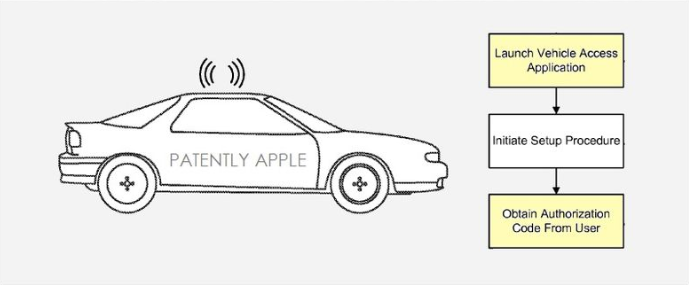
Your iPhone could replace your car’s key – and help you find it in an underground car-park

Site default logo image

Patently Apple spotted two car-related Apple patent applications, one allowing an iPhone to act as a smart-key, the other helping you locate your car when parked in a large car-park.

The smart-key idea uses a Bluetooth connection from the phone to unlock the car, which could be done either manually or via a proximity rule, unlocking your car as you approach it …
Expand
Expanding
Close

Site default logo image

Apple wins last of series of Motorola patent infringement claims

Apple has won the last of six patent infringement claims filed by Motorola, after the US International Trade Commission agreed with Apple that the patent was invalid for ‘lack of novelty’, aka being too obvious.

When you lift your iPhone to your face to make or receive a call, the touchscreen is disabled to prevent accidental input. Motorola claimed to have patented this approach, Apple argued that it was an obvious thing to do and the USITC has agreed with them. The other claims by Motorola, dismissed previously, related to wifi, 3G and UMTS.

Site default logo image

Judge says Apple and Google are using litigation as a business strategy, have ‘no interest’ in settlement

In an ongoing case in which Apple and Google’s Motorola have accused each other of infringing various mobile related patents since 2010, U.S. District Judge Robert Scola said in an order yesterday that the two companies have no interest in reaching a settlement. Bloomberg reports Scola said in his order that both companies are using the litigation as a “business strategy that appears to have no end”:

“The parties have no interest in efficiently and expeditiously resolving this dispute; they instead are using this and similar litigation worldwide as a business strategy that appears to have no end,” U.S. District Judge Robert Scola in Miami said in an order dated yesterday. “That is not a proper use of this court.”

“Without a hint of irony, the parties now ask the court to mop up a mess they made by holding a hearing to reduce the size and complexity of the case,” he wrote. “The court declines this invitation.”

The result is Apple and Google will now have a four month period to narrow their claims related to the case that now includes over 180 claims for 12 patents. Bloomberg notes that Scola said the case currently includes “disputes over the meaning of more than 100 terms,” and that the case would be put on hold until the disputes are resolved if the two companies are unable to come up with a solution before the four month timeframe expires.

Back in November there were reports that Apple and Google’s Motorola were considering a settlement and even submitted “proposals on using binding arbitration to reach a licensing agreement” for standard essential patents to courts in Wisconsin. At the time Apple said “such an agreement could lead to a global settlement of all of their patent disputes,” but the two companies couldn’t come to an agreement on the arbitration process.

Last year Apple and HTC announced they reached a global settlement in multiple patent-related cases that some analysts estimated could be worth as much as $180 million to $280 million annually. When it comes to Samsung, many reports quoted Samsung’s Shin Jong-kyun as claiming the company does not “intend to (negotiate) at all” following the HTC settlement.

Apple job listing confirms Apple is investigating using flexible displays in future products

Site default logo image

Update: Apple appears to have removed the job listing, but we grabbed a screenshot above and below.

We know that Apple has been investigating various methods of incorporating flexible displays in its mobile devices thanks to a handful of patents and patent applications published over the last year. Flexible display rumors have picked up steam even more since rumors of an iWatch from Apple, and just today we came across two new Apple patent applications detailing flexible devices that could change states as a user bends or twists the device. We all know Apple patent applications have never been a good indication of future product releases, but now Apple has came right out and stated in a job listing that it is indeed considering flexible displays.

Apple Inc. is looking for a Display Specialist to lead the investigation on emerging display technologies such as high optical efficiency LCD, AMOLED and flexible display to improve overall display optical performance.

The job listing seeking a Sr. Optical Engineer was posted earlier this month and looks for a display expert to investigate “high optical efficiency LCD, AMOLED and flexible display.” Specifically, Apple is requesting someone to “Analyze the trade-offs between design, process, optical performance, and implementation feasibility,” hinting that the company is considering introducing new, advanced display technology in the future:
Expand
Expanding
Close

More Apple patents detail completely flexible devices that change as they bend

Site default logo image

Update: The patent was granted on 6th January 2015 (via Apple Toolbox)

These are certainly not the first flexible display related patent applications that we’ve seen from Apple. A few different Apple patent applications have received attention in recent months, including one for a slap wrist-style bracelet with a flexible display, and others for curved and flexible displays in various iOS device-like form factors. Today we’ve come across a couple of recently published Apple patent applications filed as early as September of last year that further show Apple’s work with flexible displays (via UnwiredView).

The first patent application, titled “Flexible Electronic Devices” is pretty straight forward: Apple is interested in methods of providing not only flexible displays but also flexible components like batteries, circuit boards, and the housing of the device itself. Apple describes a device that could respond accordingly depending on how a user was manipulating the flexible display. The patent applications provides examples such as the device shutting off and entering standby mode when folded, or a user answering a call or changing volume:
Expand
Expanding
Close

Site default logo image

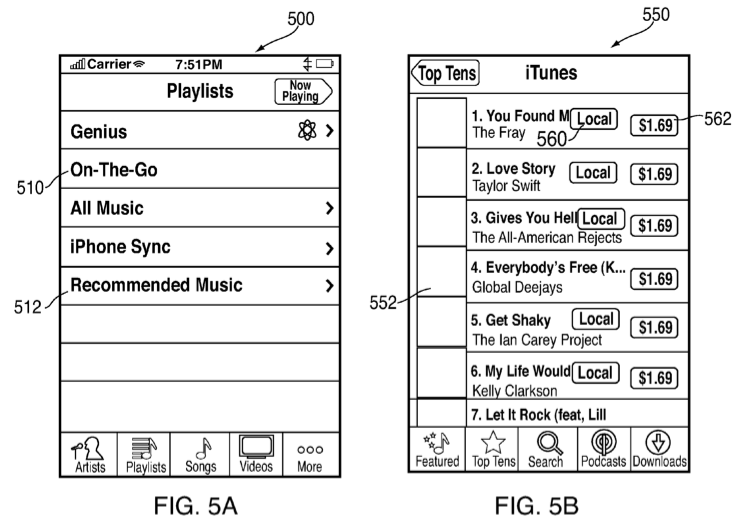
Apple patent allows you to buy music even when offline

An Apple patent granted on Tuesday would allow you to buy some music and other iTunes content even when offline.

It appears that iTunes would proactively download locked versions of new recommendations (and perhaps more generally new releases) which you could later unlock by using credit stored on the device. So if you are both very impatient and without wireless data access, Apple may one day have you covered.

Apple in court: Samsung infringes key text-selection patent, anti-poaching class action blocked, slide to unlock invalidated in Germany

Site default logo image

Apple’s decision to disable VPN on demand functionality on iOS due to the virnetX lawsuit isn’t the only patent related Apple news today. Head below for a roundup of Apple’s court woes and wins from earlier today:

Samsung infringes key text-selection patent: Reuters reports that the International Trade Commission has handed down a preliminary decision ruling Samsung infringed on an Apple patent related to a text-selection feature. However, the courts also ruled Samsung didn’t infringe another patent related to detecting when other devices are plugged into a microphone jack. If the text-selection decision is upheld, the result could be a U.S. import ban on Galaxy, Transform, and Nexus devices:
Expand
Expanding
Close

Apple patents detail quick app access on lockscreen, touch sensitive home button & unlikely tablet/notebook hybrid

Site default logo image

We all know Apple, like most big tech companies, files a lot of patent applications for inventions that will likely never see the light of day. Today we get a look at a couple of its latest patent applications via documents published by the U.S. Patent & Trademark Office and detailed by PatentlyApple.

On the more believable side, we get one that includes a new animated lock screen that would provide quick access to frequently used apps via a new animated feature accessible through a home button that could also recognize touch and pressure input (pictured above). Redesigning the lockscreen with new features has been a big request from many users, so this one isn’t entirely out of the realm of possibility for future iOS releases:
Expand
Expanding
Close

Site default logo image

Apple denied iPad mini trademark in the US

BBC reported today that Apple was recently denied a trademark for “iPad mini” after authorities in the United States claimed the term was “merely descriptive.” Apple still has until July to convince the United States Patent and Trademark Office, but its official stance thus far according to a recently surfaced document is that iPad mini fails to “create a unique, incongruous, or non-descriptive meaning in relation to the goods being small handheld mobile devices comprising tablet computers capable of providing internet access.” In other words, “mini” simply describes a variation of the device, rather than a unique feature that differentiates it from the full-sized iPad.

An excerpt from the USPTO document:

The term “IPAD” is descriptive when applied to applicant’s goods because the prefix “I” denotes “internet.” According to the attached evidence, the letter “i” or “I” used as a prefix and would be understood by the purchasing public to refer to the Internet when used in relation to Internet-related products or services.  Applicant’s goods are identified as “capable of providing access to the Internet”.

The term “PAD” is also descriptive of the applied for goods. The term “pad” refers to a “pad computer” or “internet pad device”, terms used synonymously to refer to tablet computers, or “a complete computer contained in a touch screen.” Please see the attached dictionary definition. In addition, the attached excerpts from third party websites show descriptive use of the term “pad” in connection with tablet computers. This marketplace evidence shows that the term “pad” would be perceived by consumers as descriptive of “pad computers” with internet and interactive capability. Applicant’s goods are identified as “a handheld digital mobile electronic device comprising tablet computer”.

The term “MINI” in the applied for mark is also descriptive of a feature of applicant’s product. Specifically, the attached evidence shows this wording means “something that is distinctively smaller than other members of its type or class”.  See attached definition. The word “mini” has been held merely descriptive of goods that are produced and sold in miniature form.

The main request by the USPTO is that Apple added a disclaimer clarifying that it is only seeking the exclusive right to “MINI” as part of the entire iPad trademark. That would prevent claiming exclusive rights to the word mini, which the USPTO noted, “others may need to use to describe or show their goods or services in the marketplace.”

This isn’t the first time that Apple has run into hurdles related to its iPad trademark. It previously fought cases in both California and China with companies claiming to own rights to the iPad name.

Apple in Shanghai court over Siri speech recognition patent infringement claims

Site default logo image

AFP reported Apple is in court in Shanghai, China again today, but this time it’s over a lawsuit alleging the company copied components of Siri’s speech recognition software. According to the report, Shanghai-based Zhizhen Network Technology Co. claimed in pretrial proceedings that Apple infringed its patent related to voice recognition technology via Siri. While the suit notes that development of Siri began in 2007, there is no mention of Nuance. Apple currently partners Nuance with to implement the speech recognition component in Siri, and it is also a market leader that presumably has its own arsenal of speech recognition related patents.

Zhizhen says it patented its “Xiao i Robot” software in 2004, while Apple’s Siri, which made its debut with the release of the iPhone 4S in 2011, was first developed in 2007.

“The company will ask Apple to stop manufacturing and selling products using its patent rights, once Apple’s infringement is confirmed,” Si Weijiang, a lawyer representing Zhizhen, told AFP.

“We don’t exclude the possibility of demanding compensation in the future,” he added.

The company is behind Siri-like software called ‘Xiao i Robot’ that it claimed was first developed before Siri in 2004. The technology is apparently available on some smart TVs and enterprise applications, but it doesn’t appear to be available as a consumer-facing app for smartphones or tablets. The video below appeared online when the company originally filed suit against Apple last year, and it shows the Xiao i Robot software running on a Lenovo smartphone:

http://www.youtube.com/watch?v=Ku0H10_G1X4