Apple is the target of a new patent infringement suit filed today by Intertrust—a company backed by Sony and Philips that has licensed its patents to many companies in the past including Samsung, Nokia, Microsoft, HTC, Motorola, and others. The Wall Street Journal noted Philips and Sony each hold a 49.5-percent stake in the company that previously settled with Microsoft in 2004 for $440 million related to a patent infringement case.
The announcement from Intertrust on its website doesn’t mention the specific patents or technologies involved in the suit, but it claims Apple products, including iPhone, iPad, Apple TV, Macs, iCloud and iTunes, infringe on 15 Intertrust patents related to “security and distributed trusted computing.”
The lawsuit accuses Apple of making products and services that infringe on 15 Intertrust patents on security and distributed trusted computing. The lawsuit covers a broad range of key Apple products and services including iOS devices such as the iPhone and iPad, Mac computers and laptops, Apple TV, and services including iTunes, iCloud, and the Apple App Store.
“Apple makes many great products that use Intertrust’s inventions,” said Talal Shamoon, Intertrust’s chief executive officer. “Our patents are foundational to modern Internet security and trusted computing, and result from years of internal research and development. We are proud of our record of peaceful and constructive licensing with industry leaders. We find it regrettable that we are forced to seek Court assistance to resolve this matter.”
However unlikely—the United States Patent and Trademark office today published an Apple patent application that details a system of inductively charging an iPad through the Smart Cover. The idea is that rather than plugging in the iPad, the Smart Cover would include an inductive power transmitter that would allow it to pair with an inductive power transceiver embedded into the iPad. The result is the Smart Cover would become a wireless charging station, connecting to an external power source, and allowing you to power your iPad in various positions. Apple also explained that it could use “ambient power gathering devices, such as solar cells, can be used to gather ambient power (such as sunlight) to be stored internally in the flap for later inductive transfer.”
A method for wireless powering a tablet device, comprising: determining if a protective cover is in a closed configuration with respect to the tablet device; enabling a wireless power receiver circuit in the tablet device when it is determined that the protective cover is in the closed configuration with respect to the tablet device; and wirelessly receiving power from a wireless power transmitter associated with the protective cover.
Apple described the advanced Smart Cover as including multiple power transmitters to allow the iPad to charge even when using the case, for example, as a stand to prop up the device. Alternatively, the cover could continue charging the device when in the closed position or when an iPad is placed on top: Expand Expanding Close
Color us a little skeptical on this one, but the U.S. Patent Office released Patent US 20130044215 filed by Apple (via Patently Apple) on Thursday that basically described a wristwatch-like device. According to the patent application, Apple is looking into methods that integrate flexible components into a bi-stable spring, slap on bracelet design. Apple even highlighted a number of use cases for the accessory that would talk to other electronic devices, i.e., iOS devices, such as viewing recent calls, responding to text messages, managing playlists, and viewing maps:
The bracelet goes far beyond being a wristwatch. Apple states that with a multitouch display, the user “can accomplish a number of different tasks including adjusting the order of a current playlist, or reviewing a list of recent phone calls. A response to a current text message can even be managed given a simple virtual keyboard configuration across the face of the flexible display.”… According to Apple, a larger display is also more desirable for map viewing. The arm mounted location makes map viewing a desirable function for such a device, as a traveler or explorer can easily reference the information with a flick of the wrist while exploring.
The patent application also described a number of methods of powering the wristwatch accessory including the use of a solar panel underneath the display that 9to5Mac discussed before. It also covered the possibility of using kinetic power sources similar to systems already used in wristwatches.
Apple states that the Kinetic energy gathering device noted above in patent figure 5A (# 502) has its advantages. Having the accessory device on an extremity is an ideal location for gathering kinetic energy. The simple motion of a user’s arm or leg allows the accessory device to harness some of that energy for charging battery. The Antenna in patent figure 5A (# 506) is for establishing and maintaining the connection between the bracelet accessory and a portable electronic device such an iPhone. The antenna can be configured to pass data over WiFi, Bluetooth or any other suitable wireless protocol.
Other possible features of the device mentioned in the application include using the device as a nighttime light for bike riding, edge lighting to configure a colored backlit border, and the ability to quickly view maps and high quality video streams. Apple also described an end-detection sensor to deactivate unused portions of the display for individuals with smaller wrists.
Another interesting aspect of the patent application is a method of using built-in accelerometers and gyroscopes as orientation sensors to make sure content is always visible and facing the user as the device—and user’s arm—is in motion.
With all the rumors that Apple is working on a smart watch, it’s hard to ignore a patent application that covers the form factor in such detail. However, it’s important to note many concepts make their way to Apple patents but never see the light of day, and this could very well just be one possible form factor that Apple has experimented with. You can learn more about today’s patent at PatentlyApple. Another image from today’s patent application below:
Since the old iWatch rumor reared its head again in December, there have been a few more reliable sources adding weight to the idea that we could see a smart watch from Apple this year. Over the weekend, The New York Times, which said essentially the same thing in 2011, followed up the rumors with a report that Apple is working on a curved glass watch prototype running iOS. The Wall Street Journal quickly followed with more information, claiming Apple and partner Foxconn are now testing wearable, watch-like devices.
While many have speculated what Apple might include in an iWatch, such as Apple employee #66 and founder of Apple’s Human Interface Group Bruce Tognazzini, all we get from reports is “curved glass” and “iOS”. Apple has clearly been testing wearable prototypes with several patents dating as far back as 2009, describing potential integration with wristwatches and iOS devices. By taking a look at the technology for watches that Apple is already experimenting with through the many publicly available patents, we put together a list of some of the features the company could very well include in an Apple-branded smart watch. Expand Expanding Close
The U.S. Patent and Trademark Office published a couple of interesting patent applications from Apple today. One patent described various embodiments of a depth perception system and laser projection, while another concerned an “ad-hoc cash dispensing network” that would turn iPhone users into walking ATMs.
PatentlyApple first covered the patent and highlighted several possibilities of using cameras and a laser source to determine the distance of an object and implement various applications based on detection of depth. The report explained an embodiment of the invention by describing how Apple could use the system integrated into, for example, an iMac. PatentlyApple also described how Apple could use the invention for laser projected keyboard applications (as pictured above):
In this example, the iMac is able to detect a user approaching it and activate a particular program, application, awake from sleep or power save mode, and the like… In patent FIG. 12, we see a user positioned in front of this future iMac such that the first and second beams 206a, 206b may at least partially intersect the user. The iMac’s updated iSight Camera will be able to determine the distance that the user is from iMac. The depth perception system increases the sensitivity of user detection for the iMac so that it could make a distinction between the user and an occupied chair… In Apple’s patent FIG. 11A shown below, we see the depth perception system incorporated into a mobile electronic device such as an iPad. In this example, the system may be used in combination with a projected control panel 115 (such as a keyboard, audio/video controls, and so on). The control panel 115 may be a light pattern projected from a light source onto a surface (e.g., table or desk), the control panel 115 may include different light shapes, colors, or the like for representing different inputs.
Unwiredview.com pointed us to the “ad-hoc cash dispensing network” patent published today and recently filed by Apple that would essentially allow iOS users to become ATMs for other iPhone users. Just imagine being able to withdraw cash when there simply isn’t an ATM or bank nearby. Apple’s system would allow other close by iPhone users to lend you cash, with the borrowed money returned to the lender through your iTunes account/credit card for a small fee (as pictured in the patent drawing below): Expand Expanding Close
In July 2011, a federal jury in Texas awarded “patent licensing company” Personal Audio LLC $8 million in its patent infringement lawsuit against Apple. The jury found Apple infringed two valid patents related to downloadable playlists with its iOS devices as far back as the original iPod. One covered an “audio program player including a dynamic program selection controller,” while the other covered an “audio program distribution and playback system.” 9to5Mac has now learned Personal Audio LLC is attempting to target content creators directly, starting with a new patent infringement case in Texas against one of iTunes biggest podcasters, Adam Carolla’s Ace Broadcasting.
If the outcome of the case is anything like Personal Audio’s previous cases, it could have a major impact on podcasters and other content creators on iTunes and elsewhere. Personal Audio also sued and entered licensing agreements with Sirius XM Radio, Archos, Coby, RIM, Samsung, Amazon, and Motorola related to its downloadable playlist patents and others.
The new patent, issued just last year on Feb. 7, 2012, is quite broad and describes a “System for Disseminating Media Content Representing Episodes in a Serialized Sequence.” Personal Audio is also suing the popular Howstuffworks.com series, which like Ace Broadcasting, is a large podcasting presence on iTunes and across the web…
According to a report from Bloomberg this morning, the European Union is preparing to announce antitrust objections against Samsung for its use of “standard- essential patents in legal disputes with Apple.”
“We will adopt the statement of objections very soon,” said EU antitrust chief Joaquin Almunia at a press conference, while noting the objections will arrive by the end of 2012 or early 2013 as a formal complaint that lists antitrust concerns.
While regulators were “happy” with Samsung’s announcement this week that it will withdraw patent lawsuits in Europe seeking to block sales of Apple Inc. products, Almunia said the commission will continue to investigate the company over whether threat to use such injunctions harm competition.
The Apple-Samsung patent news doesn’t end there, though…
Today, Kodak announced the $525 million sale of its patents to two firms, Intellectual Ventures and RPX Corporation. It is interesting that the two companies will work with 12 intellectual property licensee to pay a portion of the over $500 million price tag. The 12 licensees, who aren’t listed by name in Kodak’s press release, would all receive varying access to the digital imaging patent portfolio and other Kodak patents included in the sale. In turns out that Apple, Google, and many other large tech companies, will provide cash toward the purchase as licensees.
Under the agreements, Kodak will receive approximately $525 million, a portion of which will be paid by 12 intellectual property licensees organized by Intellectual Ventures and RPX Corporation, with each licensee receiving rights with respect to the digital imaging patent portfolio and certain other Kodak patents. Another portion will be paid by Intellectual Ventures, which is acquiring the digital imaging patent portfolio subject to these new licenses, as well as previously existing licenses.
Bloomberg is reporting, as relayed by Business Insider, that the 12 companies are made up of Apple, Google, Samsung, Microsoft, Facebook, and just about every major player in the tech business: Expand Expanding Close
Today, we have updates on Apple and Samsung’s ongoing court woes. A report from Bloomberg noted U.S. District Judge Lucy H. Koh in the San Jose, California case rejected Apple’s most recent request for a United States sales ban on 26 Samsung devices. According to the report, Koh said the decision was based on the fact that the “case involves lost sales—not a lost ability to be a viable market participant.”
“Samsung may have cut into Apple’s customer base somewhat, but there is no suggestion that Samsung will wipe out Apple’s customer base, or force Apple out of the business of making smartphones,” Koh said. “The present case involves lost sales — not a lost ability to be a viable market participant.”
As noted by The Verge, a second post-trial order delivered by Koh yesterday denied Samsung’s request for a new trial on the claims of jury misconduct. Koh claimed that juror Velvin Hogan disclosed his previous involvement with Seagate during the jury selection process, giving Samsung’s lawyers more than enough time to discover the litigation. From the court filing:
Samsung has waived its claim for an evidentiary hearing and a new trial based on Mr. Hogan’s alleged dishonesty during voir dire. Prior to the verdict, Samsung could have discovered Mr. Hogan’s litigation with Seagate, had Samsung acted with reasonable diligence based on information Samsung acquired through voir dire, namely that Mr. Hogan stated during voir dire that he had worked for Seagate.
Samsung vs. Apple cases abroad are also making news today: FossPatents reported today that Samsung has dropped all requests for sales bans against Apple in Europe related to standard-essential patents. However, as pointed out in the report, Samsung will still attempt to win monetary compensation in its cases against Apple, but will no longer request courts to enforce bans on Apple products. FossPatents speculated on Samsung’s decision: Expand Expanding Close
In October, as pointed out in Samsung filings with U.S. District Lucy Koh, we told you that the U.S. Patent and Trademark Office issued a non-final decision that declared 20 claims related to Apple’s rubber-banding patent invalid. While Samsung and Apple were back in court yesterday regarding post-trial motions, today FossPatents reported (via MacRumors) the USPTO has issued another non-final ruling declaring yet another Apple multitouch patent invalid.
This time it’s a touchscreen patent, commonly called “the Steve Jobs patent,” that courts previously deemed valid in cases against Samsung and Motorola in the past:
This week, the USPTO issued a first Office action rejecting all 20 claims of U.S. Patent No. 7,479,949 on a “touch screen device, method, and graphical user interface for determining commands by applying heuristics”, which has been referred to by many people, including Apple’s own lawyers, as “the Steve Jobs patent”.
The touchscreen heuristics ‘949 patent has also been asserted against Motorola. Judge Posner declared large parts of the patent invalid and identified only some minor potential infringement on Motorola’s part that he decided would not warrant injunctive relief even if Apple prevailed on whatever little was left of its related claims. Expand Expanding Close
In order to get its new Lightning technology out on the market, Apple had to acquire the trademark “Lightning” from the popular motorcycle maker Harley-Davidson. According to Patently Apple, two trademark applications published on Sunday by the EU Patent and Trademark Office show the transfer of the trademark officially went down on Saturday. The term “Lightning” is still protected until 2013 under the original filing, and Harley-Davidson still owns some rights to the term. Still having access more than likely gives the Motorcycle manufacturer the right to use Lightning on some of its products, which includes helmets and electrical parts, while Apple also has free reign. It seems somewhat odd that a term like “Lightning” can be trademarked. [Patently Apple via Gizmodo]
We reported earlier this week that the ITC would reevaluate its Sept.14 ruling that Apple did not infringe four Samsung patents, with a final decision—that could potentially block imports of the device to the U.S—expected by January of next year. Today, head of Samsung’s mobile and IT division Shin Jong-kyun had some words about the case, following the ITC’s decision to reevaluate the initial ruling. Korea Times quoted Shin as claiming it would be “impossible” for Apple to make handsets without “Samsung-owned wireless patents” and that a new trial or the case is a possibility. Here’s the full quote:
The truth never lies. Without Samsung-owned wireless patents, it’s impossible for the Cupertino-based Apple to produce its handsets,’’ said Samsung’s mobile chief Shin Jong-kyun in a brief meeting with local reporters on his way to the company’s main office in downtown Seoul, Wednesday. “As you know, Samsung is very strong in terms of portfolios of wireless patents,’’ the executive added.
`”The re-evaluation decision by the USITC doesn’t necessarily mean Samsung is better-positioned for the fight with Apple. But Samsung will do its best,’’ Shin told reporters.
“Samsung’s legal team is effectively responding to this fight. Yes, a new trial for the case is a possibility,’’ the executive stressed. Shin’s remarks were confirmed by its spokesman Park Han-yong.
Shin is the same Samsung executive who made comments earlier this month regarding the recent Apple and HTC settlement, claiming Samsung had no intentions of negotiating or entering a similar agreement with Apple. Today’s report noted that Shin once again confirmed Samsung is not currently in negotiations with Apple related to “a possible peace treaty.”
In July, a 10K filing showed that Apple acquired security company AuthenTec for $356 million. At the time, we noted Apple was presumably after the company’s various fingerprint-related technologies, while companies such as Samsung, Motorola, and others entered in deals with AuthenTec for its secure VPNs, encryption algorithms, and security-related products. Today, NFCWorld (via TechCrunch) reported Authentec has now sold its embedded security solutions division to NFC company Inside Secure. The sale would seem to indicate that Apple was indeed specifically after the company’s fingerprint and NFC solutions:
The sale suggests that Apple’s interest in acquiring Authentec lies with the company’s innovative combined fingerprint and NFC solution, which is not part of the division being acquired by Inside Secure, and will lead to renewed speculation that Apple will include NFC in future iPhones and other devices…. NFC and contactless chip provider Inside Secure is to acquire the embedded security systems division of Authentec, the fingerprint and secure solutions specialist which Apple agreed to buy for US$356m in July 2012. The transaction is valued at up to US$48m.
To get a hold of AuthenTec’s Embedded Security Solutions Division, Inside Secure will reportedly pay $38 million in cash and another $10 million “subject to completion of certain post-closing transactions.” Products the division is responsible for are currently used in hundreds of millions of mobile and networking devices worldwide, with customers ranging from Samsung, Nokia, LG, and Motorola to HBO, Cisco, and Texas Instruments. Last year, the division brought in sales of $25.3 million. Expand Expanding Close
The U.S. Patent and Trademark Office published a patent application from Apple today that covers various methods of detecting a user’s presence and augmenting the user experience accordingly. Apple has covered face recognition and presence detection systems in various patent applications in the past, notably for multi-user logins, security features, and an Android-like face unlock feature. Today’s patent application covers even more implementations of Apple’s presence detection technology that would utilize ultrasonic sensors, microwave radar, and camera and audio systems to detect and identify the user. PatentlyApple covered the highlights of the patent including the ability to activate or augment features using presence detection:
In some embodiments, the device may also be configured to track the user movements (e.g., position and velocity) and, in response to certain movements, provide feedback and/or enter or change a state of operation. For example, movement toward the device may activate more features, such as providing more options/menus in a user interface, whereas movement away from the device may reduce the number of features available to a user, such as reducing the number of menus/options and/or reducing or increasing the size of the options displayed.
PatentlyApple also described another interesting possible implementation that would allow for intelligent zooming based on the movement of the user: Expand Expanding Close
On Friday, a press release confirmed Apple and HTC reached a global settlement regarding two patent infringement lawsuits that would include a 10-year licensing agreement and dismiss the current lawsuits between the companies. There was no other information on the deal at the time, but today Sterne Agee analyst Shaw Wu claimed to have the specifics (via BusinessInsider):
Apple will get $6-$8 for every Android-based HTC phone sold, says Shaw Wu, an analyst at Sterne Agee… HTC sells 30-35 million Android smartphones annually, so it will generate $180-$280 million in annual revenue for Apple. Since there is no almost cost associated with that revenue, it should be pure profit. But, Apple made $41 billion in net income during its last fiscal year, so it’s not like this HTC money means much.
A number of Apple patents and applications have been published today, one of which details an interesting new design for the packaging of iOS devices that would also double as a stand or dock of sorts. The patent application was originally filed in May 2011, but it was published today by the United States Patent and Trademark Office and detailed by PatentlyApple. The image above is pretty self-explanatory, showing iPod nano-like packaging with a removable lid and base that transform into a dock or stand for the device. It appears the dock would act as a permanent solution, with the image above showing room to accommodate a charging cable as well as small parts to hold the device snugly in place.
This is actually something we’ve seen before. Although many iPhone and iPad users have no problem dropping a decent amount of money on a dock, there are no shortage of users who have come up with innovative ways to turn the current iPhone and iPad packaging into a dock and or stand for free. Below is a video, courtesy of GottaBeMobile, showing an iPad mini box being transformed into a free docking station with very little effort: Expand Expanding Close
Last week, Apple lost an appeal in the U.K. that forced Apple to apologize to Samsung publicly and state that its Galaxy Tab does not infringe on Apple’s patents.
Britain Court of Appeal upheld a previous ruling that Samsung’s Galaxy Tab does not infringe on the iPad’s patents because it is not “as cool.” Reuters reported that after losing the appeal this morning, Apple has been instructed by the court to apologize to Samsung by running ads on its website and in newspapers saying Samsung did not infringe on patents in at least Arial 14 font.
Hidden at the bottom of Apple’s U.K. website this morning is the required link to the apology, but the apology is more like one your big sister would give you after being reprimanded by your parents. After mentioning Samsung did not infringe, Apple nicely sliced out some complimentary quotes from the ruling:
“The extreme simplicity of the Apple design is striking. Overall it has undecorated flat surfaces with a plate of glass on the front all the way out to a very thin rim and a blank back. There is a crisp edge around the rim and a combination of curves, both at the corners and the sides. The design looks like an object the informed user would want to pick up and hold. It is an understated, smooth and simple product. It is a cool design.”
Apple goes on to say German and U.S. courts ruled otherwise.
However, in a case tried in Germany regarding the same patent, the court found that Samsung engaged in unfair competition by copying the iPad design. A U.S. jury also found Samsung guilty of infringing on Apple’s design and utility patents, awarding over one billion U.S. dollars in damages to Apple Inc. So while the U.K. court did not find Samsung guilty of infringement, other courts have recognized that in the course of creating its Galaxy tablet, Samsung willfully copied Apple’s far more popular iPad.
With Apple’s $356 million purchase of mobile security firm AuthenTec, for its nearly 200 patents covering fingerprint and sensor technologies, there has been a lot of talk about how Apple might integrate the technology into future devices. Adding to the rumors are recent reports that Apple signed a deal with Sydney, Australia-based Microlatch to develop NFC apps using its fingerprint authentication tech. Today, we get a look at some possible areas Apple might be exploring with the technology thanks to a patent application published by the U.S. Patent and Trademark Office and detailed by Patently Apple.
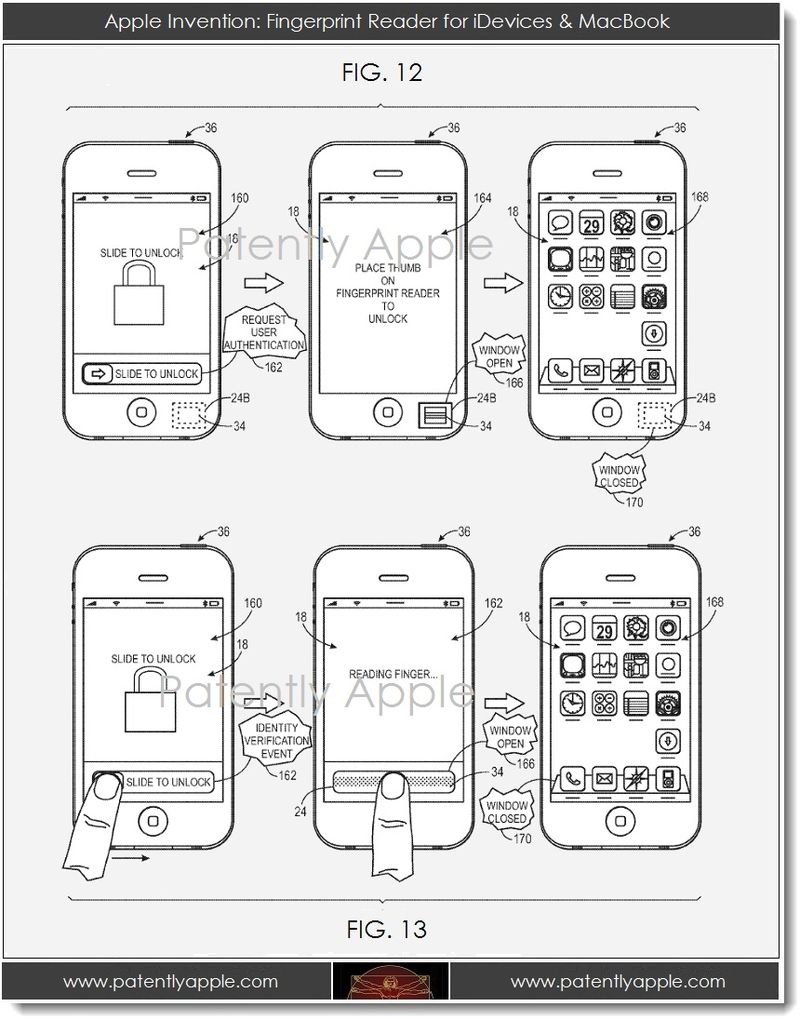
As highlighted in the image above, Apple’s patent covers a hidden color-matched or transparent “window”—next to the iPhone’s home button in this case—that could reveal “components by causing the electronic window to change opacity, allowing the components to suddenly appear as from out of nowhere.” In other words, Apple could build a biometric sensor or camera into a device’s bezel but have it remain invisible to the user—at least when not in use. One embodiment of the invention described using fingerprint tech during the unlocking process (pictured right):
In Apple’s patent FIGS. 12 and 13 shown below we see a biometric sensor in context with a fingerprint reader which is initially concealed behind a closed window on an iPhone. Upon the iPhone’s activation in a locked state, a lock screen 160 may be displayed requesting a user to slide a finger across the display to unlock the device. The electronic device may request user authentication to access the handheld device. The device may then display an instruction screen requesting that a user provide biometric data via their fingerprint which will be read by the fingerprint reader.
The patent also covers similar methods using face recognition and eye recognition rather than fingerprint sensors; the invention would also not be limited to unlocking devices. The patent continued by describing e-commerce and wallet applications, which would line up with the earlier reports regarding Microlatch: Expand Expanding Close
Update: While the meeting apparently didn’t result in any resolution, ZDnet reports the ITU’s Malcolm Johnson said the ‘heated debate’ “has gone a long way to help clarify the positions” of the companies involved:
“Today’s event has gone a long way to help clarify the positions of various stakeholders in determining the effectiveness of FRAND commitments and the impact of litigations surround standards-essential patents,”
ZDnet also reported Motorola argued “Apple was misunderstanding the way FRAND works in the telecoms industry”:
“For 20 years the [FRAND] licensing commitments made by innovators in the communications industry have been sufficient,” Warren said. “Past experience would indicate that [FRAND] has been effective… but that doesn’t mean there isn’t room for improvement to improve the present situation.”
The world’s biggest tech companies are meeting today for a Patent Roundtable with the United Nation’s International Telecommunications Union to “assess the effectiveness of RAND (reasonable and non-discriminatory) – based patent policies.” The meeting will take place at the ITU headquarters in Geneva, Switzerland; and according to several reports, it will include Apple, Samsung, Nokia, Google, Microsoft, and many of the industry’s other biggest players. The discussions follow high-profile, patent-related cases and failed settlement talks between Samsung and Apple, while the European Union continues to probe Motorola, Samsung, and others over potential abuse of the patent system. It also comes as Google’s legal chief David Drummond issued statements to the press calling for a reform on software patents.
A report from BBC noted others attending the roundtable include: Qualcomm, Cisco, Research in Motion, Intel, Philips, Huawei, Sony, and Hewlett-Packard. BBC also provided statements from the companies that submitted pre-event arguments (below).
According to the ITU, the meeting will have the following objective: Expand Expanding Close
The United States International Trade Commission announced today (via TNW) that it would launch an investigation of Apple devices, including iPhones, iPods, iPads and Macs, following a complaint filed by Motorola last month that sought an import ban related to seven patents. The release from the ITC does not provide many details and only stated it will investigate “certain wireless communication devices, portable music and data processing devices, computers, and components thereof” from Apple.
USITC INSTITUTES SECTION 337 INVESTIGATION ON CERTAIN WIRELESS COMMUNICATION DEVICES, PORTABLE MUSIC AND DATA PROCESSING DEVICES, COMPUTERS, AND COMPONENTS THEREOF
The U.S. International Trade Commission (USITC) has voted to institute an investigation of certain wireless communication devices, portable music and data processing devices, computers, and components thereof. The products at issue in this investigation are certain Apple iPhones, iPods, iPads, and Apple personal computers.
The investigation is based on a complaint filed by Motorola Mobility LLC of Libertyville, IL, Motorola Mobility Ireland of Bermuda, and Motorola Mobility International Limited of Bermuda, on August 17, 2012. The complaint alleges violations of section 337 of the Tariff Act of 1930 in the importation into the United States and sale of certain wireless communication devices, portable music and data processing devices, computers, and components thereof that infringe patents asserted by the complainants. The complainants request that the USITC issue an exclusion order and a cease and desist order.
The USITC has identified Apple Inc. of Cupertino, CA, as the respondent in this investigation.
By instituting this investigation (337-TA-856), the USITC has not yet made any decision on the merits of the case. The USITC’s Chief Administrative Law Judge will assign the case to one of the USITC’s six administrative law judges (ALJ), who will schedule and hold an evidentiary hearing. The ALJ will make an initial determination as to whether there is a violation of section 337; that initial determination is subject to review by the Commission.
The USITC will make a final determination in the investigation at the earliest practicable time. Within 45 days after institution of the investigation, the USITC will set a target date for completing the investigation. USITC remedial orders in section 337 cases are effective when issued and become final 60 days after issuance unless disapproved for policy reasons by the U.S. Trade Representative within that 60-day period.
Apple just won another ruling brought by Samsung, according to a U.S. International Trade Commission notice, in regards to patented technology found in iOS devices.
Apple Inc. (AAPL) won a round of a U.S. International Trade Commission case brought by Samsung Electronics Co. (005930) over patented technology in the iPhone and iPad tablet computer, its second U.S. legal victory in a month over its largest smartphone competitor.
Apple didn’t violate Samsung’s patent rights, ITC Judge James Gildea said in a notice posted on the agency’s website. The judge’s findings are subject to review by the full commission, which has the power to block imports of products that infringe U.S. patents.
…Gildea said there was no infringement of any of the four patents in the ITC case, and also determined that Samsung had not proven it had a domestic industry that used the patents, a requirement that is unique to the trade agency. The judge didn’t provide the reasons behind his findings. The opinion will be public after both sides get a chance to redact confidential information.
[Internal Memo] Regarding the Jury Verdict in California
On Friday, August 24, 2012, the jury verdict in our trial against Apple was announced at the US District Court for the Northern District of California. The following is an internal memo that reflects Samsung’s position regarding the verdict:
We initially proposed to negotiate with Apple instead of going to court, as they had been one of our most important customers. However, Apple pressed on with a lawsuit, and we have had little choice but to counter-sue, so that we can protect our company.
Certainly, we are very disappointed by the verdict at the US District Court for the Northern District of California (NDCA), and it is regrettable that the verdict has caused concern amongst our employees, as well as our loyal customers.
However, the judge’s final ruling remains, along with a number of other procedures. We will continue to do our utmost until our arguments have been accepted.
The NDCA verdict starkly contrasts decisions made by courts in a number of other countries, such as the United Kingdom, the Netherlands, Germany, and Korea, which have previously ruled that we did not copy Apple’s designs. These courts also recognized our arguments concerning our standards patents.
History has shown there has yet to be a company that has won the hearts and minds of consumers and achieved continuous growth, when its primary means to competition has been the outright abuse of patent law, not the pursuit of innovation.
We trust that the consumers and the market will side with those who prioritize innovation over litigation, and we will prove this beyond doubt.
If, when you read “History has shown there has yet to be a company that has won the hearts and minds of consumers and achieved continuous growth, when its primary means to competition has been the outright abuse of patent law, not the pursuit of innovation.” you thought “Microsoft!”, you are not alone. Expand Expanding Close
Following the verdict in the Apple vs. Samsung trial today, where Samsung was found guilty of infringing various Apple patents related to the case, Apple is also coming out a winner, at least temporarily, in Google/Motorola’s attempt to block imports of iPhones and iPads to the United States.
In late June, we told you about Google’s attempt to block U.S. imports of iPhones and iPads based on a previous ruling that Apple infringed on one standard-essential Motorola patent. The initial ruling was under review by the ITC, which has power to block U.S. imports of Apple devices from Asia, with a decision expected at a hearing scheduled for today.
The ITC has now concluded its review (via paid blogger FossPatents), finding no violations for three of the four patents in the initial suit (including the one mentioned above), but remanded an investigation on a fourth, non-standard essential patent to Judge Thomas Pender. The result? According to FossPatents, there might be a violation and import ban related to the patent, but a remand and ITC review could take up to a year: Expand Expanding Close
Jury deliberations for the much-reported Apple vs. Samsung trial are set to begin this week, and both companies want the nine jurors to complete an intricate exam to determine if a patent was infringed. As The Wall Street Journal first noted, each side created an elaborate worksheet with dozens of multi-part questions:
The general principle is that for each device, the jury has to indicate “yes” or “no” for whether a certain patent is infringed.
Then there are fill-in-the-blank questions like: “What is the dollar amount that Samsung is entitled to receive from Apple for Samsung’s utility patent infringement claims on the ’516 and ’941 patents?” Fun stuff.
The jurors must be unanimous to determine whether a patent was infringed.
Judge Lucy Koh will decide on the final form to be presented to the jury.
Check out both proposed verdict forms below (via WSJ).





 .
.