patents

See All Stories

Twitter announces IPA to support engineers, also calms ‘Pull-to-Refresh’ patent poachers


Site default logo image

.
Engineer support (almost) never tasted so good. 

Twitter just announced a little agreement that subsequently guarantees it would never pursue other companies that poach its “pull-to-refresh” patented feature, which is duplicated across a slue of iOS and Android applications.


The micro blogging service unveiled the “Innovator’s Patent Agreement” today that assures the world it will not use its patents against competitors, while allowing engineers to keep control over their patents.

“The IPA is a new way to do patent assignment that keeps control in the hands of engineers and designers. It is a commitment from Twitter to our employees that patents can only be used for defensive purposes. We will not use the patents from employees’ inventions in offensive litigation without their permission. What’s more, this control flows with the patents, so if we sold them to others, they could only use them as the inventor intended,” explained Twitter in a bog post.

The IPA will affect every patent issued to Twitter engineers in the past and going forward:


Expand
Expanding
Close

German judge upholds ban on Apple push email, Apple must pay damages to Motorola Mobility

Site default logo image

Apple suffered a significant blow in the ongoing patent battles with Android competitors today when a Mannheim regional court in Germany ruled against an Apple appeal.

The court backed an earlier decision that banned Apple from offering the service for synchronizing emails on Apple’s mobile devices that use iCloud.

The court said Apple must pay damages to Motorola Mobility, but didn’t specify the amount.

The judge adjourned a decision on mobile communication standards, which Motorola Mobility regards as standard-essential. He didn’t say when the court will rule on this patent case.

Thermonuclear.
Expand
Expanding
Close

Future MacBooks could have this surround sound speaker system

Site default logo image

According to an Apple patent application published by the United States Patent & Trademark Office and detailed by PatentlyApple, Apple is working to implement audio transducers in combination with multiple speakers to enable surround sound configurations on MacBook-like devices. Apple’s focus of the patent appears to be improving audio in mobile devices as speakers decrease in size to accommodate smaller and thinner form factors.

As detailed in the image to the right, one embodiment of the invention shows the use of several speakers and an audio transducer integrated into the bezel and enclosure of a MacBook. These configurations would allow, for example, the speakers embedded next to the display to handle high range frequencies, while the lower speakers would handle mid-range and the audio transducer the low-range. Additional speaker enclosures could be added to enable 3.1 or 4.1 surround sound configurations. Apple also stated the audio transducer could provide both low and mid-range frequencies, “essentially performing as a “subtweeter” for frequency ranges from 20-500 Hz and 500-1500 Hz. The report explained:


Expand
Expanding
Close

Apple shows off a 3D Avatar building app as part of a patent application

Site default logo image

.

Patently Apple did what it does and dug up a patent related to building 3D avatars:

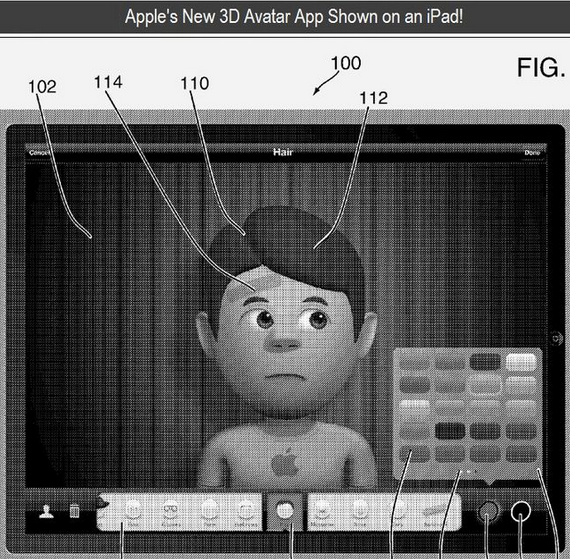
Earlier today we introduced Apple’s 3D Avatar App which covered a basic overview of the new application in the works. Now a second patent application has surfaced and it actually shows that the app is already running on an iPad! We have the screenshot to prove it. The new patent application focuses on how the app will work with color palettes and more. The big news however is that the new 3D Avatar App is in its final stages of development and that’s very cool. Evidently phase-one of the application is geared for the younger crowd, but other editions could be in the works as discussed in our first report today.

This could be for GameCenter or a number of other areas where you would want to create an online personality.


Expand
Expanding
Close

Apple working on advanced 3D cameras with object and gesture recognition

Site default logo image

This is not the first time an Apple patent has surfaced relating to three-dimensional camera technologies. A previous patent highlighted advanced 3D object recognition and verification. A new patent—published today by the United States Patent & Trademark Office and detailed by PatentlyApple—shows Apple is continuing to work on 3D camera technologies that could land in future iOS devices. Apple’s patent described a 3D imagining camera that uses advanced microlenses, depth-detection, chrominance, and luminance sensors. The camera could recognize facial expressions and gestures while creating 3D models of scanned objects. PatentlyApple explained:


Expand
Expanding
Close

Apple offers royalty-free licensing of proposed nano-SIM to competitors (Updated)

Site default logo image

Update: Nokia has responded to reports that Apple is offering to license its nano-SIM patents royalty-free by claiming Apple does not have patents “essential to its nano-SIM proposal” (via ITworld):

“We are not aware of any Apple Intellectual Property which it considers essential to its nano-SIM proposal. In light of this, Apple’s proposal for royalty-free licensing seems no more than an attempt to devalue the intellectual property of others.”

In recent weeks, reports popped up that suggest Apple is attempting to push a new standard for miniaturized SIM cards. In May 2011, Reuters reported Apple “submitted a new requirement to (European telecoms standards body) ETSI for a smaller SIM form factor.” More recent reports from the Financial Times confirmed other companies, including Motorola and Nokia, were attempting to push their own “nano-SIM” design. At the time, FT said Apple had support from “most of the European operators.” Ahead of the Smart Card Platform Plenary meeting with the European Telecommunications Standards Institute this Thursday and Friday, Foss Patents reports Apple is promising the ETSI it will license any Apple-owned patents related to nano-SIM free of charge to its competitors:

Expand
Expanding
Close

Apple seeking to settle for up to $15 per Android device in patent disputes

Site default logo image

Following a report from Bloomberg in December featuring advice from analysts, we asked you if Apple should settle for up to a $10 royalty per Android device and not keep paying its lawyers to fight patent disputes. Today, Dow Jones Newswiresreports that Apple is interested in seeking settlements. According to the report, Apple “indicated a willingness to cut deals with competitors,” including Motorola and Samsung:
Expand
Expanding
Close

Apple pressures EU regulators to set FRAND licensing rules

Site default logo image

After taking a beating by Motorola over FRAND patents this month, Apple issued a letter to the European Telecommunications Standards Institute asking the body to establish consistent royalty fees for patents deemed essential to wireless standards, reported the Wall Street Journal. The body has a role in setting the standards related to GSM, 3G UMTS, and 4G LTE radio technologies.

Apple is involved in nasty patent disputes with Motorola, HTC and Samsung in courtrooms around the world, and it previously asserted in court documents that handset maker Motorola refused to license its essential patents on “Fair, Reasonable, and Nondiscriminatory” (FRAND) nature at rates offered to Nokia, Samsung and other vendors. According to the Journal:

Many mobile technology companies, such as Motorola Mobility Holdings Inc. and Samsung Electronics Co. Ltd., hold patents that became part of industry-wide standards. Standards bodies often require the patent holders to offer to license their patents to any company on a basis known as Frand, or fair, reasonable and nondiscriminatory. Questions about such commitments have arisen amid a flurry of patent suits between rivals in the mobile-device market.

Apple’s lawyer wrote in the letter: “It is apparent that our industry suffers from a lack of consistent adherence to FRAND principles in the cellular standards arena.” A copy of Apple’s letter was posted online by the FOSS Patents blog. Motorola recently likened its enforcement of FRAND patents to bank robbery: “It only takes one bullet to kill.” Samsung and Motorola reportedly demanded that Apple pay a 2.4 percent and 2.25 percent royalty, respectively, illustrating what the iPhone maker called are unreasonable FRAND licensing terms.


Expand
Expanding
Close

Apple researching social fitness tech sporting real-time sharing of performance data for competitive workouts

Site default logo image

In the future, hitting the gym along with your iPhone-toting pals could spur competitiveness in ways unlike ever before. Apple’s mobile devices run a variety of fitness apps and third parties provide useful accessories ranging from casual jogging to some serious working out. Not content with resting on its laurels, Apple is looking to ratchet it up a notch with a new patent filing titled “Interfacing Portable Media Devices And Sports Equipment” that surfaced Thursday in the United States Trademark and Patent Office database.

It outlines new fitness technology letting you share performance data with your friends in real-time, as you are working out. Mentioning that traditional sharing through a third-party website is so last century, the filing goes on to describe immediate data sync between friends exercising on a similar equipment. Moreover, unlike Apple’s fitness center app patent or this fitness freak filing, it does not even pretend to mention Nike+. This suggests Apple could be developing its own solution that might some day augment or even replace Nike’s technology with numerous bells and whistles.

Fancy yourself working out on a treadmill next to your boss and being able to brag about your lower heart rate and blood pressure all the while covering greater distances. Heck, you could be even working out at your local gym while boss is running on a treadmill at his office in Tanzania.

Speaking of competitiveness…


Expand
Expanding
Close

Apple gets a break as EU antitrust watchdog launches full-blown probe into Samsung over essential 3G patents

Site default logo image

European Union regulators today announced the launch of a formal investigation of Samsung over mobile patents to determine whether the South Korean conglomerate breached EU antitrust rules in its legal dealings with competitors. The investigation is focused on so-called FRAND patents, a common rule that stipulates a patent applying to the standard must be adopted on “fair, reasonable, and non-discriminatory terms” (FRAND). According to the press release, EU regulators want to figure out whether Samsung “used certain of its standard essential patent rights to distort competition in European mobile device markets, in breach of EU antitrust rules.”

The Commission reminds that Samsung a decade ago promised to let rivals license its mobile patents under FRAND terms. The full-blown investigation comes in the light of the lawsuits Samsung filed against Apple at courts in Germany, France, the Netherlands and other countries around the world, asserting copyright infringement related to patents essential to wireless telecommunications standards.

The case is “a matter of priority,” the document reads. Patent blogger explained, “The European Commission can’t wait until Samsung finally wins a ruling based on such a patent and enforces it, potentially causing irreparable harm.” The full text of the European Commission Antitrust Commission announcement can be found below.


Expand
Expanding
Close

Apple researching universal touchscreen remote with adaptable user interface for future TVs

Site default logo image

A patent application published by the U.S. Patent & Trademark Office earlier today reveals Apple is flirting with the idea of a universal touchscreen controller capable of controlling multiple devices including a “television, a video tape player, a video disk player, a stereo, a home control system, or a computer system.” The patent application is titled “Apparatus and Method to Facilitate Universal Remote Control” and was filed Sept. 30, 2011.

The patent application’s background covers many of the issues with current controllers for televisions and the devices mentioned above. It noted current universal remotes are “complex to operate” and unable to adapt to incorporate every command or control functionality supported by a device or future device. It also mentions the fact that users are often “confronted with multiple” remotes, which is the classic “table full of remotes” scenario described by Steve Jobs when talking about the Apple TV at D8. The patent application explained:


Expand
Expanding
Close

Apple spends hundreds of millions to sue Android makers, is it working?

Site default logo image

Newsweek‘s Dan Lyons reported today that Apple’s “thermonuclear war” on Android smartphone manufacturers is fading fast, while a new rumor surfaced among the suits’ lawyers claiming the company spent $100 million on its initial set of claims against HTC.

Imagine how much Apple spent on other Android makers, such as Motorola (who is near locking Apple products out of Germany in retaliation) or Samsung (the biggest Mobile Communications patent holder in the world), if it spent so much on just HTC.

“Who knows if it’s true, but if so, Apple didn’t get a lot for its money,” wrote Lyons on his RealDanLyons’ blog Jan. 23.

Apple’s legal claims are abruptly junked left and right, and its only minor victories to date are so inconsequential that Android device makers can dance around the momentary obstacles with just a few minor tweaks to products, explained the Newsweek reporter.

The technology giant’s case against HTC with the International Trade Commission began in February 2010, when the Cupertino, Calif.-based company wanted the ITC to block HTC from importing products into the United States. The case originally had 84 claims based on 10 patents, but it was dwindled down to only four claims by the time a judge became involved, according to Lyons.

The rulings —for the most part— were a wash for Apple. One patent was invalid as Apple did not have a rightful claim to it, and HTC did not infringe upon two of the other patents due to Apple apparently not implementing them into its products. In other words, Apple did not have a right to seek an injunction, because ITC injunctions can only occur if it is provable that both parties are “practicing” the patent in question, which Apple could not demonstrate against HTC…


Expand
Expanding
Close

Does Siri infringe old Excite patents?

Site default logo image

Shawn Carolan of Menlo Ventures, an investor in Siri Inc., prior to Apple acquiring the company, recently sat down on Bloomberg to discuss the technology. Apart from talking about the initial demo that attracted him to the investment and meeting Siri Co-Founder Norman Winarsky, Bloomberg host Cory Johnson pressed him on exactly how Siri is able to take voice-recognition data and determine intent.

Around the 3:20 mark, Carolan discussed Siri’s unique approach of taking all words as “one big block” and mapping “those strings of words across” a group of 10 domains of expertise. This approach sounds familiar to at least one technology journalist who claimed the method is similar to patents owned by search portal Excite in 1994. Robert Cringely explained:


Expand
Expanding
Close

Apple exploring 3D iOS interface with motion sensing gestures

Site default logo image

The United States Patent & Trademark Office published an Apple patent application today (via PatentlyApple) detailing new 3D GUI concepts and touch-free, motion sensing gestures that would allow you to simply wave your hand over a device equipped with proximity sensors. This follows a patent application published in July that explores similar 3D gestures and user-interfaces, and another in September detailing 3D display and imaging technology that could lead to Kinect-like gestures on future Apple products.

The image to the right (larger version is below) shows a 3D UI environment consisting of two sidewalls, a back wall, a floor, and a ceiling. As you can see, 2D objects are posted to the back and sidewalls, while 3D objects rest on the floor of the environment. The patent mentions a “snap to” feature that appears to allow objects to move from one surface to another by changing the orientation of the 3D environment. In other words, the user’s perspective of the UI, which PatentlyApple said could be imagined as the “view from an imaginary camera viewfinder,” would change when rotation of the device is detected by its gyro sensor or accelerometer:


Expand
Expanding
Close

Apple takes Samsung to court over patented smart cover for smartphones and tablets

Site default logo image

UPDATE [Wednesday, December 21, 2011 at 7:25am ET]: A Samsung spokesperson chimed in, providing us with the official statement, included at the end of this article.

After Samsung confirmed the addition of four more complaints to its German patent offensive (two are standard-related patents, the other two being utility patents) on Monday, Apple this morning fired back by extending its Australian patent complaint to include Samsung-made cases for Galaxy tablets and smartphones, according to Bloomberg.

Apple issued the notice of infringement to Samsung in Australia over the cases, and will file a statement of claim, Apple’s lawyer Stephen Burley said at a hearing in Sydney today. Samsung’s lawyer Katrina Howard said at the same hearing the company was served with the notice that the cases infringe at least 10 patents.

The two companies are embroiled in a complicated legal fight that already includes more than 30 lawsuits filed against each other across the globe. The exact nature of Apple’s patent infringement claim concerning smartphone and tablet cases is not known, but 9to5Mac can’t help but wonder whether it has something to do with this.


Expand
Expanding
Close

Apple submits ‘invalid’ patents to W3C to delay Touch Events standard

Site default logo image

International web standards organization W3C last year created the Web Events Working Group to create a standard for the way touchscreen enabled devices interact with web content. The standard is known as the W3C Touch Events Specification. Now, according to Opera browser developer Haavard, Apple is delaying the process by using “invalid or irrelevant patents” to buy time, something the company has apparently done in the past.


Expand
Expanding
Close

Samsung drops iPhone 4S Germany patent suit after discovering Apple’s Qualcomm licensing agreement

Site default logo image

Samsung dropped its lawsuit in Germany seeking to ban the sale of Apple’s iPhone 4S.

The South Korea-based company had focused its complaint against a patent covering 3G communications tech. According to patent expert Florian Mueller of FOSS Patents, Samsung recently discovered a Qualcomm licensing agreement protects the technology.

“Other news from Mannheim: Samsung has formally given up attacking the iPhone 4S with 3G patents. Recognizes Apple is licensed thru Qualcomm,” tweeted Mueller on Dec. 16.

Samsung recently lost a preliminary bid to ban iPhone 4S sales in France; although, the case can progress as a patent trial:


Expand
Expanding
Close

Apple experimenting with inflatable shock mounts to drop-proof cover glass

Site default logo image

In January we told you about a class action lawsuit filed by a Los Angeles man who describes the iPhone 4’s glass back panel as a “design flaw” and claims Apple “refuses to warn consumers” about its susceptibility to cracked glass under normal usage . We already know the iPhone 4S hasn’t made many improvements in terms of the durability of its glass casing, but a new patent application shows exactly what Apple has been working on to better implement a drop-resistant all glass design.

Our friends over at PatentlyApple detail the patent which describes different embodiments of including a shock mount made of polymer, foam, gel, or similar material in a future iPhone or iPad’s cover glass (as usual Apple also mentions the majority of their other products including iMacs, MacBooks, iPods, displays, and televisions). In one solution, Apple describes a “mechanically actuated retractable”, which would essnetially allow the cover glass to withdraw “at least partially into the housing in response to sensing the drop event, thereby protecting for the cover glass.”  The report explains:

Expand
Expanding
Close

Apple could lose German patent case vs. Samsung in January, gives up iPhone 4S firmware in Australia

Site default logo image

In Australia, as part of discovery, Samsung got access to Apple’s Qualcomm baseband source code for the iPhone 4S (lookout for battery issues while you are in there Sammy!).

Other matters appeared to be resolved, including Samsung’s access to the firmware used in the iPhone 4S’ baseband chip, supplied by Qualcomm.

A software expert had approximately two hours’ access to the firmware and would submit his findings by Sunday.

According to FOSSPatents, Samsung’s lawsuits against Apple in Germany are really heating up after a Mannheim hearing set a schedule for January 20 and 27 of 2012. It looks like Apple has a tough case, as the hearing leaned towards Samsung’s claims.

The two patents asserted in today’s litigations are

  • EP1005726 on a “turbo encoding/decoding device and method for processing frame data according to QoS”, and
  • EP1114528 on an “apparatus and method for controlling a demultiplexer and a multiplexer used for rate matching in a mobile communication system”.

Samsung’s third German complaint against Apple, which wasn’t at issue today, relates to EP1188269 on an “apparatus for encoding a transformat format combination indicator for a communication system”.

Below is a full rundown of the issues discussed at today’s hearing..


Expand
Expanding
Close

Did Motorola just win an injunction barring Apple from selling mobile products in Germany?

Site default logo image

Florian Mueller isn’t a patent attorney but he plays one on his blog FOSSPatents.  For better or worse, he’s often quoted in the ongoing mobile technology patent battles where the winner is often Apple.  He’s also German so he probably understands this new, disturbing ruling a lot better than us (Our German is “rostig”)

Apple knows what it’s like to win injunctions against rivals. It won four of them against Samsung (two in Germany, one in the Netherlands and most recently one in Australia; all of them preliminary). Now it seems that Apple has just come out on the losing end of a patent infringement lawsuit. I have received a copy of what purports to be a default judgment by the Mannheim Regional Court barring Apple from selling in Germany — the single largest market in Europe — any mobile devices infringing on two Motorola Mobility patents and determining that Apple owes Motorola Mobility damages for past infringement since April 19, 2003.

If true, this would be a Hindenburg-sized backfire for Apple’s legal efforts in Europe.

The two patents and their US equivalents, Statements from Apple and Motorola and an update from Mueller below:
Expand
Expanding
Close

Slide to Unlock? Patented!

Site default logo image

The United States Patent & Trademark Office this morning issued a patent grant to Apple pertaining to the familiar Slide to Unlock gesture. Remember, the now ubiquitous sliding move debuted on the original iPhone as a fun way to keep your device secured while in your pocket. “To unlock the phone, I just take my finger and slide it across. Wanna see that again? We wanted something you couldn’t do by accident in your pocket. Just slide it across – BOOM.”, Steve Jobs said entertaining the invitees at the phone’s unveiling in January of 2007.

The iOS chief Scott Forstall is credited as one of the inventors, in addition to Apple engineers Imran Chaudhri, Bas Ording, Freddy Allen Anzures, Marcel Van Os, Stephen O. Lemay and Greg Christie. Apple actually filed a patent application in December of 2005, a little over a year ahead of the iPhone introduction at the Macworld Expo. Of course, the work on the iPhone had begun a few years earlier.

It’s a bit silly, really, but blame it on the patent system. Be that as it may, nobody now gets to use the popular ‘Slide to Unlock’ without infringing on Apple’s patent unless a court rules it is invalid or prior art. Here’s a video of the 2004-5 Neonode N1m, showing a similar Slide to Unlock that existed before the iPhone (4 minutes in):

[youtube=http://www.youtube.com/watch?feature=player_embedded&v=Tj-KS2kfIr0]

Interestingly, a Dutch court ruled that the slide to unlock patent was invalid because of this very device.

The company explains in the granted patent document:


Expand
Expanding
Close

Tim Cook calls Siri “profound innovation”, talks patent disputes, and Thailand. Tablet market could be bigger than the PC market

Site default logo image

Live from Apple Q4 2011 earnings call, Tim Cook is answering questions from the press and just discussed, among other things, his thoughts on Siri, patents disputes, and the disaster in Thailand.

Of course Cook was asked to comment about Siri and did so using the words “amazing” and “incredible” calling it a “profound innovation” and saying, “over time…many, many people will use it in a substantial way”.

Talking on patent disputes, Cook of course wouldn’t discuss specific cases but did note:

“We spend a lot of time and money and resource on coming up with incredible innovation…we dont like it when someone else takes those”, he continued, “unfortunately we’ve been pushed into the court system as a remedy.”

When asked to talk about the potential unibody enclosure shortage we reported yesterday, he mentioned it’s being treated as a concern and that Apple is “currently investigating”. He also talked about the recent disaster in Thailand and its potential impact (quote via This is my next):


Expand
Expanding
Close

US Judge says Samsung tablets do infringe Apple patents but doesn’t issue an injunction

Site default logo image

US District Judge Lucy Koh came down on Samsung today for infringing on Apple’s patents in a preliminary hearing on Apple’s request to bar some Galaxy products from being sold in the United States. She stopped short of issuing an injunction however, like her Australian counterpart yesterday, saying that Apple may have some issues establishing the validity of its patents.

Apple and Samsung have been at each others’ throats in more than 20 districts around the world. The fight has ensnarled some of the two companies’ partners and vendors.

Mobile providers Verizon Wireless and T-Mobile USA have opposed Apple’s request, arguing that a ban on Galaxy products would cut into holiday sales.

Apple must show that Samsung infringed its patents and that its patents are valid under the law.

At the hearing on Thursday in a San Jose, California federal court, Koh also said she would deny Apple’s request for an injunction based on one of Apple’s so-called “utility” patents.

She did not say whether she would grant the injunction based on three other Apple “design” patents.

Koh characterized her thoughts on the utility patent as “tentative” but said she would issue a formal order “fairly promptly.

The case in U.S. District Court, Northern District of California is Apple Inc v. Samsung Electronics Co Ltd et al, 11-1846.


Expand
Expanding
Close

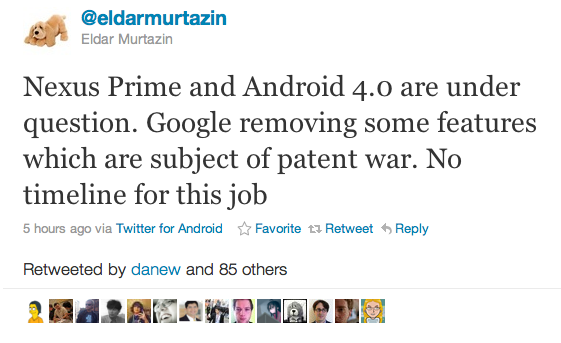
Google delaying Nexus Prime/ICS because of Apple patents?

Site default logo image

Update: He’s wrong.  We’ve heard from an impeccable source that Google plans to have invites out “in the next day or so” and there is no patent delay.

We reported earlier that Google and Samsung were delaying the release of the new Nexus Prime phone and Android 4.0 “Ice cream Sandwich” out of respect for the passing of Steve Jobs.

“We believe this is not the right time to announce a new product as the world expresses tribute to Steve Jobs’s passing,” the companies said.

But according to often (but not always) correct blogger Eldar Murtazin, there are patent issues at hand which need to be addressed before the devices and OS  ship.  Specifically, Google is slicing out features which may be subject to Apple’s Patents…

See Steve Jobs introducing multi-touch in 2007 below, saying “Boy have we patented it!”.  More coverage at 9to5google.com
Expand
Expanding
Close