Just like Verizon, T-Mobile has chosen to side with Samsung in its fight against Apple reportsFoss Patents. T-Mobile’s reason, in response to a preliminary injunction proposed by Apple, is that they don’t want key 4G devices to be banned for the holiday season. And since it doesn’t look like T-Mobile is getting the iPhone anytime soon, Samsung’s 4G phones could be a big part of their sales. Check out T-Mobile’s response below:
As noted by MacRumors, Apple has been denied the tradmark for multi-touch, which they applied for on January 9, 2007 after the first iPhone was introduced. Once the decision was reached by the the Board, Apple then filed for an appeal which was then again shot-down. Excerpt from the decision that is embedded after the break:
Again, simply because the applied-for term has been used in association with a highly successful product does not mean the term has acquired distinctiveness. Decision: The examining attorney’s finding that the Section 2(f) showing is insufficient is affirmed.
Apple was denied the trademark simply because it is too broad, and lacks distinctiveness to Apple alone. As a reference, NYU’s Jeff Han has multiple mentions of Multi-Touch as a generic term in papers from 2005 and before. Here’s his multi-touch video demonstration more than a year before Apple filed for ‘Multi-Touch’ or released the iPhone.
But another peculiarity of the ITC is that its rulings can be waived by the president. Verizon thinks it would be great if President Obama, in a blanket statement, made clear he would not let stand any decision blocking importation of consumer wireless devices. The parties then would have to recur to normal patent litigation, and whatever rights and wrongs are discovered could be settled by exchanges of cash. Mobile is a rare industry exhibiting growth, job creation and animal spirits. Who needs a paralyzing meltdown?
It will be interesting to see if the President will override if Apple wins any of the blockades it is seeking against Android devices in the ITC. IF he does, Apple/Google/Microsoft/whoever will have to go through the longer patent dispute process.
Both iPhones and Android devices could be blocked by pending ITC rulings.
A new patent application published by the US Patent & Trademark Office (via Patently Apple) today reveals Apple’s possible plans to radically change the implementation of antennas in future iPhones and other small form factor devices.
The majority of the patent describes a new composite material made up of a “foam substrate formed of a plurality of foam cells”. However, possible uses for the composite, as detailed in the patent, include a possible new antenna window on mobile devices. This would mark a huge departure from the antenna design in the currently shipping iPhone 4, which still relies on the antenna baked into the stainless steel frame. The same antenna that caused so much controversy regarding reception issues.
Patently Apple explains the potential benefits of the composite: Expand Expanding Close
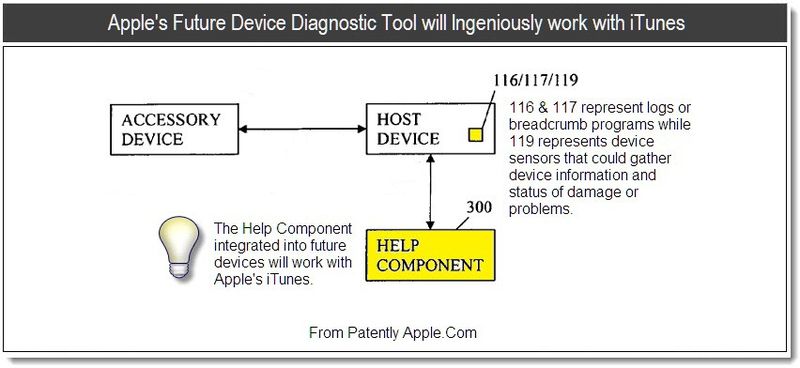
As noted by PatentlyApple, Apple has filed a patent report today that details a new diagnostic tool that works through iTunes. The tool uses in-depth change logs that details firmware updates, physical conditions that surround the device during the events, the location of the device, and more. iTunes could be set to find corruption in the change log to let the user, and possibly a support Genius, know of what needs to be changed.
The log may be generated periodically (e.g., every 5 milliseconds, every 30 minutes, every 5 hours, after every reset, or at any other time based or event based or environment based event occurs). Each generated log may be stored on the Apple device or uploaded to a remote entity, and each log may be retained or overwritten by a more recently generated log depending on available storage space and/or processing capabilities, for example.
So what about privacy? The log will contain only information that will aid Apple in helping you, and will be without any personal information. As we’d imagine, each time you connect a device, like an iPhone, to iTunes it will pull the log. Like any patent, this might not actually be used. But hey, anything to save a trip to the Genius Bar right? Could this possibly tie in with this morning’s report regarding a web based tool?
Apple has won 16 new patents published by the the US Patent and Trademark Office today (viaPatentlyApple) that cover everything from possible methods of charging future Apple products via solar power, to key multi-touch technology and iOS camera related patents. Certainly more fuel for the ongoing patent wars between Apple and the rest of the smartphone industry.
We already know Apple is experimenting with solar power from past patents, even going as far as considering which company would produce panels for future products. We also heard reports in March of a superthin solar panel layer from French company Wysips that could be rolling out to handset manufactures within a year. Today one of the 16 newly granted patents gets us a step closer by detailing “methods and apparatuses for operating devices with solar power”.
PatentlyApple explains:
“a solar power tracking apparatus includes, but is not limited to, a voltage converter and a controller coupled to the voltage converter. The voltage converter includes an input capable of being coupled to a solar power source and an output capable of being coupled to an electronic load, such as, for example, a portable electronic device. The voltage converter is configured to monitor or detect an amount of power drawn by the electronic load at the output of the voltage converter. In response to the monitored power drawn, the controller is configured to control the voltage converter to reduce amount of power to be drawn subsequently if the monitored amount of power exceeds a predetermined threshold. As a result, the output voltage from the solar power source is maintained within a predetermined range.”
Apple is intent on stopping Samsung from marketing and selling “copycat” Galaxy devices in all of the European Union.
Apple has already tried to ban the Galaxy Tab 10.1 in most of Europe (injunction lifted), but today they are going even farther with their legal proceedings, asking a Dutch court to ban all Galaxy series devices. The ban includes the widely popular Galaxy S II, which has seen some success in Europe.
Apple’s complaint, seen by Webwereld, a Dutch IDG publication, seeks an injunction for the entire Galaxy series. This includes smartphones — the Galaxy Ace, Galaxy S and Galaxy SII — and tablets: the Galaxy Tab 7 and Galaxy Tab 10.1. Other Galaxy devices, like the Gio, Nexus, 551, Europa, Apollo and Mini are also involved, albeit only in a footnote in which Apple states, “It is expected that these devices are also covered by one or more of the patent rights invoked.”
On top of trying to ban sales, Apple is trying to push the thought of Samsung sending a letter to all of their partnered retailers within 14 days to end sales. Stated strongly:
For the record we would like to mention the fact that by storing, offering and/or selling of the above mentioned Galaxy smartphones [and tablets], you commit infringement of the intellectual property rights of Apple Inc.
The trial will take place in The Hague, Netherlands September 15th, and the judge said if he grants any injunctions, they would take effect no sooner than October 13, reportedWebwereled (via Computerworld)
It’s no secret patent-related legal disputes have become the subject of most media coverage lately…Whether it’s Apple halting sales of Samsung’s tablets, HTC going after Apple, or Google snatching up Motorola to beef up their patent portfolio, it’s clear the company with the most patents will have an advantage over others in the legal proceedings that we’re bound to continue encountering down the road. This is why we’re intrigued by the graphic above (via GigaOM)from mobile analyst Chetan Sharma charting the number of issued patents (in the US and Europe) between 1993 and 2011.
While these estimates of mobile communications related patents don’t take the quality of patents into account (which is obviously a huge factor in determining their long-term value), you can see from the breakdown below that Nokia and Samsung top the list, with the other expected players including IBM, Microsoft, Sony, Motorola, and Intel following.
Noticeably far down the list is Apple, the one company who seems to have had more success than others fighting patent-related issues recently. Again, these numbers in no way represent the quality of patents and the ability for companies to protect their IPs in the courtroom… which is also a good indication that perhaps we should be looking more closely at the quality of patents rather than the sheer number.
Recently patent expert Florian Mueller took to Twitter following the Google/Motorola acquisition saying he“would caution everyone against overestimating the strength of Motorola Mobility’s patent portfolio,” he continued, “Apple and Microsoft sued Motorola Mobility anyway”. Remember kids… all patents aren’t created equally. Expand Expanding Close
A few more interesting Apple Inc-filed patents have surfaced today (viaPatently Apple) as part of the many applications published by the US Patent & Trademark Office recently. Perhaps the most notable include a design for an iPhone antenna clip, new finger reducing oil resistant coating, and a patent describing using solar energy as an alternate power source in portable devices (something we know Apple has been researching from patents and other sources in the past).
One of the more interesting patents with technology that could (and probably should) make its way to iOS devices in the near future is a the method of reducing “finger oils on touch surfaces”. The patent describes Apple’s method of “Direct Liquid Vaporization for Oleophobic Coatings”. Fingerprints have seem to become less of an issue to iPhone users over the years, but are definitely still a major annoyance to users in less than desirable lighting conditions.
From the report:
Apple states that to prevent the deposition of oils on an electronic device surface, an oleophobic ingredient could be bonded to the electronic device surface. The oleophobic ingredient could be provided as part of a raw liquid material in one or more concentrations. To avoid adverse reactions due to exposure to air, heat, or humidity, the raw liquid material can be placed in a bottle purged with an inert gas during the manufacturing process.
The image below shows what appears to be an antenna attached to a small device’s housing via an “attachment member”. Patently Apple reports Apple states the antenna invention could be used in “their iPod family (MP3 players), a radio, an audio/video recorder, a mobile telephone, personal digital assistant, tablet computing device, or other similar device”. They also speculate from the “exploded view above that it might even be an “iPhone-nano-like device”. Expand Expanding Close
Pinch? Swipe? How about “dig a hole” or “open the window”? Another round of Apple Inc filed patents have been published today by the US Patent & Trademark Office. The most interesting of the latest patents (via Patently Apple) is one focused on “advancing iOS metaphors to a higher level”. What does this mean exactly?
Essentially it would see iOS including a number of new interactive UI elements, many of which will replicate the experience of being able to “manipulate and organize various graphical objects”, similar to the desktop-like environment of “conventional personal computers” (OS X). In other words, Apple wants you to have more control over what you can do with elements within iOS, presumably to close the gap between what’s possible on OS X compared to current iOS builds… which also highly supports theories of iOS and OS X becoming one in the future.
Perhaps the most clear example of how these new UI elements might appear to the end user comes from the “Example Interactions Digging a Hole in a Device User Interface” section of the patent…
From Patently Apple:
Apple is always looking for new ways to distinguish iOS from the pack and today Apple introduces us to a number of new GUI gestures and metaphors that are fun and Kooky – if not creatively insane. The first one describes the notion of “digging a hole” in your interface that will allow you to drop a file into it quickly or act as a garbage bin or other uses.
Apple also described a number of other interactions similar to “digging a hole” including opening a trap door or window via gestures. Expand Expanding Close
There certainly isn’t a shortage of Apple patents being published today (probably more fuel for a legal battle a year from now). We just told you about a new Map related (Placebase acquisition) patent, and now Patently Apple reports Apple has been granted a patent that will allow them to integrate tiny projectors into future mobile devices.
This latest patent describes, in rather clear detail, exactly how Apple could integrate projectors into iPhones, iPads, and MacBooks. It even suggests Apple cameras will be able to detect gestures and “shadows and/or silhouettes” (Kinect-style iOS games anyone?).
The patent also describes what Apple calls a “shared projected workspace”. This appears to essentially be the ability for users to share content with one another over two projected displays. For example, if I were to project an image from one iOS device, and you from another, we could then share content (via gestures?) between both displays. The patent explains: Expand Expanding Close
In a report from Computerworld way back in 2009, we learned that Apple had quietly acquired Maps API company Placebase. Then, founder of Placebase and CEO, Jaron Waldman, started working at Apple on a new “Geo Team”, presumably helping to integrate Placebase mapping technologies into future Apple products.
Fast forward two years to a new patent application titled “Schematic Maps”, filed by Apple Inc. and published today with Waldman, along with Placebase co-founder Moran Ben-David, listed as inventors.
Essentially the patent describes new methods of modifying a map in order to highlight certain objects by distorting others. For example, Apple could provide more data to the user (especially those on smaller screens) by blurring useless data and highlighting what it predicts is most useful to the user at any given time. You can imagine this being particularly useful for navigation. If a user were to request directions to a specific location, the maps could dynamically blur data that isn’t helpful and modify objects or landmarks that would otherwise be difficult to locate.
A snippet from the patent summary explains:
The following relates to preparing and presenting schematic maps, which are maps that present information in a format that presents only information that is most relevant to a given situation in order to provide a simple and clear representation sufficient to aid a user in guidance or orientation. The schematic maps as described herein can be formatted based on the attributes of a display on which they are presented so that the map layout and presentation can be optimized for the particular display. The schematic maps can be “distorted” to better illustrate important maps areas in greater detail and using a relatively larger display area while deemphasizing less important map areas by illustrating them in less detail and using a relatively smaller display area, and thus the schematic maps can be devoid of adherence to a particular scale.
There was originally speculation that Apple might be acquiring Placebase in order to build their own native Maps application, rather than having to rely on Google Maps. With the patent wars heating up and relationships between smartphone makers weakening, the likelihood of Apple not wanting to rely on their rivals for key technologies is increasing. Expand Expanding Close
Today the US Patent and Trademark Office posted 20 new patents granted to Apple Inc, two of which are valuable patents related to the iPhone, iPad, and iOS. Patents like these have been becoming more important as mobile device manufacturers take each other to court.
According a report from Patently Apple, the three most noteworthy of the patents include one for integrated touch screen technology that allows the display to be “thinner, brighter and require less power” and require less parts to manufacture, another is related to the “Voicemail Manager” for iPhone, and the last appears to be related to “improved installation, retention and removal of hardware components” in Mac Pro or other tower-like personal computers.
Perhaps the most notable of the three is the “Integrated Touch Screen” patent. Below is a snippet of Apple’s summary from Patently Apple.
Apple’s Summary: The patent relates to touch sensing circuitry integrated into the display pixel stackup (i.e., the stacked material layers forming the display pixels) of a display, such as an LCD display. Circuit elements in the display pixel stackups could be grouped together to form touch sensing circuitry that senses a touch on or near the display. Touch sensing circuitry could include, for example, touch signal lines, such as drive lines and sense lines, grounding regions, and other circuitry.
Remember Quark? The developer of popular publishing software QuarkXPress has been sold to merger and acquisition firm Platinum Equity, and, according to a report from Techcrunch, the company is already focusing on finding a new home for the Quark’s IP. In the midst of heated patent battles between smartphone makers, what might the patents and technologies owned by Quark have to offer Apple?
Magazine and newspaper subscriptions are a big focus for Apple, it’s clear with the introduction of Newsstand in iOS 5, an app dedicated to helping manage digital subscriptions. Quark recently launched their QuarkXPress 9 publishing software that will allow publications to “design for and publish to digital devices in a variety of formats”, specifically the iPad, “without requiring the services of a programmer.”
Apple has helped Quark in the past, offering their services to get the publishing platform working on Mac OSX.
The majority of large publications have millions in funding behind them when creating the digital version of their magazines for the iPad. However, if Apple were to integrate Quark software into an SDK specifically for publishers, the subscriptions market on iOS devices might closer resemble the ecosystem currently in place for games. In other words, giving developers without millions in funding the “tools to convert existing layouts to rich, interactive content — or create new iPad content from scratch” may bring with it a rush of quality content with subscription models much more attractive to users than those offered by the larger publications.
Apple is clearly making digital subscriptions a focus in iOS 5 with Newsstand Kit, which provides the ability update issues in the background and auto-update subscriptions, but the SDK certainly falls short of everything Quark software could offer publishers. Expand Expanding Close
In January of 2010, Kodak sued Apple and RIM for infringing on their patent to preview photographs. The lawsuit is still going on, but today Wall Street Journal is reporting that Kodak is currently looking to sell 10% of their patent portfolio, which includes the patent Apple and RIM are bring sued for.
The 1,100 patents include patents covering capturing, storing, organizing and sharing digital image. WSJ credits the sale to Kodak’s loss in profit over the last two quarters.
Chief Executive Antonio Perez has been using Kodak’s intellectual property as a means of funding the company’s long and expensive transformation. In 2008, Mr. Perez put forth a goal to generate between $250 million and $350 million a year from Kodak’s patent portfolio.
Google is fresh off acquiring 1,000 patents from IBM and is likely still in a buying mood as it battles everyone from Oracle to Microsoft to Apple-by-proxy in the courts. Apple, who outbid Google for the Nortel patent portfolio at $4.5B is obviously on the offensive.
Kodak’s decision to sell its patents follows a $4.5 billion patent sale by Nortel Networks Corp. Kodak has retained Lazard as an adviser for the sale. Lazard also advised Nortel on its sale.
Shares of the Taiwanese Android phone maker HTC fell 6.5 percent this morning following the ruling by the International Trade Commission (ITC) that the company violated two patents held by Apple. The company’s shares had been pretty much in a free-fall throughout last week as well. The agency’s commissioners still have to support the ruling, but investors are already panicking over fears that the ruling will favor Apple. This, in turn, would open doors to ITC’s ban on imports of HTC’s phones into the United States. In response to the crisis, HTC announced a share buy back program worth up to $760 million in an attempt to stabilize its share price and restore investor confidence, reportsFinancial Times:
The attempt to prop up HTC’s share price appeared to have little effect as the stock fell below HTC’s minimum purchase price of T$900 to close down 3.9 per cent at T$871. The sell-off highlights investor fears that the legal battle could have wider implications for the competitive balance between Apple and Google Android-based phonemakers like HTC, Samsung and Motorola.
HTC is thought to have recently acquired S3 Graphics for $300 million in a bid to secure a stronger ground in its legal dealings with Apple, which filed its patent infringement complaint against the Taiwanese company back in March 2010. That’s not all HTC’s been doing lately in order to buy its way out of this mess…
In April, Apple originally filed a lawsuit against Samsung saying Samsung’s Galaxy Tab copied the iPhone and iPad. Soon after, Samsung filed a counter-patent suit against Apple and asked to see the iPhone 5 and iPad 3. Seeing the unreleased devices was denied by a judge earlier this year. This week Samsung has dropped their counter-patent suit.
The suit was dropped on June 30th, but Samsung will continue to fight patents with an earlier counter-patent suit. While Samsung dropped the suit in the U.S., it won’t affect other patent suits they have. Besides the U.S., Samsung has lawsuits against Apple in South Korea, Japan, Germany, and the U.K.
Samsung’s spokesperson Nam Ki Yung toldBloomberg the counter-suit was dropped “to streamline the legal proceedings”. Nam also told Bloomberg, “Samsung will continue to actively defend and protect our intellectual property”.
Apple has finally made a public statement on the Lodsys matter. According to the Loop, Apple says that Lodsys has no claim to patent infringement because Apple has already purchased indemnity from Lodsys.
“Apple is undisputedly licensed to these patents and the App Makers are protected by that license,” wrote Bruce Sewell, Apple Senior Vice President and General Counsel.
While it is good to hear Apple finally come out with a statement on the matter, it doesn’t seem like the end of this case for everyone involved. Interestingly, we’ve been hearing that Apple is offering to help protect indy developers with representation against Lodsys.
In fact, it wouldn’t surprise me if Apple and Lodsys haven’t been negotiating behind the scenes for a long time now. Lodsys probably only went to indy developers when Apple decided it didn’t owe Lodsys any more money and negotiations broke off.
Full text of the email to Lodsys (via Macworld) below:
Billionaire Microsoft co-founder Paul Allen’s patent trolling lawsuit filed against Apple, Facebook, Google, YouTube and others has been dismissed by the courts.
“Plaintiff has failed to identify the infringing products or devices with any specificity,” wrote U.S. District Court Judge Marsha Pechman in her order to dismiss. “The Court and Defendants are left to guess what devices infringe on the four patents.