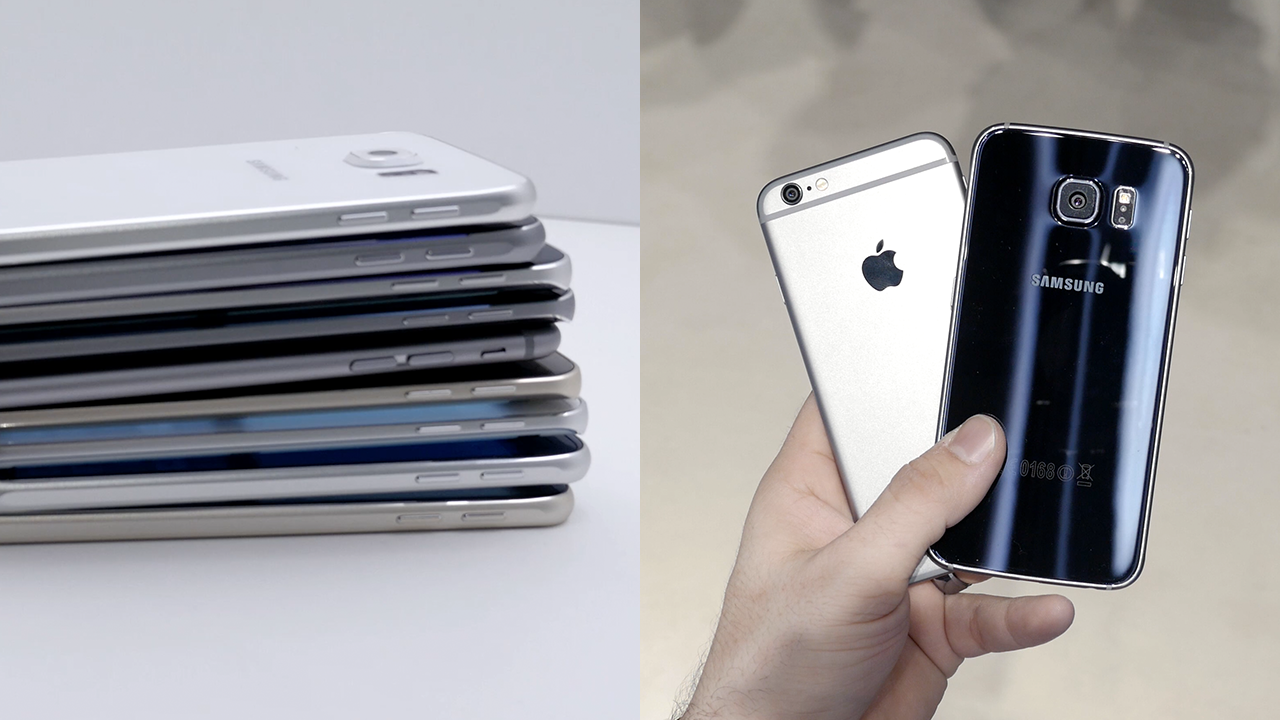
It’s always a difficult task when comparing iOS and Android devices, but this year it may be more important than ever. Samsung has finally stepped up its game with the Galaxy S6, and now we have something that is truly comparable to Apple’s iPhone lineup. Today we’re getting into the ultimate comparison between Samsung’s Galaxy S6 and Apple’s iPhone 6…
Bloomberg reports that Samsung has signed on to provide A9 chips to Apple for the next-generation iPhone. Apple moved to Taiwan Semiconductor Manufacturing Company (TSMC) in 2013 for its processors, looking to reduce its reliance on Samsung, who is a major competitor in the smartphone space and a legal foe. With that said, it was reported last September that Samsung was still supplying 40 percent of the A8 chips found in the iPhone 6 despite Apple’s attempt to part ways.
Apple has applied for a patent for a method of waterproofing the internal components of ‘computing devices.’ The application, filed last year but only published today (via AppleInsider), does not name any specific devices, but the iPhone would be the most logical candidate … Expand Expanding Close
Gartner is out with its latest report tracking smartphone movement during the previous year and more specifically the holiday quarter.
Headlining the report is news that over 1 billion smartphones were sold in 2014, a data point IDC first said was hit in the previous year, adding that two out of three phones sold last year qualified as smartphones.
Gartner’s data shows Apple topped Samsung in worldwide smartphone sales with 74,832,000 units shipped during the holiday quarter, just 1.8 million units more than Samsung, giving Apple 20.4% market share for the quarter, a virtual tie with Samsung’s 19.9%. Expand Expanding Close
Believe it or not, there’s an iPhone 6 in that pile of smartphones shown in the image above and we’re going to compare it to Samsung’s newly announced Galaxy S6. Which one would you prefer? More importantly, what are the major differences between these two devices? Well, let’s go ahead and find out…
As Mobile World Congress kicks off in Barcelona, Samsung and HTC have both unveiled their respective 2015 flagship devices. First off, HTC this morning unveiled the One M9. The device features a Snapdragon 810 processor under-the-hood with a 2,840mAh battery to go with it. HTC infamously ditched Megapixels with its One M8 flagship, but this time around, the company is touting that the One M9 feature a 20MP rear-facing shooter with a f/2.2, 27.8mm sapphire lens and 4k video recording.
Visually, the One M9 looks almost identical to its predecessor…
Ericsson, an early pioneer in cellphone technology, has upped the ante in a patent dispute with Apple by asking the U.S. International Trade Commission to block the import of iPhones into the country.
Ericsson owns patents to a number of fundamental technologies used in all cellphones, including LTE, and Apple had been paying royalties for these up until mid-January when the license fell due for renewal, reports Bloomberg … Expand Expanding Close
Samsung has acquired the battery pack business of leading automotive parts supplier Magna International. The move, according to a statement from the companies, will “enhance Samsung SDI’s capabilities in batteries for electric vehicles.”
While Samsung producing batteries and energy storage solutions for vehicles isn’t exactly new—it already supplies batteries for Tesla and others—there is an Apple Car connection in its latest acquisition… Expand Expanding Close
While Apple has notably been engaged in a back-and-forth poaching war with electric vehicle maker Tesla in recent months, a new report from The Korea Times claims that Apple has also been targeting “experts in next-generation technology” from Samsung Electronics. Citing an anonymous official from Samsung, the report highlights that the iPhone maker has a history of picking off chip experts from the Korean company using competitive compensation and “greater independence” as engineers. Expand Expanding Close
Samsung announced in a press release this evening that it has purchased LoopPay, an Apple Pay-like mobile payment company. LoopPay turns existing magnetic stripe card readers into secure, contactless receivers. This means that, in an ideal world, LoopPay would be available in nearly every retailer that accepts magnetic strip cards. A specific acquisition price is unclear at this point.
According to the latest numbers from IDC, Xiaomi—the rising star of the smartphone industry—has managed to pass up Samsung in China. In 2013, Xiaomi trailed Samsung’s almost 19% market share by a solid 13 percentage points (at just 5.3%), and was only the 5th largest maker of smartphones in China. Things changed in 2014. Last year, Xiaomi finished off with 12.5% of the market, almost a half-point more than Samsung at 12.1%, taking the top spot and passing not just Samsung, but Lenovo, Huawei, and Coolpad as well.
Interestingly, though, the latest numbers also show that Apple’s launch of the iPhone 6 and 6 Plus contributed to a decent size dent in both Samsung and Xiaomi’s market footprint in Q4 of last year. Expand Expanding Close
Apple reported the largest profit ever recorded by a public company in the holiday quarter, mostly driven by sales of 74 million iPhones with an average selling price of $687. According to Cannacord, this meant Apple captured 93% of handset smartphone profits. Perhaps more staggering is that it claims Apple dominated on similar levels across the entire of 2014 — with 79% of mobile device profits.
The analyst expects continued growth for the iPhone for the next few users, with an estimated 650 million iPhone users by the end of 2018.
After moving to Taiwan Semiconductor Manufacturing Company (TSMC) to produce chips for its latest mobile devices and reduce reliance on competitor Samsung, Recode reports that Apple is tapping Samsung for its next-gen A9 chips.
While Apple had hoped to rely more heavily on Taiwan Semiconductor Manufacturing Co. to fabricate the Ax family of processors used in its iOS devices, the company has turned to Samsung for its next-generation A9 chip, according to people with knowledge of the situation…. Though Samsung refuses to identify chip customers, sources say the company is working to ensure an adequate supply of application processors for the next-generation iPhone.
The report mirrors much of what we’ve already heard in recent reports from others adding that “Samsung holds a technological edge over TSMC when it comes to the latest manufacturing process.”
More specifically, Recode cites the fact that “Samsung has managed to shrink the size of the transistors on its chips to 14 nanometers — effectively packing more processing power into a smaller space and consuming less power. TSMC is still at 20 nanometers.” The upper hand with Samsung’s tech was also noted as a reason behind Apple’s decision in earlier reports.
Samsung was said to be handling around 30% of Apple’s latest A8 chips in current gen iOS devices with TSMC producing the majority. Prior to the current-gen A8 chip, Samsung was previously producing the majority of Apple’s mobile chips alongside many other components for Apple products.
IDC is out today with its numbers on tablet shipments for Q4 2014 showing Apple remained on top of the market both last quarter and throughout 2014 despite a slight drop in overall market share.
Apple sold 21.4 million iPads during the holiday quarter last year, which gave the company around 28% market share compared to 33% with 26 million units sold during the same quarter last year. Apple beats out number two Samsung, according to IDC, which grabbed 14.5% of the market in Q4 with 11 million units shipped. Samsung also dipped in overall market share from 17.2% with 13.5 million units shipped in the year ago quarter. Expand Expanding Close
Following on the heels of a record-breaking quarter for Apple, Strategy Analytics has crunched the numbers and crowned Apple the king of the smartphone vendors for Q4 2014—or rather, one of the kings. It seems the Cupertino company managed to tie rival Samsung for the title.
Both companies shipped 74.5 million handsets during the quarter, though Samsung still outsold Apple in terms of the annual total by a hefty margin. Those quarterly sales gave both companies an equal marketshare of 19.6%.
If Apple does indeed report iPhone sales in line with analyst expectations of 66.5M units, the company could be closing in on the market share lead Samsung has held in the smartphone market since 2011, reports the WSJ.
Research company Canalys notes that Apple’s anticipated growth in iPhone sales coincides with a dramatic drop in sales of Samsung smartphones.
Samsung’s share has been falling, hurt by lackluster sales of its flagship models and the rise of homegrown brands in fast-growing emerging markets. In the third quarter, Samsung shipped about 78 million smartphones, about 25% share of the global market, down from 34% a year earlier, Canalys said.
While that still leaves Samsung well ahead for now, it’s a trendline which could see Apple regain the lead it once held … Expand Expanding Close
Korean news site MK Business News (via Reuters) is reporting that Samsung will make 75% of the A9 chip for the next iPhone. This matches an earlier detailed prediction by KGI Research, which stated that the balance of the chips would be made by Global Foundry, and is in line with a statement by Samsung which last year confirmed it as a major supplier of the new chip.
The Samsung-fabbed chips will, says the report, be made in the USA … Expand Expanding Close
As we reported earlier this week, often reliable KGI is predicting that Apple will bring its in-house designed A-series processor to an entry-level Mac sometime in 2016 with TSMC and Samsung expected to fab the potential A9X and A10X chips, respectively. As the move to put non-Intel chips in the Mac lineup would be a departure for the company, CNBC asked Intel CEO Brian Krzanich about the chip-maker’s business plans with Apple… Expand Expanding Close
Samsung announced last year that, after negative reviews of the design of its Galaxy S5, its head of mobile design Change Dong-hoon was being replaced by then VP of mobile design Lee Min-hyouck. Today, however, it was revealed that the company is bringing in an outside designer to help refresh its product lineup. A report from the Korea Herald states that Samsung has hired Lee Don-tae to be its new head of design. Don-tae would lead design of all Samsung gadgets, including smartphones.
Taiwan Semiconductor Manufacturing Company – better known as TSMC – has posted record Q4 profits after taking around 60% of the orders for the A8 chip in the iPhone 6/Plus. Nasdaq reports the company’s net profits for the quarter rose 79% year-on-year.
TSMC, the world’s largest contract chip maker by revenue, said Thursday that net profit for the three months ended Dec. 31 was 79.99 billion New Taiwan dollars (US$2.51 billion), up from NT$44.81 billion a year earlier.
TSMC’s move into 20-nanometer chip production enabled Apple to reduce its reliance on Samsung for the A8 chip, with the chipmaker saying that it is making further investment in more advanced chip-making technology. It plans to increase its capital expenditure this year to $11.5-12B, up from $9.52B last year.
A KGI report yesterday predicted that TSMC would pick up 100% of orders for the A9X chip expected to be used in the next-generation iPad, as well as making all of the A10 chips for the nominal iPhone 7, and all the S2 chips for the second-generation Apple Watch.
BlackBerry Limited (NASDAQ:BBRY)(TSX:BB) (“BlackBerry”) is aware of certain press reports published today with respect to a possible offer by Samsung to purchase BlackBerry. BlackBerry has not engaged in discussions with Samsung with respect to any possible offer to purchase BlackBerry. BlackBerry’s policy is not to comment on rumors or speculation, and accordingly it does not intend to comment further.
Samsung approached BlackBerry regarding a possible takeover of the company for as high as $7.5 billion, according to a report from Reuters (via CNBC). BlackBerry stock has jumped 16% following the report.
Blackberry stock skyrocketed Wednesday afternoon after a report that the device maker had been approached by Samsung about a potential takeover… At its high, Blackberry was up more than 21 percent… South Korea’s Samsung proposed an initial price range of $13.35 to $15.49 per share, which represents a premium of 38 percent to 60 percent over BlackBerry’s current trading price, the source said.
The report says executives from Samsung and BlackBerry met last week regarding the possible takeover, but both companies declined to offer a statement to Reuters for the story. The buy would be mostly for access to the patent treasure trove according to the GlobeandMail.
Smartphone company Samsung Electronics Co. Ltd. has recently approached BlackBerry Ltd to buy the company for as much as $7.5-billion, looking to gain access to its patent portfolio, according to a person familiar with the matter and documents seen by Reuters. South Korea’s Samsung proposed an initial price range of $13.35 to $15.49 per share, which represents a premium of 38 per-cent to 60 per-cent over BlackBerry’s current trading price, the source said.
Recently Samsung announced a partnership with BlackBerry in an attempt to push its Knox security services and mobile devices to enterprise customers, and it’s likely Samsung would be after BlackBerry’s patents and presence in the enterprise. The companies announced in November that the partnership would include bringing BlackBerry’s BES12 platform to Samsung Galaxy devices equipped with Knox.
BlackBerry currently develops its enterprise platforms and BBM messaging services for both iOS and Android, but what an acquisition might mean for support on non-Samsung devices remains to be seen.
Is an A-series chip destined for a future model of the 12-inch MacBook Air?
A KGI report predicts that Apple will begin using its own processors for Macs “in the next 1-2 years,” with a specific prediction of a Samsung-fabbed A10X chip powering at least one Mac made in 2016. The wording appears to suggest an entry-level machine–possibly a future model of the 12-inch MacBook Air.
Apple may launch Mac products that use own AP [Application Processor] in next 1-2 years. This prediction is based on the assumption that Apple’s self-developed AP performs at a level between Intel’s Atom and Core i3 and is good enough for Mac. Using self developed AP can help Apple better control the timing of Mac launches and Mac product features.
With performance between an Atom and Core i3, the chip would not be suitable for mid- to high-end Macs.
An accompanying table (below) shows an A10X chip made with a 10-nanometer process to be made by Samsung at some point during 2016 …
We noted a couple of days ago that you didn’t have to look far at CES to find the Apple Watch knock-offs, but for those desperate enough to pretend they have one some two months before it’s even launched, they don’t have to dig very deep into their pockets. Mashable’s Karissa Bell was able to buy one for the grand sum of $27.
It even works, kind of. Bell reports that it did, after a few attempts, pair to her iPhone 6 and allow her to make phone calls and play music through the watch. She said that it looks almost like the real thing – “for about three seconds.” Looking at the photo, I think she’s exaggerating by about two-and-a-half seconds … Expand Expanding Close