Siri is Apple’s personal assistant technology that debuted in 2011 with the iPhone 4S. Apple purchased Siri in 2010. At the time, it was a dedicated app on the iPhone. When it became built into the iPhone, it could do basic things like play music and make phone calls.
Now, it can do things like integrate with third-party messaging apps. payments, ride-sharing service, calling app, set timers, get directions, add reminders, start TV shows on the Apple TV, make language translations, search for photos, open documents, interact with your smart home though HomeKit, and a lot more.
In iOS 12, it became integrated into more third-party apps through Shortcuts. Companies can build their own interactions for the service to work with.
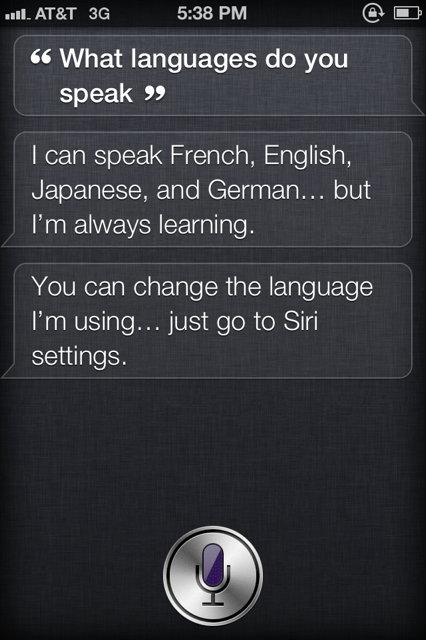
Siri is many things, but it seems she is not a good secret keeper. A few tipsters reached out and told us that Siri now speaks Japanese. Rumors earlier this month said Apple’s AI speech recognition interface would gain Mandarin Chinese, Japanese, and possibly Russian. It now appears that Japanese is about to be announced, perhaps at the iPad 3 announcement next month. There is no word yet on Chinese or Russian, but those are also likely coming soon.
When Siri was announced in October, Apple said that that additional languages would follow this year. Apple’s Siri FAQ says that she will support Japanese, Chinese, Korean, Italian, and Spanish in 2012:
Language Support and Availability
Siri works exclusively on iPhone 4S. Siri understands and can speak the following languages:
English (United States, United Kingdom, Australia)
French (France)
German (Germany)
In 2012, Siri will support additional languages, including Japanese, Chinese, Korean, Italian, and Spanish.
Can I use Siri in any of these languages in other countries?
Yes. Siri can be enabled in any country, and you can choose to speak to it in English, French, or German. However, Siri is designed to recognize the specific accents and dialects of the supported countries listed above. Since every language has its own accents and dialects, the accuracy rate will be higher for native speakers.
Apple usually disables jailbreaks in new software releases. That is part of the reason why it took so long for Absinthe to debut for the iPhone 4S. It appears that Apple is also trying to break Siri running on unsupported devices, such as the iPhone 4. Many people who use Spire, the popular Siri port for the iPhone 4, have reported Siri is now disabled on their unsupported device. Has another cat and mouse game begun?
Historically, to get Siri working on an older device, you only need a server host and an iPhone 4S certificate. However, Apple apparently added a “SetActivationToken” that breaks services like Spire.
Just as quick, hackers have found a temporary workaround to get Spire working again. The fix is simply to delete “com.apple.assistant.plist” and the service should work again.
Siri is an AI-driven virtual assistant that launched last October as an iPhone 4S exclusive, and it currently speaks English (United States, United Kingdom, and Australia), French, and German languages. The official Siri FAQ from the onset made it clear that in 2012: “Siri will support additional languages, including Japanese, Chinese, Korean, Italian, and Spanish.”
9to5Macdiscovered job openings last December indicating possible Siri enhancements, including a prettier interface and a Siri API to extend the functionality to third-party iOS programs. We also uncovered this LinkedIn profile belonging to Apple’s language technologies engineer Chen Zhang that proves Apple’s been at work completing Siri support for the Chinese market. According to today’s article by Tech Asia, Mandarin-only support for the Chinese language could be released as early as next month…
Apple’s digital secretary named Siri, an iPhone 4S exclusive, is now responsible for nearly 25 percent of all searches conducted on Wolfram Alpha, an answer-engine developed by Wolfram Research.
As you know, Apple collaborated with Wolfram Alpha on Siri (Microsoft is another licensee), and took advantage of algorithms powering Mathematica, another Wolfram Research product. It lets users type in complex factual queries, and then Wolfram Alpha computes accurate answers from its structured data containing hundreds of datasets.
The Cupertino, Calif.-based Company fancies Wolfram Alpha’s curated knowledge database, which is a nice fit for the iPhone 4S’s factual question answering feature. According to the New York Times’ Steve Lohr, Siri accounts for a quarter of all Wolfram Alpha queries after four months:
Siri accounts for about a quarter of the queries fielded by Wolfram Alpha, whose staff has grown to 200.
Google should be worried, as this could be another sign of Siri users becoming accustomed to retrieving factual answers from Wolfram Alpha and not Google. For example: Telling Siri to “Google the iPhone” launches Safari with Google search results accompanied by text-based adverts, but just asking “How many days are there until Easter” produces a formatted answer from Wolfram Alpha with no advertising whatsoever. This is also important knowing that a quarter of all searches on mobile devices are conducted through voice commands.
We have seen Siri clones in the Android Market trying to pass themselves off as the real thing, and some Siri alternatives making their way to the Windows Phone Marketplace. Evi, on the other hand, might actually be the first true Siri competitor/alternative for Android and non-iPhone 4S iOS users.
Available on the App Store for 99 cents and free to Android users on the Android Market, Evi is the work of True Knowledge and its “core semantic search technology” better known as The True Knowledge Answer Engine. The 99-cent price tag on iOS is apparently to cover the cost of using Nuance voice recognition (the same voice recognition tech as Siri), which is not used in the Android version.
The app’s iTunes page explained Evi is capable of returning local data for the United Kingdom (along with the United States), which has been a complaint from U.K. Siri users since the iPhone 4S launch. According to TechCrunch, the app uses “an ontology of tens of thousands of classes into which” every possible user command can be recognized. True Knowledge said the app contains “almost a billion ‘facts’ (machine understandable bits of knowledge)” with the ability to infer trillions if necessary. It also reportedly uses all the expected sources, such as local results from Yelp, third-party websites, traditional web searches, and APIs.
While as of yet Evi is incapable of integrating with Calendar and Reminders like Siri, TechCrunch pointed out it sometimes provides more accurate and useful results for certain types of questions. Siri requests to search the web for an answer when users ask certain questions, such as “How do I make apple pie?” Evi, however, would provide a list of recipes with relevant links to that specific question. TechCrunch highlighted another example where Evi excels:
Shawn Carolan of Menlo Ventures, an investor in Siri Inc., prior to Apple acquiring the company, recently sat down on Bloomberg to discuss the technology. Apart from talking about the initial demo that attracted him to the investment and meeting Siri Co-Founder Norman Winarsky, Bloomberg host Cory Johnson pressed him on exactly how Siri is able to take voice-recognition data and determine intent.
Around the 3:20 mark, Carolan discussed Siri’s unique approach of taking all words as “one big block” and mapping “those strings of words across” a group of 10 domains of expertise. This approach sounds familiar to at least one technology journalist who claimed the method is similar to patents owned by search portal Excite in 1994. Robert Cringely explained:
UPDATE [Wednesday, January 18, 2012 at 7:35am ET]: Steve Wozniak commented on the original article on Facebook, saying he’s been misinterpreted (again). His full comment can be found at the bottom of this article.
Journalist Dan Lyons (aka Fake Steve Jobs) filed a report with The Daily Beast on Saturday that highlights Steve Wozniak’s thoughts on the iPhone 4S’s widely reported battery woes (that did not go away with iOS 5.1 Beta 3):
With the iPhone, something happened with the new OS or the new phone, and it just started running through the battery so fast. I’ve had a lot of issues with things I have to turn off just to save the battery life.
Wozniak, 61, who cofounded Apple with Jobs in 1976, also has gripes with Siri. The engineer thinks Siri is cool, but at times impractical compared to Android’s voice action. This is mostly due to Siri’s architectural reliance on network connectivity that is required to complete functions.
I have a lower success rate with Siri than I do with the voice built into the Android, and that bothers me. I’ll be saying, over and over again in my car, ‘Call the Lark Creek Steak House,’ and I can’t get it done. Then I pick up my Android, say the same thing, and it’s done. […] On the 4S I can only do that when Siri can connect over the Internet. But many times it can’t connect. I’ve never had Android come back and say, ‘I can’t connect over the Internet. […] Plus I get navigation. Android is way ahead on that.
Apple is thought to be creating its own navigation and mapping solution stemming from the company’s three mapping-related acquisitions: C3 Technologies, Poly9 in 2010, and Placebase. Wozniak is also good friends with Andy Rubin who heads the Android project and one said, “There’s more available [on Android] in some ways.”
Although Apple did not detail Siri, its voice recognition and artificial intelligence systems run on Apple’s servers rather than the phone itself. Siri may also infringe old Excite patents, said to be changing hands soon as a valuable asset in order to compete with Siri. In case you are wondering, the iPhone remains Wozniak’s primary phone. He loves “the beauty of it,” and he is first to recommend it to friends. However, Wozniak sometimes wants the iPhone to do “all the things my Android does.”
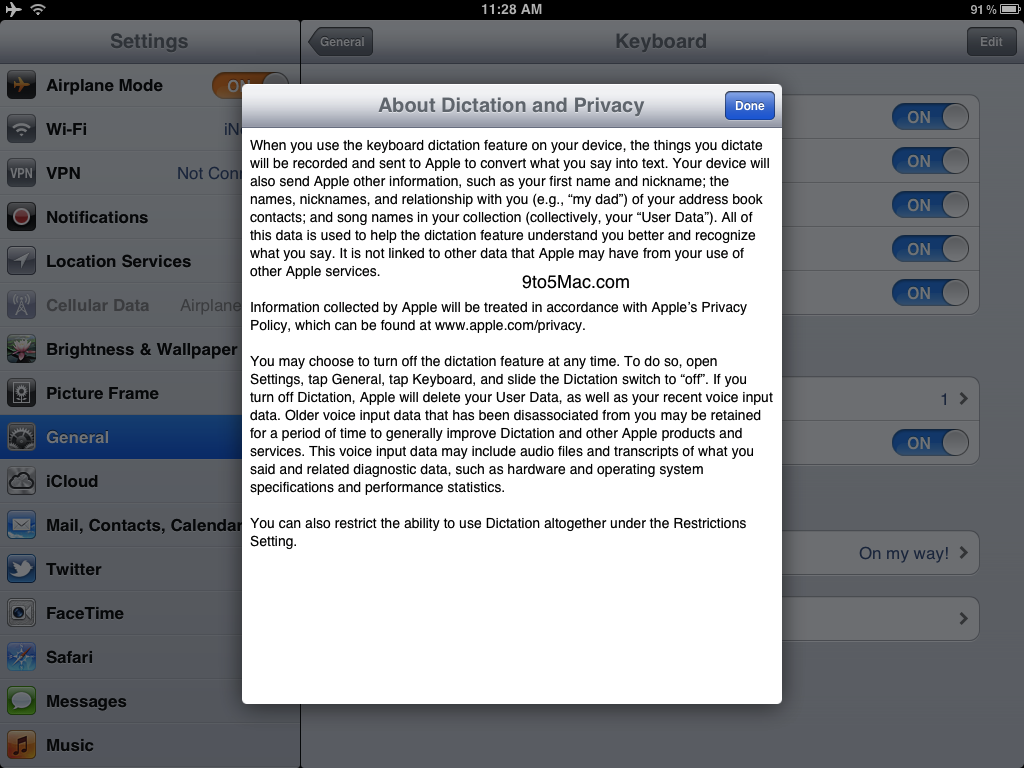
The iOS 5.1 beta 3 is apparently lacking new features or exciting hints at the future of iOS devices, but we have discovered something potentially major: Siri Dictation references. Our own tipster Sonny Dickson was looking through the iOS 5.1 beta 3 settings application on the iPad and discovered a new section in the keyboard menu called “About Privacy and Dictation.” When opened, as shown above, the iPad provides the user with the standard legal literature and feature information for Siri Dictation.
Dictation is not actually functional on the iPad 2 running iOS 5.1 beta 3, so perhaps this will be an iOS 5.1 launch feature for the iPad, or it may be an iPad 3-exclusive feature; a similar process to the iPhone 4S exclusively gaining Siri and Siri Dictation support in iOS 5.0. We’re also hearing this link/document is also appearing on retina iPod touches as well.
On the iPhone 4S, Apple does not have a specific menu related to “Dictation and Privacy” in the keyboard settings panel. That literature is reserved exclusively for the Siri preferences under general settings and covers both Dictation and Siri. This may weaken concerns that this new iPad Dictation menu is simply carried over code from the iPhone 4S. This also may mean that the iPad’s Siri support could be limited to Siri Dictation, but that is pure speculation. Separately, we heard months ago that Apple was internally prototyping a version of the full Siri experience for the iPad, but have not heard any new developments since.
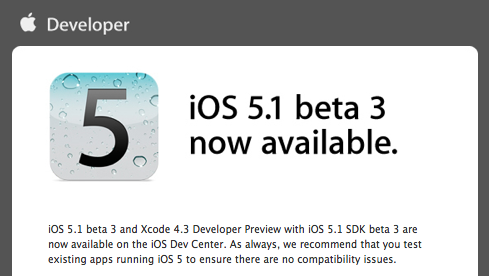
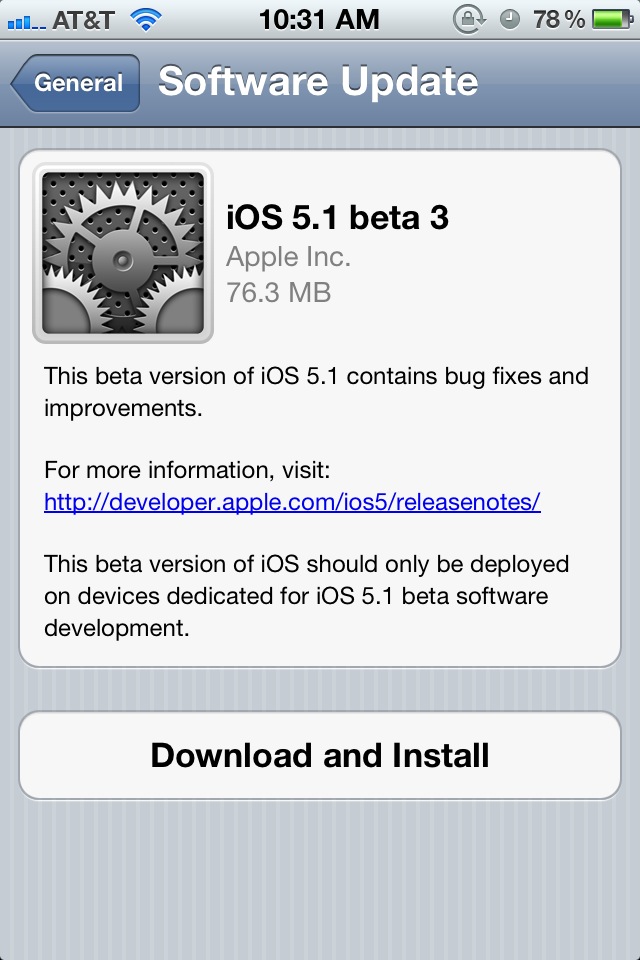
Apple just released a third beta version of the upcoming iOS 5.1 firmware (Build 9B5141a). The software is available as an over-the-air update for existing iOS 5.1 beta users, but is not yet available (update: now available) as a standalone download through Apple’s developer portal.
As you might imagine, it contains the obligatory bug fixes and improvements. According to the tips we’ve received, it also restores the Enable 3G toggle in the Settings app which has been strangely absent on the iPhone 4S since it’s mid-October release. This should help save battery by switching to Edge connectivity in order to maintain cellular data for applications that do not require high data throughput. iPhone 4S users are currently forced to choose between having 3G cellular data turned on, which decreases battery life, or turning off their cellular data connection altogether.
Nuance, the speech recognition company currently powering Apple’s Siri in the iPhone 4S, announced (via TechCrunch) it would be dropping a new voice-controlled TV platform known as “Dragon TV.” Apple is —of course— expected to include Siri-like voice capabilities in the rumored Apple branded HDTV, but Dragon TV has beat them to it with a platform that will enable users to find “content by speaking channel numbers, station names, show and movie names.”
Nuance Communications Inc. (NASDAQ: NUAN) today unveiled Dragon TV, a unique voice and natural language understanding platform for TV, device and set-top box OEMs and service operators. Dragon TV makes finding and accessing shows, movies and content in today’s digital living room easy and fun for consumers.
Nuance provided a few examples of what type of voice-control commands might work on the platform, such as “Go to PBS” or “Find comedies with Vince Vaughn,” but a user’s commands could include “virtually anything.” The company also announced the platform will include social and messaging features, such as email, Twitter, messaging, Skype, and Facebook. Those features will also be voice-controlled allowing a user to use voice-commands, such as “Send message to Julie: ‘Old School is on TBS again this weekend – super excited’”.
According to the press release, the Dragon TV platform is already available to television and device OEMs with support for “all major TV, set-top box, remote control and application platforms.” As for specific platforms, the press release mentions Linux, Android, and iOS. There is —of course— a possibility that the technology used in the Dragon TV platform will land in a version of Siri for an Apple TV device.
Senior Vice President and General Manager at Nuance Mobile Mike Thompson said this regarding the announcement:
We showed you some Siri clones available in the Android Market last week that use official Apple icons, and they are even promoted as “Real Siri for Android” and “Siri for Android.” Now, the first round of Windows Phone Siri alternatives seem to be popping up in the WP Marketplace.
If you are craving Siri like functionality for Windows Phone and more, look no further. Ask Ziggy is your Personal Assistant that goes beyond Siri functionality.
The first app is called “Ask Ziggy” from developer Shai Leib and it is not exactly a rip-off like the Android Siri alternatives. As you can see in the video above from WP Central, the app takes inspiration from the Siri UI and seems to work rather smoothly in comparison to Windows Phone’s built-in TellMe voice control features. It does not borrow Apple’s icons, but has an overall similar feel to Siri. The app apparently utilizes Nuance voice-recognition (same as Siri), but the developers handled everything else themselves. It is available for free now, and the updated version seen in the video should be landing soon.
Another Siri alternative for Windows Phone currently available in the Marketplace isn’t really a functioning voice control app, but it is marketed as “Siri for Windows Phone”. The name “iSiri Faker” also seems to be associated with the app. This app will allow you to “fake Siri conversations on your Windows Phone.” We are not sure exactly what that means, but according to the app’s description you can “program custom responses” using speech recognition, text to speech, data compression, and voice effects. The app is available for $0.99 in the Marketplace. Screenshots are available after the break. Expand Expanding Close
Siri has seen many cool hacks, from using it to control watching videos on Plex to starting a car. Today, another clever mind shows Siri controlling a piano to play tracks on an iPhone. Yamaha specifically develops the hack for the Disklavier piano, and it uses a special MIDI version of the music file to stream to an AirPort Express. The hack even uses the foot pedals and the piano’s keys.
There are fewer options for speech recognition these days, and now there are even fewer with Nuance announcing they acquired Vlingo for an undisclosed figure. Following multiple lawsuits related to patent infringement, the two companies apparently came to what CEO of Vlingo Dave Grannan called “a good outcome.” Grannan elaborated in a prepared statement (via AllThingsD):
Vlingo and Nuance have long shared a similar vision for the power and global proliferation of mobile voice and language understanding. As a result of our complementary research and development efforts, our companies are stronger together than alone. Our combined resources afford us the opportunity to better compete, and offer a powerful proposition to customers, partners and developers.
Vlingo is notably used in various voice-controlled Android apps, and it is viewed as competitors to Apple’s Siri built into the iPhone 4S. However, Siri, also used it prior to it being used by Apple, before switching to Nuance…
In an interview with 9to5Mac, Siri co-founder Norman Winarsky said Vlingo was originally used as the speech recognition component of Siri before switching to Nuance. He noted: “Theoretically, if a better speech recognition comes along (or Apple buys one), they could likely replace Nuance without too much trouble. ” The full quote is below.
9to5Mac: How important is Nuance speech recognition to the Siri technology? Expand Expanding Close
The New York Time’s Nick Bilton, who reported in October Apple’s alleged television plans describing “large parts floating around” Apple’s supply chain that looked like they “could be part of a large Apple television,” is back with a new story. He recently implied Apple’s researched prototyped small and wearable devices.
According to the article published last night, both Apple and Google have worked for years on wearable computers that interface with smartphones (having the ultimate goal of selling more smartphones):
A person with knowledge of the company’s plans told me that a “very small group of Apple employees” had been conceptualizing and even prototyping some wearable devices. […] Apple has also experimented with prototype products that could relay information back to the iPhone. These conceptual products could also display information on other Apple devices, like an iPod, which Apple is already encouraging us to wear on our wrists by selling Nanos with watch faces.
Interestingly, a year ago, Apple hired wearable computer wizard Richard DeVaul. He is believed to be developing secret wearable product prototypes under the guidance of Jonathan Ive, Apple’s senior vice president of industrial design. Specifically, aNew York Times story described a curved glass iPod:
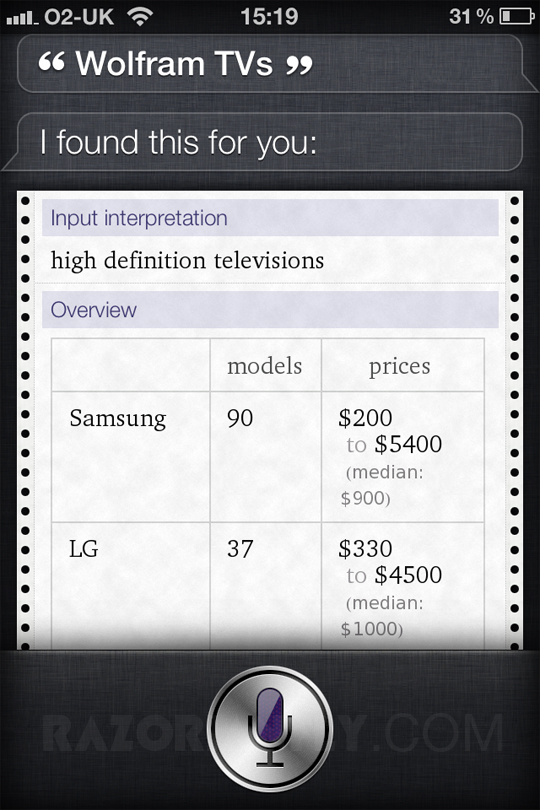
As noted byRazorianFly, Siri can now help users retrieve the best deals for consumer electronics and gadgets sold at Best Buy. How does she handle this, you might ask? Well, Siri gets some of its answers from the acclaimed answer-engine Wolfram|Alpha.
Wolfram Research announced yesterday they are leveraging data from Best Buy’s public application programming interface, allowing users to browse more than 35,000 appliances and consumer electronics products sold by Best Buy.
Third-party applications and services that integrate with Siri automatically benefit, so Siri is now able to deliver answers to your product-related queries sourced from Best Buy’s vast database.
In addition, taking into account Wolfram|Alpha’s clever decision-making and analysis engine and Siri’s natural-language interface, you can ask her to, let’s say, list plasma TVs larger than 50-inches. Even though Best Buy-sourced answers are laid out as any other information Siri sources from the web, Apple could -in the future- take advantage of Best Buy’s public APIs to produce rich results sporting product images, categories, more meta data and so forth.
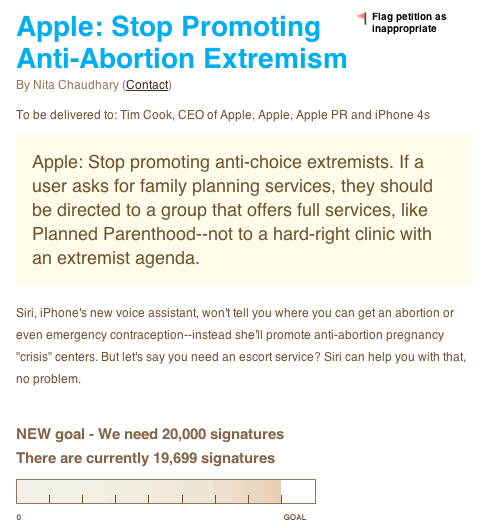
A petition has been floating around this afternoon railing Apple for being ‘anti-choice’ extremist, because Siri won’t serve up Siri results for Abortion providers, instead leading users to “anti-choice crisis pregnancy centers”(CPCs). Groups like NARAL want Apple to take action:
News reports have documented that, in some instances, Siri responded to a question concerning where to find abortion providers by directing an individual to anti-choice organizations known as “crisis pregnancy centers”(CPCs). Anti-choice groups created CPCs to look like comprehensive health clinics, but many do not provide women with accurate pregnancy-related information. This issue is especially important to us at NARAL Pro-Choice America Foundation, as our state affiliates in California, Massachusetts, Maryland, New York, North Carolina, Texas, and Virginia have produced reports that document these deceptive practices. Many of these centers are not up front about their anti-abortion, anti-contraception agenda when advertising online or in other channels. For instance, many CPCs do not disclose their bias to women who walk through their doors or call their toll-free lines seeking information. Ultimately, many of these centers can be harmful and do nothing to help women locate the services they requested from Siri.
The petition is issued straight to CEO Tim Cook with almost 20,000 backers. But is Apple really at fault here? Just like when Google’s search algorithm pulls up manipulated results (like Santorum), Apple and its location partners like Yelp are pulling up manipulated results. Still, Apple plans on fixing this issue.
The NY Timesasked Apple about the matter and got a response from PR Rep Natalie Kerris. She basically said that this isn’t intentional and that Siri is a beta product that will see changes in the coming weeks.
“Our customers want to use Siri to find out all types of information, and while it can find a lot, it doesn’t always find what you want,” said Natalie Kerris, a spokeswoman for Apple, in a phone interview late Wednesday. “These are not intentional omissions meant to offend anyone. It simply means that as we bring Siri from beta to a final product, we find places where we can do better, and we will in the coming weeks.” Expand Expanding Close
Not only can Siri and a Proxy Server start or lock you car, it can help you watch TV. This is, of course, using the Siri Proxy we’ve talked about before with a Plex command line interface allows the developer, above, to start movies almost immediately.
But, this works so quickly and effortlessly that we wonder if this is the “finally cracked it” interface that Steve Jobs was talking about in the bio.
Microsoft’s Craig Mundie shoved his foot knee deep in his mouth this week when he said that Siri was nothing special, and Microsoft’s own voice capabilities have been around for over a year. The reason for Siri’s success? Marketing, of course.
People are infatuated with Apple announcing it. It’s good marketing, but at least as the technological capability you could argue that Microsoft has had a similar capability in Windows Phones for more than a year, since Windows Phone 7 was introduced.
To be fair, Siri isn’t even about the Voice Recognition, it is what the iPhone does with it. The voice recognition is outsourced to Nuance’s engine. The Microsoft Phone barely made it to the point where you could make sense out of what its engine produced.
If you were Microsoft, would you rather Mundie be so out of touch with the technology he is talking about that he can’t tell the difference, or that he’s just flat out shamelessly lying?
The “Siri Proxy” plugin I wrote handles interaction with a php script that runs on my web server. The php script, which I developed months ago for personal use, allows me to send commands to my car which has a Viper SmartStart module installed.
Current commands accepted are: “Vehicle Arm”, “Vehicle Disarm”, “Vehicle Start”, “Vehicle Stop”, “Vehicle Pop Trunk”, and “Vehicle Panic”.
Siri hacking is rapidly turning into a fun sport. How long until Apple blesses third parties with this type of functionality?
Microsoft and Apple tackled touch interfaces in diametrically opposing ways. As Apple set out to bring multitouch on mobile devices to the masses with the 2007 release of the original iPhone, Microsoft created a blown up version with its Surface multitouch tabletop (which can now be yours for a cool $8,400, shipping in early 2012).
Microsoft also progressed natural user interfaces with the Kinect motion controller for the Xbox 360 console while Apple charted its way into the future with an artificial intelligence-driven personal assistant dubbed Siri.
So, when Microsoft’s chief strategy and research officer Craig Mundie sat down with Forbes’ Eric Savitz to talk the company’s planned expansion of the new user interface, he did what Microsoft executives typically do when challenged with a cool tech developed outside the Windows maker’s labs: He stuck his foot in his mouth over Apple’s groundbreaking digital secretary exclusive to the iPhone 4S.
In the above clip, he said (mark 1:45):
People are infatuated with Apple announcing it. It’s good marketing, but at least as the technological capability you could argue that Microsoft has had a similar capability in Windows Phones for more than a year, since Windows Phone 7 was introduced.
Windows Phones, seriously? Mundie couldn’t acknowledge Siri as an ace up Apple’s sleeve and barely accepted that Microsoft could learn a lesson or two about “productizing” technology. He then went on to describe how their version of Siri works on Windows Phones: Expand Expanding Close
We’ve seen examples of the Siri interface running on prior iPhones and a proof-of-concept video allegedly showing the full Siri port running on iPhone 4. And now, a St. Louis developer @plamoni has figured out how to run a proxy server on his computer to fool Siri into thinking it is talking to Apple’s servers.
The proxy server acts as a middleman that intercepts Siri commands and returns answers. According to the project page, “the idea is to allow for the creation of custom handlers for different actions”. It works by setting up a DNS server on your network to forward requests for guzzoni.apple.com (the Siri servers) to the computer running the proxy.
He used the proxy server to run a custom plug-in that can manage his radio-controlled thermostat via Siri (Tony Fadell should love this). It doesn’t require a jelabroken iPhone since everything is going on off the device. As you can see in the video, Siri responds to commands such as, “What’s the status of the thermostat?”, or “Set the thermostat to 68 degrees”, or even “What’s the inside temperature?”. What’s best, his hack lets any device with a plug-in to be controlled via Siri. A sign of things to come from Apple? Two more videos follow right after the break.
The developers over at Applidium are claiming they have cracked Siri’s security protocol, which could enable the speech recognition technology on any device. The possibilities of devices range from iPhone 4, to iPad, to Mac, to even Android.
Last month we showed you Siri running on an iPhone 4 (seen above), but today the possibilities look beyond that. With the crack, developers could even work to implement Siri inside of their own apps. Of course, Apple could push a fix for this sparking another cat and mouse game.
When it comes to this crack you actually need a UDID of an iPhone 4S to get this working. At any time Apple could block the UDID if they see something suspicious.
Applidium has released a set of tools for developers to begin cracking, and says it will be fairly easy to obtain a UDID with them. Check out their post for all of the details.
Apart from a press of the home button to initiate Siri, this prototype Siri hack first spotted by IntoMobile is completely thought-controlled. The guys behind Project Black Mirror have recorded brain wave activity with ECG pads, matched the incoming patterns to pre-saved digital patterns saved on a MacBook, then fed the matched commands to a speech synthesizer chip that translates the command to Siri. The video above shows the developers initiating a call, but they say they’ve linked approximately twenty-five brain wave patterns to various Siri-controlled functions, and hope to bypass having to physically press the home button with a fully automated solution in the future. IntoMobile breaks down the intricacies: Expand Expanding Close
The WSJ reports that amid losing money on every television set they make, Sony somehow has a strategy for redemption. Stringer declined to provide details about what Sony is developing but said “there’s a tremendous amount of R&D going into a different kind of TV set”.
He he has “no doubt” Apple’s Steve Jobs also was working on changing the traditional TV set. “That’s what we’re all looking for”, he noted, warning “it will take a long time to transition to a new form of television”. Slim margins, low prices and little innovation make the business of researching, developing and marketing high-definition television sets a cutthroat one, he remarked:
We can’t continue selling TV sets [the way we have been]. Every TV set we all make loses money.
His company, Stringer said, spent the last five years creating an ecosystem to take on Apple, even though the company had seen little success with the Google TV platform and other connected television efforts: Expand Expanding Close