Tvc-mall.com (via CydiaBlog) has some “iPhone 5” cases for sale (at just $1.58 each!) that seem to align with the many, many, many, many next generation iPhone body part leaks. One thing to remember: Just because a case maker is producing cases, does not mean the next generation iPhone will fit into it.
As you can see, the cases are longer to accommodate the larger 4-inch display and have a smaller dock connector hole at the bottom. The speaker holes are bigger with the addition of the headphone jack rumored to be moving down south.
If you are one of the 65 percent of smartphone owners who are already signed up for the next iPhone, are you buying a case for it yet?
The last time we updated you on the Federal Trade Commission’s investigation into Google’s method of bypassing the default Safari browser settings on iOS devices, reports claimed the company was facing possible fines that could reach tens of millions. Today, The Wall Street Journal said Google is close to reaching a $22.5 million settlement with the FTC, according to people close to the negotiations:
The fine is expected to be the largest penalty ever levied on a single company by the U.S. Federal Trade Commission. It offers the latest sign of the FTC’s stepped-up approach to policing online privacy violations, coming just six months after The Wall Street Journal reported on Google’s practices.
While the fine likely will represent only a tiny portion of Google’s revenues—last year, the Internet giant raked in that much cash roughly every five hours or so—it counts among a series of negative reports about Google’s privacy practices that could undermine users’ trust in its services.
Apple officially opened up the iTunes Store and iTunes Match in 12 new Asian countries late last month, bringing the total to 155 countries worldwide. Perhaps the most notable addition was Hong Kong. Apple said at the time that the local stores would include “an incredible selection of local and international music from all the major labels and thousands of independent labels,” but many Chinese users are disgruntled with the method Apple is using to translate the titles and descriptions of some content in the store. The Wall Street Journal published a story today highlighting the problem with translations in the Hong Kong store:
On accessing the iTunes store for the first time, some Hong Kong users were irritated to find that the store was listing a number of song titles by the city’s popstars in Mandarin pinyin, a system that transcribes Chinese characters into phonetic Latin script, instead of displaying titles transliterated for the Cantonese language, which is spoken by the majority of the population.
For example, the popular Cantonese pop song titled “Autumn Wind, Autumn Rain” would be written and pronounced as qiu feng qiu yu using Mandarin pinyin. Though there is no broadly accepted official system for rendering Cantonese using the Roman alphabet, a transliteration for Cantonese speakers would be closer to cou feng cou yu.
“Those are CANTO pop [songs],” wrote one Hong Kong-based user on Twitter. “Use cantonese [sic] phonetics.”
In other Chinese Apple news, Bloomberg reported today that Apple is using China-based AutoNavi to power its new iOS 6 Maps app in China. Apple is already confirmed to be using TomTom and various other sources for map data in the United States and elsewhere, and Bloomberg noted today that AutoNavi signed a joint venture with TomTom in China in 2010.
Yesterday, Bloomberg reported Apple has a smaller iPad in the works approximately 7-inches to 8-inches in size that may be scheduled for an October unveiling. Today, a report fromThe Wall Street Journal backs the rumor by claiming Apple’s suppliers are now preparing for mass production of the device in September, which would make an October unveiling alongside the next-generation iPhone all the more likely if true: Expand Expanding Close
A few reports have floated around today that we are filing under rumor. The first comes from a Digitimesreport that claimed Apple suppliers are prepping for mass production of a new Retina iMac scheduled for July with a possible October unveiling. We told you in May that Retina iMacs were likely on the way when higher-resolution iMac display panels were spotted in Apple’s supply chain before the unveiling of the new Retina MacBook Pro at WWDC in June. Apple quietly updated the Mac Pro lineup after the event, and then it confirmed a redesigned Mac Pro was in the works for 2013, but we have heard nothing official from Apple on future iMacs.
We heard a lot about a possible 7-inch or 7.85-inch iPad, and today there are more roughly translated reports, coming from Chinese publication MyDrivers.com (via UnwiredView), that claim Apple has a 7.85-inch iPad using a Sharp IGZO panel. There have been several reports in recent months claiming Apple is working on the device, and the The Wall Street Journalreported in February that Apple was testing displays roughly 8-inches in size. Apple looks to be at least testing these screen sizes, but we have no solid proof that anything is planned as of yet. Previous reports indicated a possible October launch for a 7-inch iPad under $250. Expand Expanding Close
Another batch of newly granted Apple patents were published today by the U.S. Patent and Trademark Office, and then detailed by Patently Apple. Perhaps the most notable is one for an inductive charging solution that we have heard about in the past. Apple patents surfaced last year showing new methods of inductive charging that could be used in various Apple devices. There were even rumors last year that a next-gen iPhone could sport a similar cable-free charging solution. Patently Apple described the docking station invention covered in today’s patent that would include an “eradiating antenna and an inductive charging circuit for inductively charging a handheld device”:
The Wall Street Journalreported that travel-recommendation website Orbitz discovered that those of us who own a Mac are spending as much as $20 to $30 more a night on hotel rooms than PC users on average. That is a whopping 30 percent difference, and the smart folks over at Orbitz are looking to take advantage by changing what listings they show Mac users.
According to the WSJ, Orbitz has a new platform that tracks its visitors habits to recommend a room to match their spending habits, which can be oh-so expensive for those who own a Mac. The company is currently experimenting with a platform that shows hotel rooms matching a Mac user’s spending taste a little better, but Orbitz executives stressed that it is not showing the same room to different people for a different price. For example, the WSJ found listings for a Baton Rouge hotel room were 13 percent more expensive on a search from a Mac compared to a PC. In essence, Mac users are shown the nicer rooms.
In a Forrester research note released last October, the firm noted that Mac users are falling into the “power laptop user” range, or people who work 45 hours a week on average and have a solid 44 percent more income. They put it: “Most of the Macs today are being freewheeled into the office by executives, top sales reps, and other workaholics.” I certainly think that stands true, because owning an Apple product is an expensive investment. The lowest priced Mac laptop costs $999, which certainly is not cheap and not something everyone can buy. Despite the high price, you are buying a quality product.
To be clear, Orbitz is not putting an “Apple Tax” on the price of hotels. It is just defaulting the higher-end stuff to Mac users, because Orbitz believes Mac users are more likely to choose higher-end hotels.
It is a risky strategy and may put some people off, however. Moreover, as Mac users, it is very easy to get smug about something like this. But does it make good business sense?
The Wall Street Journal reported that Google is accelerating its plans to launch a competitor to Siri. 9to5Google has the full story:
We have heard several reports in the past that Google was working on various evolutions of its Voice Actions platform for Android. Back in December we heard of “Project Majel”, which according to reports is the codename for a new voice-controlled assistant app similar to Siri. In March TechCrunch reported on a similar project dubbed Google Assistant. According to a new report from the Wall Street Journal, Google is accelerating its plans to launch a competitor to Apple’s Siri…
Rajat Gupta is on the right (image via the Wall Street Journal).
A federal jury just convicted Rajat Kumar Gupta, an ex-Goldman Sachs director, of insider trading in a case that involves swapped information about Apple and other technology firms.
According to the Wall Street Journal, Gupta was convicted on three counts of securities fraud, one count of conspiracy, and acquitted of two counts of securities fraud. The executive dabbled in a bit of insider trading when he discussed non-public boardroom information about his company and Procter & Gamble to a prominent hedge fund manager.
Raj Rajaratnam, the founder of Galleon Group, which is a New York-based hedge fund management firm, earned millions off Gupta’s tips. He is now serving an 11-year prison sentence on charges stemming from the insider trading case. Lawyers for Gupta recently submitted evidence that pinpointed another Goldman Sachs executive as sharing inside information with Rajaratnam.
As 9to5Mac previously detailed, David Loeb, who is head of Asia equity sales for Goldman Sachs Group Inc., in New York, was supposedly caught on a U.S. wiretap providing confidential information about Apple Inc., Intel Corp., and Hewlett-Packard Co., to Rajaratnam.
According to SFGate, the Manhattan jury contemplated the charges against Gupta, but did not listen the wiretap evidence during his trial. U.S. District Judge Jed Rakoff ruled that the wiretaps were inadmissible hearsay. An attorney for Gupta told the judge earlier this week that the evidence about Loeb was critical to the defense and proved “that another person committed an act of which the defendant stands accused.”
The defense rested its case and the jury concluded this morning. Gupta faces up to five years in prison for the conspiracy charge and up to 20 years for each fraud charge. His sentencing is set for Oct. 18.
In a recent story about growing concerns among app developers who want better ways to promote their apps in the App Store, The Wall Street Journal published quotes from an interview with Apple’s Vice President for Worldwide Marketing Phil Schiller about the “tremendous amount” of work Apple does to help new apps get discovered. Schiller also talked about how things will improve with the redesigned App Store, Facebook integration, and new user tracking tools for developers in iOS 6: Expand Expanding Close
Oh, Siri. Apple’s little voice-activated personal assistant in iOS can handle questions, give recommendations, and delegate requests, but does it really live up to expectations?
The folks in Cupertino like to roll out advertisements that show Siri capable of compiling individual preferences with personalized results, and even completing basic tasks like finding a nearby restaurant, but the software met very mixed reactions after it Beta-débuted on the iPhone 4S in October. Those who felt misled by Siri’s functionality depicted in commercials eventually sought reimbursement by filing a class action lawsuit against Apple earlier this year.
Fortune’s Adam Lashinsky wrote about how chief executive Tim Cook is changing Apple in an interesting piece this morning, but he also touched upon the contention surrounding Siri. He noted Apple’s future relies on the quality of its products, which holds true for any company, but then he pointed to the iOS-maker’s knowledge navigator:
“Those looking for deficiencies have found them in Siri, a less-than-perfect product that Apple released with the rare beta label in late 2011, a signal that the service shouldn’t be viewed as fully baked. Siri’s response time has been slow, meaning the servers and software powering it are inadequate. ‘People are embarrassed by Siri,’ says one former insider. ‘Steve would have lost his mind over Siri.'”
It is interesting that an unnamed insider claimed Jobs would “lose his mind” over Siri, especially because it is well-known the late CEO worked with former Siri founder and subsequent Apple Engineering Director Dag Kittlaus on the project. Kittlaus admitted last March at Network World that Jobs felt they “cracked it” in regards to Siri, which alludes to the chief’s satisfaction with the voice assistant and contrasts with the insider’s opinion.
With all the rumors that Apple plans to increase the next iPhone’s display to approximately 4-inches, and yesterday’s reports from Wall Street Journal confirming the rumors, there is much speculation regarding the exact dimensions and resolution of the upcoming display. Overdrive Design blog’s Niilo Autio pointed us to the mock-ups he did of how apps might benefit from a 4-inch display using a resolution of 640-by-1,152. The images below are compared to apps on the existing iPhone 4/4S design. The added screen real estate is especially noticeable in the Safari and Mail apps.
Last week, we revealed Apple’s decision to drop Google Maps in iOS 6 in exchange for its own in-house solution branded simply as “Maps.” At the time, we told you many versions of iOS 6 have been floating around Apple’s campus, which indicated Apple is likely on track for a mid-June unveiling at this year’s World Wide Developers Conference. Shortly after, references to an upcoming iOS 6 beta were found in the code strings of the iCloud.com beta website.
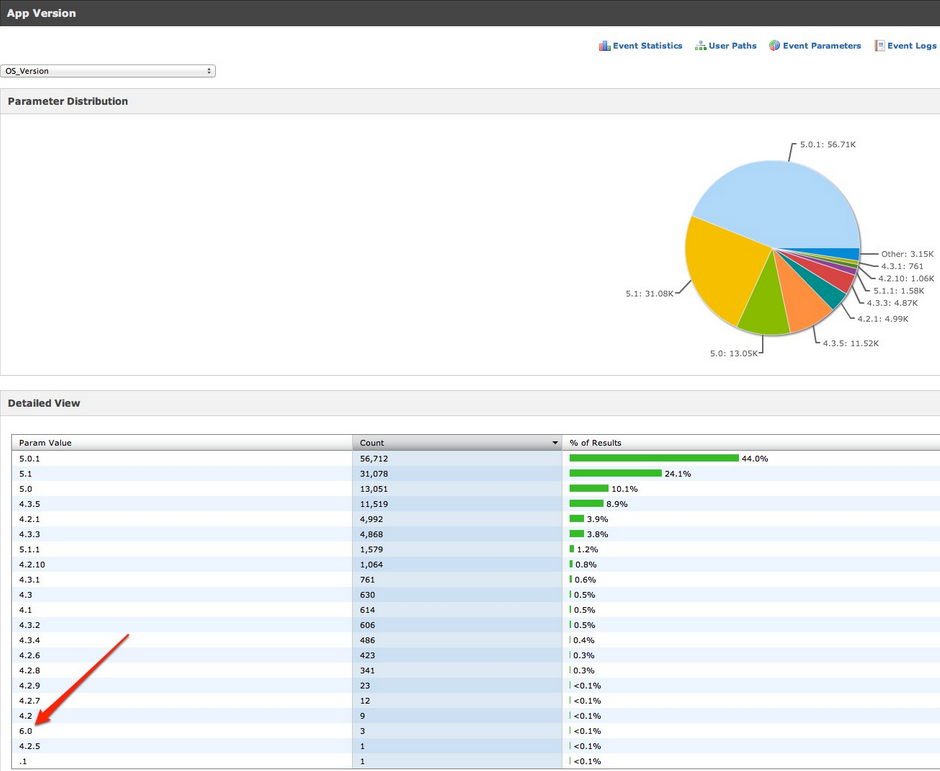
One app developer informed us today that it has recently noticed users running iOS 6 using its app. The developer observed the “iOS6” string when collecting the OS version from analytics software. It has not been able to trace exactly when the iOS 6 users started appearing, but it was sometime over the past week. Other developers that we spoke to began seeing hits in late April. There is a good chance that this means Apple is amidst iOS 6 compatibility testing with higher-profile applications from the App Store. The process of next-generation versions of iOS appearing in developer usage logs occurred last year too.
Although Apple’s new Maps app and its 3D mode will likely be pushed as a major feature of iOS 6, we noted previously that anyone anticipating major home screen changes or Android-style widgets will likely be disappointed. Yesterday, The Wall Street Journal reported Apple was preparing to unveil an upgrade to iCloud at WWDC that would include new sharing and commenting features for photos, as well as video syncing capabilities that will likely be the Video Stream feature we told you about last year. Expand Expanding Close
According to a report fromThe Wall Street Journal, Apple is about to unveil an upgraded iCloud service at WWDC in June. Citing the usual sources “familiar with the matter,” the report also claimed the features would include new photo-sharing capabilities for sharing and commenting on sets of photos. It also mentioned the ability to sync video to iCloud, which sounds a lot like a Video Stream feature that we mentioned last year. Perhaps this is the reason Phil Schiller no longer needed Instagram?
The new features, expected to be announced at Apple’s world-wide developer conference beginning June 11, will allow iCloud users to share sets of photos with other iCloud users and to comment on them, these people said… Apple is trying to better compete in the red-hot market for photo sharing, dominated by fast-growing online services such as Facebook Inc. and mobile apps like Instagram—which Facebook has agreed to acquire for $1 billion.
We revealed last September that Apple was readying its Find My Friends network. At the time, we reported references to video streams that indicated Apple was likely considering a video syncing/stream feature similar to Photo Stream.
According to the report, Apple is “rolling out new features cautiously” as it worries about the cost of storing large amounts of data, but is also considering increasing the maximum number of photos and albums users can store: Expand Expanding Close
Following yesterday’s report from DigiTimes claiming Apple had a new 7-inch iPad in the works for August, iMore’s Rene Ritchie today claimed Apple is actually targeting an October release, alongside the next iPhone. He also claimed his unnamed source said the device will launch for $200 to $300 and pack-in a Retina display and specs almost identical to the current iPads:
Apple will be going forward with the 7-inch iPad, currently targeting an October 2012 release alongside the new iPhone, and — here’s the killer — at a $200 to $250 price point… Our source has indicated, however, that the 7-inch iPad will be identical to the current 9.7-inch iPad, just scaled down. That seems to include a 2048×1536 resolution display, just like the new iPad. If accurate, that would put the pixel density at around 326 ppi, the same as the iPhone 4S (and higher than the 264 ppi new iPad) retina display.
Ritchie noted his source is not sure of the exact dimensions, but past rumors indicated a 7.85-inch size could work. According to the report, one way Apple will meet the low price point is to offer the new 7-inch iPad with just 8GB of storage. We are taking this report for what it is until we have some solid proof, but we know iMore’s Ritchie has been accurate with several Apple product launches in the past, including the third-gen iPad and iPhone 4S.
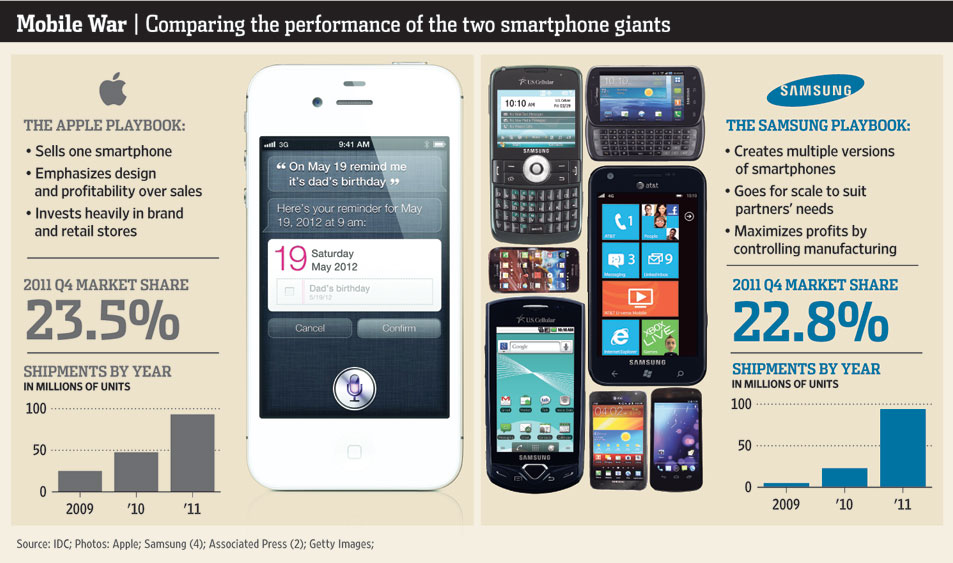
Apple, the world’s most valuable company, sells just one phone, the iPhone. The Cupertino, Calif., company emphasizes design and profitability over sales. It also invests heavily in its consumer brand and its tightly controlled retail stores, and it benefits from a strong ecosystem of software and apps.
Meanwhile, Samsung, the world’s largest tech company by revenue last year, goes for scale. The South Korean company is a fast-follower that places its bets broadly, creating multiple versions of myriad products such as its Galaxy smartphones to suit partners’ needs. It maximizes profits by controlling its own manufacturing
By now you probably know that the U.S. Department of Justice launched an antitrust lawsuit against Apple and two publishers this month following an investigation into Apple’s eBook pricing agency model. Three publishers, including Hachette, HarperCollins, and Simon & Schuster, decided to reach a settlement with the Department of Justice to return to Amazon’s set-your-own price wholesale model. Meanwhile, Apple, Macmillan, and Penguin will take the fight to court.
Interestingly, a report fromThe Wall Street Journal, which is owned by the HarperCollins’ parent company News Corp, suggested Apple was only ever trying to continue its App Store business model. The Wall Street Journal’sL. Gordon Crovitz described visiting Senior Apple Executive Eddy Cue to discuss changing Apple’s policies for publications. He quoted Cue as comparing book pricing to apps and not wanting to treat publications differently than app developers: Expand Expanding Close
Good ‘ole Walt Mossberg from The Wall Street Journal warned readers today about not buying a new laptop this spring:
Apple is overdue for redesigned laptops, especially in its MacBook Pro line, and it is a good bet that new, possibly heavily redesigned, models will begin appearing later this year. Current Macs will likely be upgradable to Mountain Lion, but if you buy now, you’ll miss out on the likely new hardware.
In February, the story broke that Google and other advertising companies were bypassing iOS Safari’s privacy settings and continuing to track users without their consent. Google quickly disabled its code responsible for the tracking after a story from The Wall Street Journal published, and Apple then claimed it was “working to put a stop” to the issue.
Now, a new report fromMercury News claimed the U.S. Federal Trade Commission is considering whether to fine Google over the incident. The decision is expected in the next 30 days:
The Federal Trade Commission is deep into an investigation of Google’s actions in bypassing the default privacy settings of Apple’s (AAPL) Safari browser for Google users, according to sources familiar with ongoing negotiations between the company and the government… Within the next 30 days, the FTC could order the Mountain View search giant to pay an even larger fine in the Safari case than the penalty the Federal Communications Commission hit Google with Friday, say the sources, who spoke on condition of anonymity.
The report is referring to Google being recently fined $25,000 by the FCC after it allegedly “deliberately impeded and delayed” an investigation related to Street View cars. The heart of the Safari bypassing investigation is whether the company is violating a previous privacy agreement made with the FTC following controversy over the failed “Buzz” service. The report claimed Google could face up to $16,000 per violation per day for violating the agreement. Google said to Mercury News today it would “cooperate with any officials who have questions” and explained making its +1 compatible on mobile Safari created the issue:
AllThingsD just announced Apple’s Chief Executive Officer Tim Cook would appear as the opening-night speaker at this year’s D10 conference. The 10th D: All Things Digital conference will be Cook’s first time speaking at the event, and AllThingsD noted this is his first-ever appearance onstage at a non-Apple event since becoming CEO last year. Past D conferences were notably a stage for many in-depth discussions and interviews with Steve Jobs. Jobs last appeared at the event at D8 in 2010.
Walt Mossberg and I could not be more thrilled to announce that Tim Cook, CEO of Apple, will be the opening-night speaker at our 10th D: All Things Digital conference.
The D10 conference is slated for May 29 to May 31, 2012 at the Terranea Resort in Rancho Palos Verdes, Calif. Expand Expanding Close
We knew the Fair Labor Association would publish the initial findings of its investigation into Apple’s Foxconn facilities, and now the report is officially available through the organization’s website. The full report released today and is here. The press release outlining the investigation is below. According to the recommendations, Foxconn committed to “bring its factories into full compliance with Chinese legal limits and FLA standards on working hours by July 2013.”
The last we heard from the FLA about its audits into Apple’s Foxconn facilities was that it found “tons of issues.” Apple became the first technology company accepted as a member into the organization after controversies surrounding working conditions in Apple’s supply chains abroad became mainstream. As for what the FLA found in its audits of the three Foxconn facilities, here is an excerpt from the report:
FLA’s investigation found that within the last 12 months, all three factories exceeded both the FLA Code standard of 60 hours per week (regular plus overtime) and the Chinese legal limits of 40 hours per week and 36 hours maximum overtime per month. During peak production periods, the average number of hours worked per week exceeded 60 hours per worker. There were periods in which some employees worked more than seven days in a row without the required 24 hours off.
The FLA said Foxconn’s commitment will “reduce working hours to legal limits while protecting pay, improve health and safety conditions, establish a genuine voice for workers, and will monitor on an ongoing basis to verify compliance.” This will lead to a maximum 49-hour workweek, including overtime for employees and a decrease in monthly overtime from 80 hours to 36 hours. While we reported some workers were unhappy with working fewer hours, Foxconn also committed to a compensation package for workers with reduced overtime:
Reports from the Wall Street Journal last Octoberrevealed Sprint’s Chief Executive Officer Dan Hesse convinced the company’s board to take on a staggering commitment of approximately $20 billion to purchase 30.5 million iPhones over four years. At the time, Hesse said Sprint “would likely lose money on the deal until 2014. ″ He also claimed not having the iPhone was “the No. 1 reason customers leave or switch.” In an interview with Mobile World Live (via BGR), Hesse defended the decision and claimed, among other things, that iPhone users are “more profitable than the average smartphone customer.”
“ Subsidies are heavy for the iPhone. This is the reason why a high percentage of new customers is important… But iPhone customers have a lower level of churn and they actually use less data on average than a high-end 4G Android device. So from a cost point of view and a customer lifetime value perspective. They’re more profitable than the average smartphone customer.”
Hesse went on to claim that Sprint was “pulling a lot of customers” from AT&T and Verizon during the fourth quarter by noting four out of every 10 iPhones the carrier sold were new customers. According to Hesse, that is around double the rate of the other carriers. Expand Expanding Close
While it is no secret that LTE devices are capable of burning through data quicker than their 3G counterparts burn, several reports claim many new iPad users are concerned about how quickly they are reaching their data cap. In some cases, users reported reaching their 2GB monthly cap within hours of just streaming video. According to a new report fromThe Wall Street Journalthatprofiled several disgruntled AT&T and Verizon customers, Apple’s “promise of superfast wireless connections collides with the reality of what those services cost.”
Doing some math that any consumer could: LTE speeds often hit 2 Megabytes/second. You would hit 2GB in 1000 seconds—or under 17 minutes.
One man profiled in the story, Brandon Wells, went through 2GB of his Verizon plan streaming March Madness college basketball games to his new iPad. WSJreports:



 .
.